

A long-reach tool can make upper siding seem easy to clean from the ground, but reaching farther is not always safer. A pressure washer can force water behind panels or damage the surface, and a tool that is difficult to control can leave areas unevenly cleaned. Cleaning siding without using a ladder is a practical option for accessible sections when you can keep your footing, see where water lands, and control the rinse.
This guide explains which jobs are reasonable from the ground, how to use a hose or soft-bristle extension brush, and why more pressure is not a shortcut to a better result. You’ll also learn how to limit cleaner runoff near plants and when height, staining, or siding material calls for professional help. For areas beyond safe reach, professional soft washing can clean delicate siding without relying on improvised high-pressure spraying.
Key Takeaways
- Ground-level cleaning is best for areas you can reach while standing steadily. It does not mean every upper wall can be cleaned safely from the ground.
- Choose a hose or extension tool that suits the siding, and follow the manufacturer’s cleaning instructions.
- Cleaning siding without using a ladder still requires care: a forceful spray can damage siding or drive water behind it.
- Protect nearby plants, follow product labels, and stop if buildup remains or you cannot safely reach the area.
- For high, delicate, or persistently dirty siding, professional house washing in Omaha offers a safer, more thorough option.
Can You Clean Siding Without Using a Ladder? Start with Safe Reach
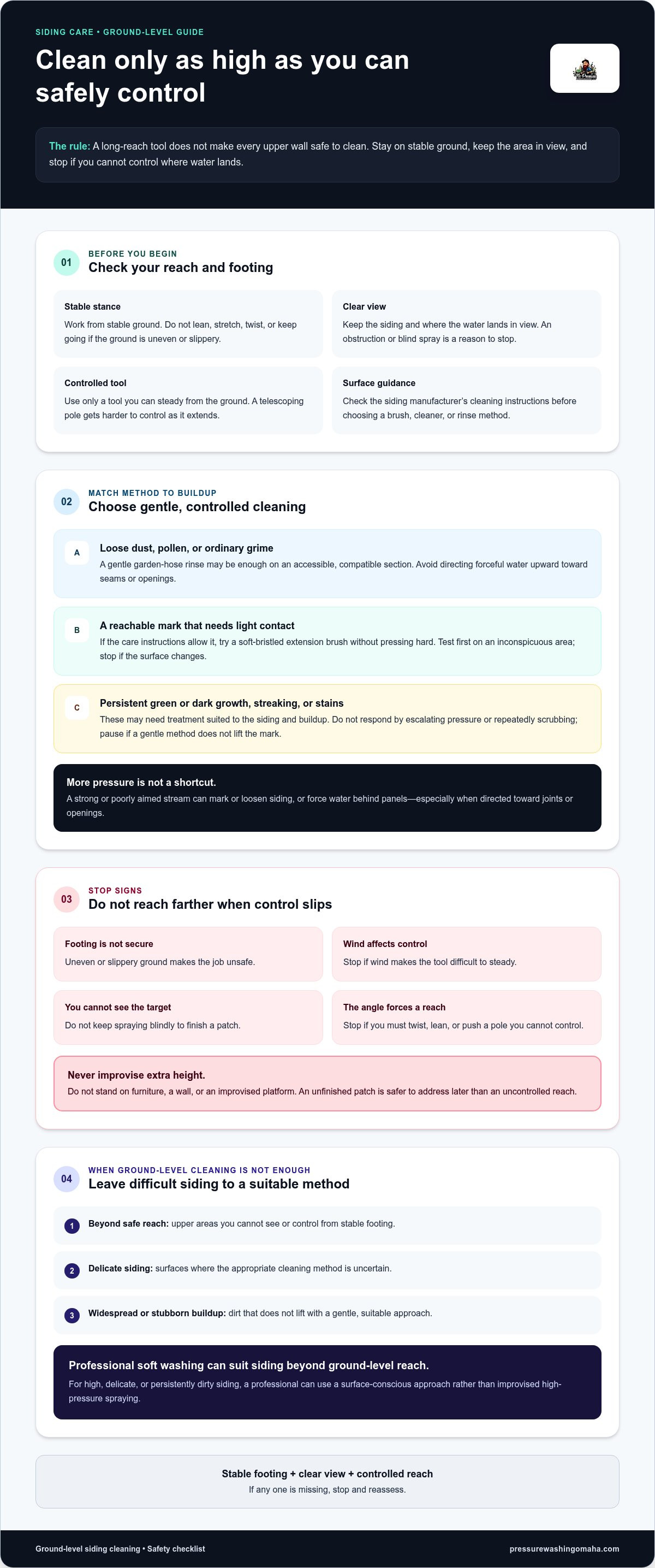
Yes, some siding can be cleaned from the ground, but safe reach matters more than how far a tool can extend. For cleaning siding without using a ladder, stay on stable ground and work only where you can see the area, keep a firm stance, and control the tool without leaning or stretching. A gentle rinse may be enough for reachable walls with light dirt. It will not necessarily clean every upper story safely or thoroughly.
This distinction protects both you and the exterior. A forceful, poorly aimed spray can hit seams at the wrong angle or drive water behind siding. Trapped moisture can contribute to damage, while excessive pressure may mark or loosen some surfaces. Siding materials and finishes vary, so check the manufacturer’s care instructions before choosing a cleaning method.
Which siding and stains are realistic ground-level tasks?
Light surface dust, pollen, and ordinary grime on an easily reached section of vinyl, aluminum, or other compatible siding may respond to a gentle rinse or light brushing. Check the siding manufacturer’s care instructions before choosing a brush, cleaner, or rinse method. If the guidance allows it, test the approach on a small, inconspicuous area first.
Persistent green or dark growth, streaking, and stains are different from loose dirt. They may need treatment suited to the siding and the type of buildup, rather than more pressure or repeated scrubbing. If a mark does not lift with a gentle method, pause instead of escalating to a stronger spray. For delicate materials or widespread growth, professional house washing can be a more appropriate approach.
When should you stop instead of reaching higher?
Stop if the ground is uneven or slippery, wind makes the tool difficult to control, an obstruction blocks your view, or the angle forces you to twist or lean. A long pole can shift as you work, and a nozzle aimed upward may send water toward siding seams, vents, or other openings. If you cannot control where the spray lands, you are beyond a safe working reach.
Do not stand on furniture, a wall, or an improvised platform to gain extra height. These are not safe substitutes for stable ground. Do not keep spraying blindly just to make the wall look complete, either. An unfinished patch is easier to address later than siding damaged by an uncontrolled rinse or an unsafe attempt to reach it.
The safest rule is simple: stop when you lose stable footing or controlled reach. Leave upper-story areas and stubborn buildup for a method suited to the surface. Professional soft washing can address siding beyond ground-level reach without relying on improvised high-pressure spraying.
What Tools and Cleaning Methods Help You Reach Siding from the Ground?
The right tool depends on the siding, the type of dirt, and how well you can control the tool from the ground. A garden hose can provide a gentle rinse, while an extension brush adds light contact for accessible marks. A telescoping rinse tool may extend your reach, but extra length does not guarantee even coverage or safe control.
Before using any tool or cleaner, check the siding manufacturer’s cleaning instructions. A method that works on one material or finish may dull, scratch, or loosen another. Do not assume an attachment is suitable just because it appears gentle.
How can a garden hose and extension brush help?
A garden hose can rinse loose dust and pollen from areas you can see, provided you do not direct forceful water upward. Aim for a gentle rinse rather than spraying toward seams or openings. For a mark that needs light agitation, use a soft-bristled extension brush and avoid pressing hard. Aggressive scrubbing can affect the finish.
Test the brush and rinse method on an inconspicuous area first. If the surface changes, stop. A cleaned patch that looks different from the surrounding siding is a sign that the technique may not be suitable.
What are the limits of telescoping poles and pressure washers?
A telescoping pole can help with a reachable section, but it becomes harder to steady as it extends. The brush or rinse head may also lose even contact with the wall, leaving missed areas or tempting you to push and twist. If you cannot keep the tool under control from stable footing, do not extend it farther.
A pressure washer adds another risk: a strong stream may damage siding or force water behind it, especially if it is aimed into joints or used with an unsuitable technique. Pressure alone does not make an upper wall safer or cleaner. Do not guess at settings. Follow the siding manufacturer’s instructions, and leave uncertain or delicate surfaces to qualified professionals.
Choose tools that let you keep stable footing, apply water or light brushing in a controlled way, and rinse without driving water into vulnerable areas. If a hose and brush cannot handle the accessible dirt, increasing the spray force is not the only next step. Professional soft washing offers a surface-conscious approach for siding that needs more than a gentle ground-level rinse.
If you would rather leave a difficult or delicate siding clean to a professional, you can request an estimate for house washing.
DIY Ladder-Free Cleaning vs. Professional Siding Washing: What Is Safer?
Ground-level cleaning can make sense for a small, reachable section with light dirt. The job changes when siding is above your controlled reach, growth covers a broad area, or the surface needs careful treatment. Avoiding a ladder does not automatically make a spray method safe. A long wand or forceful stream can still be difficult to aim, and a partial view of the wall makes it easier to miss seams, openings, or areas that need a gentler approach.
The tradeoff is straightforward: DIY may be enough for basic upkeep, but coverage and control are limited by what you can safely see and reach. Professional care can address higher or more challenging siding without relying on improvised spraying. The goal is not to make every wall spotless in one attempt. It is to clean the exterior without creating a fall risk or avoidable surface damage.
When is a cautious DIY clean reasonable?
A DIY rinse or light brush clean can be reasonable when the area is within comfortable reach, the footing is stable, and the siding manufacturer’s guidance permits the method. Work in manageable sections so you can see whether dirt is lifting and rinse each area evenly before moving on. If your tool becomes awkward, the rinse is incomplete, or you cannot clearly see where water is landing, stop rather than stretching or increasing the force.
When does professional soft washing make more sense?
Choose professional help for upper stories, extensive biological growth, delicate finishes, or walls with limited access. Those conditions require more than extra reach: the cleaning approach must suit the siding, and a strong stream can cause problems if it is aimed into joints or openings. No Pressure Power Washing specializes in soft-washing delicate siding as part of its house-washing service.
With more than 30 years of experience serving Omaha-area properties, the company brings local experience to choosing a careful approach for residential siding. Soft washing uses an appropriate cleaning solution and controlled rinsing rather than trying to remove every stain through force. That distinction matters on siding that can be marked or have water driven behind it by aggressive spraying. The right method depends on the material and the surface condition, so professional care is especially useful when a gentle DIY attempt has not addressed the buildup.
For homeowners in Omaha, Papillion, Elkhorn, Gretna, Bennington, Bellevue, Valley, and Wahoo, the safer choice is the one that keeps you in control and respects the siding’s limits. If the project calls for treatment beyond a safe ground-level clean, you can request an estimate for professional siding washing.
How to Clean Reachable Siding Safely Without Climbing
A careful ground-level clean starts before you turn on the hose. Inspect the wall, protect nearby items, and confirm that the siding and product instructions support your method. Then work only on sections you can see and control from stable ground. This helps keep a small maintenance job from turning into damaged siding, wet electrical fixtures, or an awkward attempt to reach beyond your limits.
- Inspect the surface. Look for loose panels, open seams, damaged caulking, electrical fixtures, and nearby doors, vents, or other openings. Do not direct water at a defect or assume it is sealed. If you see damage that could let water in, leave that area alone and address the underlying issue before cleaning.
- Prepare the surroundings. Move outdoor items that could be splashed or damaged, and protect vulnerable objects that cannot be moved. Wet nearby vegetation as appropriate, especially if you plan to use a cleaning product. Avoid letting wash water collect around openings or flow toward areas where it could cause a problem.
- Check care instructions. Read the cleaning-product label and the siding manufacturer’s guidance before applying anything. Confirm that the product and method suit the material and finish. Do not assume a cleaner is safe just because it is marketed for outdoor use. Follow its directions for application and rinsing.
- Clean only the reachable area. Work in a small section you can see clearly while standing securely. Apply water gently, without directing spray upward into seams, openings, or behind the siding. Use only a permitted tool and technique. More pressure is not a substitute for the right treatment.
- Rinse and reassess. Rinse according to the surface and product instructions, then look for residue, changes in the finish, or signs that water has entered where it should not. Before continuing, decide whether the next section is still safely within reach.
What should you check before applying water or cleaner?
Pay close attention to panel edges, caulking, light fixtures, outlets, vents, and windows. Water can travel through a gap that looks minor from the ground, so avoid spraying directly at uncertain seals. Move or cover vulnerable outdoor items, and wet surrounding plants as appropriate. If the surface condition or product directions are unclear, pause rather than testing an unknown cleaner across a large area.
How should you work and know when to stop?
Keep your feet on stable ground and use a tool only while you can guide it accurately. Stop if your footing shifts, visibility is blocked, or the tool becomes difficult to control. Persistent stains, hidden areas, surface changes, or signs of water intrusion are also reasons to stop. A partial clean is safer than trying to force a complete result.
For siding that needs attention beyond a safe, controlled ground-level clean, request an estimate for professional house washing.
When to Choose Professional Siding Cleaning in Omaha
Professional siding cleaning is worth considering when upper stories, persistent buildup, fragile finishes, or limited access make a ground-level approach unsuitable. Reaching farther with a tool or using a stronger spray can leave you with poor coverage while increasing the chance of harming the surface. A careful assessment matches the cleaning method to the siding and the areas that need attention.
What can a professional assessment help resolve?
An assessment considers the siding material, visible buildup, and access before selecting an approach. For delicate siding, soft washing uses a tailored surface treatment rather than relying on aggressive force. No Pressure Power Washing provides professional house washing with specialized soft-washing for delicate siding. The company uses biodegradable, non-toxic solutions thoughtfully, while matching the treatment to the surface and surrounding conditions.
How can Omaha homeowners take the next step?
House washing is available in Omaha, Papillion, Elkhorn, Gretna, Bennington, Bellevue, Valley, and Wahoo. If a cautious ground-level clean would leave areas untreated, or the siding needs a more tailored approach, describe the affected sections and any visible concerns when requesting an estimate. This gives the project a practical starting point without assuming a particular cleaning outcome.
Choose a Safer Next Step for Your Siding
Let your comfort and the condition of the siding guide what happens next. Cleaning siding without using a ladder can be sensible for accessible areas, but you do not have to reach every spot yourself. If part of the home needs attention beyond what you can safely manage, leave it for a suitable approach instead of stretching the task further.
No Pressure Power Washing provides house washing in the Omaha area using biodegradable, non-toxic cleaning solutions. If you are unsure how to approach a section of siding, an estimate is a practical way to discuss the home’s exterior and the areas you would like addressed. There is no need to turn a maintenance task into a risky project.
Take the next step at a pace that feels right, and give your siding the care it needs while keeping safety in view.
Frequently Asked Questions
Can I clean second-story siding without using a ladder?
Sometimes, but a hose or telescoping tool reaching the wall does not mean you can clean it safely or evenly. When cleaning siding without using a ladder, consider whether you can see where the water lands and rinse without aiming into an overhang, seam, or opening. If the upper wall is partly hidden or the tool swings out of control, stop. Professional house washing is a safer option for areas you cannot manage from the ground.
Is it safe to use a pressure washer on siding from the ground?
Not necessarily. Standing on the ground does not prevent a concentrated stream from marring a finish or forcing moisture behind panels. A common trouble spot is spraying upward beneath a siding edge, where water may enter instead of rinsing the surface. Follow the siding manufacturer’s care instructions, and do not choose a pressure setting by guesswork. If the material or spray direction is uncertain, leave the job to a professional.
How often should house siding be cleaned?
There is no single cleaning schedule that fits every home. North-facing walls, shaded areas, and siding close to trees may show discoloration sooner than a sunny, exposed wall, so inspect different sides rather than relying on one annual routine. Follow the manufacturer’s maintenance guidance and clean when visible buildup warrants it. Keeping a simple note of which areas change first can help you spot recurring moisture or growth patterns.
What happens if water gets behind siding during cleaning?
Water behind siding can contribute to moisture problems, particularly near seams, openings, or damaged sections. The risk depends on the wall and the condition of its exterior, so do not try to flush out a gap. If you notice a loose panel, failed caulking, dampness, or water appearing indoors after cleaning, stop using water on that area and have the source assessed before washing resumes.
Can siding cleaner harm plants around my house?
It can, depending on the product, how it is used, and how much reaches leaves or soil. Read the label before applying cleaner, and follow its directions for protecting or rinsing nearby plants. A shrub directly beneath a wall, for example, may receive both overspray and runoff even if you do not spray it intentionally. Do not assume an outdoor cleaner is harmless to landscaping. If its instructions are unclear, do not improvise.
Why does siding develop green or dark stains?
Green or dark marks can come from organic growth or accumulated dirt, and damp, shaded areas may show discoloration more readily. Color alone does not confirm the cause. A stain under an eave, for example, may have a different source from growth on a persistently shaded wall. Avoid treating every mark as the same problem. If discoloration returns, spreads, or appears with finish changes, have the surface assessed before trying a stronger cleaner.
When should I hire a professional to clean siding?
Consider professional house washing if the siding is damaged or delicate, stains persist, or the areas needing attention are difficult to see and access. No Pressure Power Washing serves Omaha and nearby communities, including Papillion, Elkhorn, Gretna, Bennington, Bellevue, Valley, and Wahoo. A professional can assess the material and visible buildup, then select a suitable cleaning approach. This can help avoid improvised reaching or escalating pressure on an uncertain surface.


