

The strongest spray may be the wrong tool for black specks that cling stubbornly to siding. Artillery fungus can leave a tar-like deposit, so ordinary washing may not lift the marks, while aggressive pressure or scraping can damage the surface. Before choosing an approach for artillery fungus removal on siding, identify the likely stain and consider how your siding may respond.
Small dark-brown or black dots near wood mulch may be artillery fungus, but other stains can look similar. The right cleaning method depends on both the mark and the siding’s material and condition. This guide explains how to recognize possible artillery fungus, compare cautious removal methods, and review nearby mulch to reduce possible sources of fresh spotting. You’ll also learn when a careful DIY test may be reasonable and when professional house washing is the safer next step.
Key Takeaways
- Small, dark dots near wood mulch may be artillery fungus. Their pattern and location can help distinguish them from other siding stains.
- Because artillery fungus can leave stubborn marks, removal should account for both the residue and the siding’s material and condition.
- Compare a gentle spot test, siding-appropriate washing, and professional assessment before using abrasive tools or high pressure.
- Review nearby mulch and monitor the area after cleaning. Reducing a possible source may lower the chance of new spots, but cannot guarantee prevention.
- Persistent marks, widespread spotting, or delicate siding are good reasons to consider material-aware professional house washing.
What Are the Black Spots from Artillery Fungus on Siding?
Small, dark dots that remain after rain or routine washing can be frustrating, especially on otherwise clean siding. One possible cause is artillery fungus, a wood-decay fungus associated with decomposing organic material, including wood-based mulch. The spots are typically spore deposits on the surface. By themselves, they do not mean the siding is failing or damaged. The Connecticut Agricultural Experiment Station’s overview of artillery fungus explains more about the fungus and its habitat.
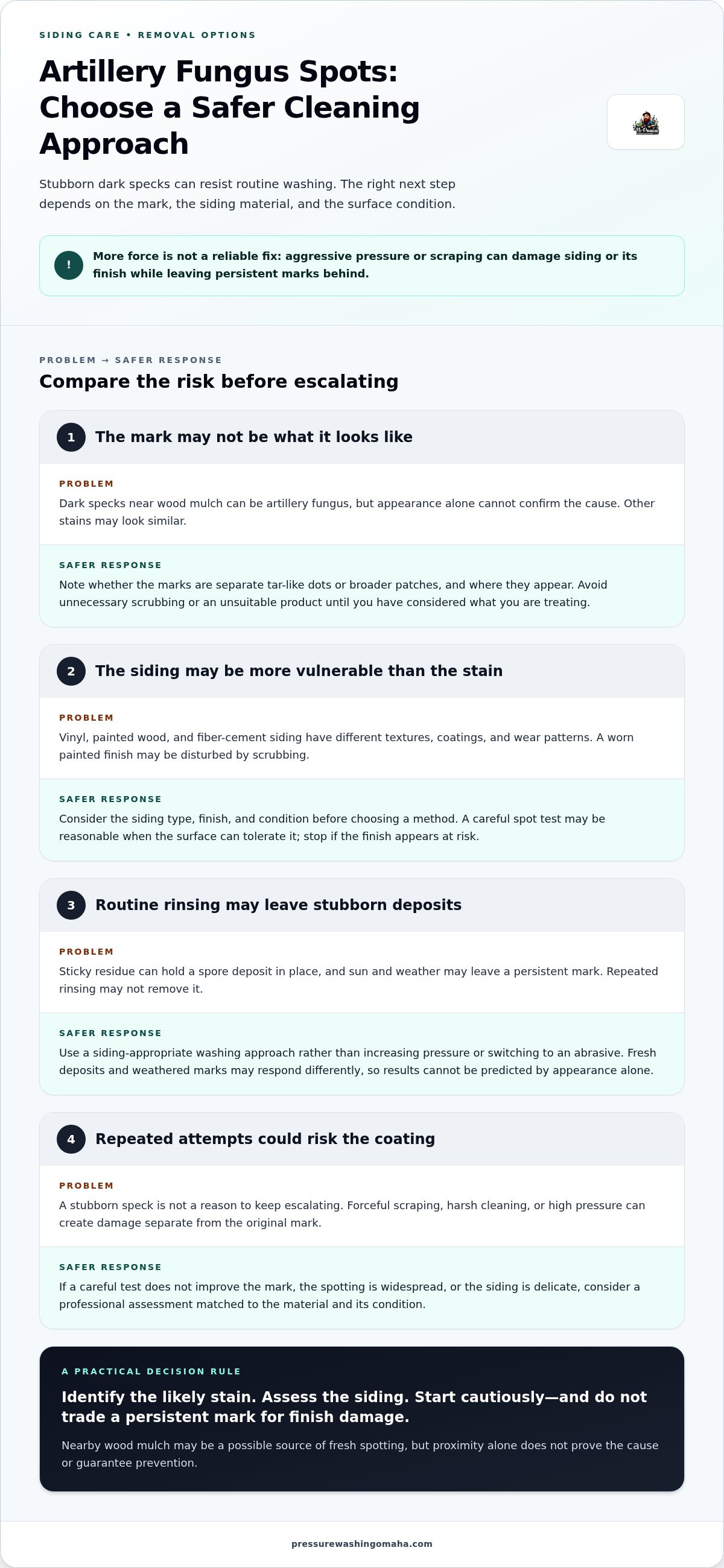
Likely artillery fungus appears as separate, dark, tar-like specks, often near mulch, but appearance alone cannot confirm the cause. Identifying the mark matters: cleaning before you know what you are treating can lead to unnecessary scrubbing or an unsuitable product.
How to Recognize Possible Artillery Fungus Spots
Look for small, discrete brown-to-black specks that appear stuck to the siding rather than spread as a continuous film. They may stand out on light-colored walls and can also appear on nearby surfaces such as fences or outdoor furniture. A cluster on the wall facing a mulched bed is a useful clue, not proof.
Other stains often have a different pattern. Dirt may form a dusty film or collect along ledges. Algae commonly appears as broader greenish or dark discoloration in damp areas. Neither pattern confirms the cause on its own. If the marks vary in shape, cover a wide area, or do not fit the pattern near a mulch bed, avoid assuming they are fungal deposits. Note where they occur and whether they are isolated dots or broad patches before choosing a cleaning method.
Why the Spots Appear on House Siding
Artillery fungus is associated with decomposing wood, including landscape mulch. Its spore masses can land on nearby surfaces and leave distinct dark marks. Light-colored siding makes the deposits especially noticeable, as can other nearby surfaces. A planting bed close to a marked wall is worth inspecting, but proximity alone does not confirm the source.
For Omaha-area homeowners, look at how the marks relate to the surrounding property rather than assuming the fungus is common in a particular neighborhood or season. Black specks alone do not establish that siding has deteriorated. Still, the material and finish matter: forceful scraping or harsh cleaning can leave damage that is more troublesome than the original mark. Other exterior stains, such as graffiti, also call for a surface-aware approach. Learn more about graffiti removal service in Omaha. Identifying the likely stain is a sensible first step before choosing how to clean it.
Why Artillery Fungus Sticks to Siding and Resists Ordinary Cleaning
A dark deposit can begin as material sitting on the surface, then become harder to remove as its sticky residue holds it in place and exposure to sun and weather leaves a persistent mark. That does not necessarily mean the siding itself has failed. It does mean repeated rinsing may not be enough. More forceful cleaning can create a separate problem by affecting the siding or its finish.
Routine rinsing may remove loose dirt but leave artillery fungus specks behind because the discharged spore mass adheres to the surface and may weather into a stain. Results depend partly on how long the deposit has been there, the siding material, its finish and condition, and any cleaning already attempted. Fresh deposits and old, weathered marks may respond differently. A spot’s appearance alone cannot reliably predict whether it will come off.
How Artillery Fungus Spreads from Mulch
Artillery fungus grows on decomposing organic matter, including wood-based mulch. Its small fruiting structures release spore masses with a forceful discharge. Those masses can travel from a nearby planting bed and land on surrounding surfaces. The Connecticut Agricultural Experiment Station’s explanation of artillery fungus describes its habitat and spore dispersal.
Nearby mulch is a plausible source, not conclusive evidence. If deposits appear on siding beside a bed containing decomposing wood, inspect that area. Marks on other nearby surfaces can provide additional clues, but distance, weather, and site conditions all affect what you observe. In Omaha, focus on whether a possible source is close to the affected area rather than assuming the fungus is common locally.
Why Siding Material Changes the Cleaning Challenge
Vinyl siding, painted wood, and fiber-cement siding have different textures, coatings, and wear patterns. A cleaning method that seems mild on one finish may be unsuitable for another. For example, a worn painted coating needs extra caution because scrubbing can disturb the finish. Check the siding’s condition before testing any cleaning approach.
Texture matters, too. A deposit lodged in a grain or uneven finish may be harder to address than one on a smooth surface. The same dark mark could also be a stain rather than removable material. Do not treat a stubborn speck as a reason to increase pressure or switch to an abrasive. Assess the surface as well as the mark. This is the principle behind material-aware house washing: match the cleaning approach to the siding’s type and condition.
If a careful test does not improve the mark, or further attempts could risk the coating, a professional assessment is a sensible next step. Request an exterior cleaning assessment before escalating your artillery fungus removal on siding efforts.
Artillery Fungus Removal Methods: What Is Safer for Siding?
The safest method depends on the siding, its condition, and whether the marks are loose deposits or persistent stains. More pressure or a stronger cleaner does not guarantee better removal. Either can damage a finish while leaving weathered specks behind. Start with the least aggressive reasonable approach. Treat any improvement as a test, not a promise of spotless siding.
Use this comparison to weigh your options for artillery fungus removal on siding:
| Approach | Likely use | Damage risk | Limitations |
|---|---|---|---|
| Gentle manual spot test | A small, accessible area where you can carefully test a compatible mild cleaning method. | Lower when you avoid abrasive tools and follow the siding maker’s care instructions, but scrubbing can still mark a finish. | Labor-intensive; bonded or weathered residue may remain even after loose material lifts. |
| Siding-appropriate washing | Removing general surface dirt before evaluating the remaining spots. Low-pressure soft washing may suit some siding, depending on its material and condition. | Depends on the surface and technique. Excess pressure or unsuitable cleaning agents may harm siding or its coating. | Washing may clean the surrounding wall without removing every embedded speck. |
| Professional assessment | Large affected areas, persistent marks, delicate finishes, elevated spots, or uncertainty about the siding material. | A material-aware approach is intended to reduce avoidable surface damage; no method eliminates all risk. | Even careful cleaning may not restore a flawless appearance if stains have weathered into the surface. |
When a Careful DIY Spot Test Makes Sense
If the marks are limited to a reachable area and you know what siding you have, test a small, inconspicuous spot first. Follow the siding manufacturer’s care instructions and the cleaning product label. Choose a mild, siding-compatible approach rather than starting with scraping or stronger chemicals. Stop if the color, gloss, texture, or coating changes, or if the mark does not lift without added force.
Why High Pressure and Abrasive Scrubbing Can Backfire
A pressure washer may not remove adhering spore deposits. Depending on the siding, its condition, and how the equipment is used, forceful spray can damage a coating or drive water behind panels. Scrapers, stiff brushes, and abrasive pads can scratch or gouge the surface, or leave a conspicuous patch where the finish has changed. Do not escalate simply because a spot resists the first attempt.
Professional help is the safer choice for fragile finishes, elevated areas that require a ladder, or siding you cannot confidently identify. A house-washing assessment can account for material and condition before choosing a method. Soft washing for siding addresses general exterior cleaning, but embedded artillery fungus stains may remain.
How to Reduce New Artillery Fungus Spots After Cleaning
Cleaning addresses marks already on the wall; it does not remove conditions that may contribute to new deposits. Removing existing spots and reducing future exposure are separate tasks: cleaning can address what is there, while reviewing nearby mulch may reduce a possible source without guaranteeing prevention.
Use this practical sequence after cleaning:
- 1. Inspect. Note which walls and nearby surfaces have spots, then look for planting beds close to those areas. A pattern near one bed can help focus your review, but it does not prove that bed is the source.
- 2. Clean cautiously. Follow the siding maker’s care instructions. Avoid escalating to harsh chemicals, abrasive tools, or forceful washing just to chase a stubborn mark. Protecting the finish matters even if some staining remains.
- 3. Review nearby beds. Check for decomposing wood-based mulch and accumulated organic debris that could provide a suitable habitat. Consider whether reducing a possible source or changing the bed is appropriate for your property.
- 4. Monitor. Photograph the siding after cleaning and recheck the affected wall and nearby surfaces over time. Comparing images can help distinguish a remaining old stain from fresh deposits.
Review Mulch and Planting Beds Near the House
Start with the bed closest to the affected wall, especially if the spots are concentrated on that side of the home. Look for aging wood mulch and organic debris, but do not assume every wood-based bed is responsible. Removing or changing a suspected source may reduce exposure, but cannot ensure artillery fungus will not appear again. Do not treat any mulch choice as universally fungus-proof based on appearance alone. Consider the planting bed as part of the property’s overall environment rather than expecting one change to solve every stain.
Monitor the Siding Without Damaging Its Finish
Take clear photographs before cleaning, then use the same angles for later comparisons. Check adjacent surfaces as well as the siding: new dots in the same area may suggest ongoing exposure, while unchanged marks may be old deposits or staining that cleaning did not remove. Do not scrape or repeatedly scrub the wall during inspections. For broader exterior buildup, professional house washing can address general siding grime with an approach tailored to the surface, though it cannot guarantee every embedded spot will disappear.
If persistent spotting or delicate siding makes further work risky, request a siding cleaning assessment.
Professional Artillery Fungus Cleaning for Omaha-Area Siding
Persistent marks after a careful test, spotting across a large section of wall, or siding with a delicate or weathered finish are good reasons to bring in an experienced cleaner. Continuing to scrub or increasing pressure can change the siding’s appearance without removing the stain. A professional assessment helps set a safer course by considering the surface first, rather than treating every dark mark the same way.
No Pressure Power Washing provides house washing in Omaha and surrounding communities, with more than 30 years of experience. Its residential house-washing approach includes soft washing for delicate siding and uses biodegradable, non-toxic solutions. Soft washing can address general exterior buildup, but cannot guarantee that every artillery fungus mark will come off. Older, embedded spots may leave a stain even after careful cleaning.
What a Careful House-Washing Assessment Considers
A useful assessment considers the siding type and finish, whether the coating is worn, how the spots are distributed, what landscaping is nearby, and whether the affected areas are safely accessible. A few marks beside a planting bed present a different cleaning challenge from widespread spotting on an upper wall. These details help determine a suitable approach; they do not promise a particular result.
House washing for siding should be matched to the material and its condition. If some marks appear deeply bonded or weathered, that limitation should be part of the expectation from the outset. Protecting the finish takes priority over pursuing a flawless appearance at any cost.
A Local Next Step for Persistent Siding Spots
For homeowners in Omaha, Papillion, Elkhorn, Gretna, Bennington, Bellevue, Valley, and Wahoo, professional support can help when DIY attempts have not improved the marks or when the next step could risk the siding. Share what the surface is made of, where the spots appear, and what cleaning you have tried. Photos can help show the affected areas when you make an inquiry.
Artillery fungus removal on siding is not always a matter of choosing a stronger cleaner. A material-aware assessment can distinguish general dirt that may respond to washing from stubborn marks that could remain, helping avoid unnecessary abrasion or pressure. The aim is careful exterior cleaning suited to the home, with clear expectations about what it may and may not change.
For related information about removing exterior stains, the same surface-first mindset applies: the cleaning approach needs to account for the material and finish, not just the mark.
If persistent spots have you unsure how to proceed, share your siding concerns and request a tailored estimate.
Choose a Careful Next Step for Your Siding
Dark marks can make a clean home feel neglected, but rushing to remove them may create a more visible problem than the stain itself. Give the siding’s finish the same consideration as the spot. If you are unsure whether another cleaning attempt is safe, pause and have the surface assessed before applying more force or a different product.
A thoughtful approach to artillery fungus removal on siding starts with realistic expectations: cleaning may improve the appearance, but older, embedded marks may not disappear completely. Choose a next step that considers your siding and the condition of the affected area rather than promising a perfect result.
With a measured plan, you can address the spotting while making a considered choice for your home’s exterior.
Frequently Asked Questions
Is artillery fungus harmful to siding?
Usually, the spots are an appearance concern, not proof that siding has failed. Check for separate signs of wear, such as peeling paint, cracked panels, or loose sections; those conditions deserve attention regardless of the dark specks. Avoid aggressive scraping or an untested cleaner, which could cause damage the deposits have not. If the surface is brittle, peeling, or unfamiliar, pause before treating it and seek experienced guidance.
Can artillery fungus be completely removed from siding?
Careful cleaning may improve the appearance, but complete removal is not guaranteed. A mark on smooth siding with an intact finish may respond differently from one on textured material or weathered paint. Before treating the whole wall, compare a small test area with nearby untreated siding in natural light. If the color, sheen, or texture changes, stop. It is better to accept a remaining mark than create a larger blemish.
Will artillery fungus eventually wash off siding in the rain?
Do not count on rain to remove established black specks. Wet weather may rinse loose surface dirt, but deposits that have adhered to siding can remain visible afterward. Repeatedly hosing the wall is not a reliable removal plan, and forceful rinsing may create new risks depending on the siding and spray direction. Note whether the marks change after rain, then consider a compatible cleaning test instead of waiting for the weather to clear them.
Is bleach safe for removing artillery fungus from vinyl siding?
Do not assume bleach is suitable for vinyl or for artillery fungus marks. Check the siding manufacturer’s care guidance and the cleaner’s label before using any product, including on a small test area. An incompatible solution may affect the siding or nearby landscaping through splash or runoff. Never mix cleaning chemicals. If you cannot establish that a product is appropriate for the surface, do not apply it. Get experienced advice first.
Can pressure washing remove artillery fungus from house siding?
Pressure alone does not ensure the spots will come off. Excessive force, an unsuitable spray direction, or a vulnerable surface can damage siding or drive water behind it. The risk depends on the material, its condition, and how the wash is performed. Avoid turning up the pressure as a shortcut, especially on delicate or elevated areas. If you are unsure how the siding will respond, leave the cleaning to an experienced professional.
Does changing the mulch stop artillery fungus from coming back?
Changing or reducing decomposing wood-based mulch near an affected wall may address a potential source, but it cannot guarantee that new spots will not appear. Check the closest planting beds and clear accumulated organic debris where appropriate; existing marks still need separate attention. Homeowners in Omaha, Papillion, Elkhorn, Gretna, Bennington, Bellevue, Valley, and Wahoo can use photos to track whether new spots appear near the same area over time.
Can I scrape artillery fungus spots off painted siding?
Scraping may lift some material, but a blade or abrasive pad can scratch paint, expose the surface underneath, or leave a conspicuous patch. On older or deteriorating paint, even careful force may worsen the finish. Check the paint or siding maker’s cleaning guidance and test only a gentle, compatible method in an inconspicuous spot. If the mark resists, stop rather than pressing harder and have the surface assessed professionally.


