

What if the pressure washing that seems to clear a dumpster pad is only moving its mess somewhere else? For Bennington businesses, grease, food residue, and standing wastewater can mean lingering odors, pest activity, and slick footing. That’s why choosing dumpster pad cleaning Bennington businesses can rely on means looking beyond a quick rinse.
You’re right to expect a waste area to be clean, safe, and presentable. But effective cleaning needs to address the organic buildup that feeds odors and attracts pests, while keeping contaminated wash water out of storm drains. A careless cleanup can trade one problem for another.
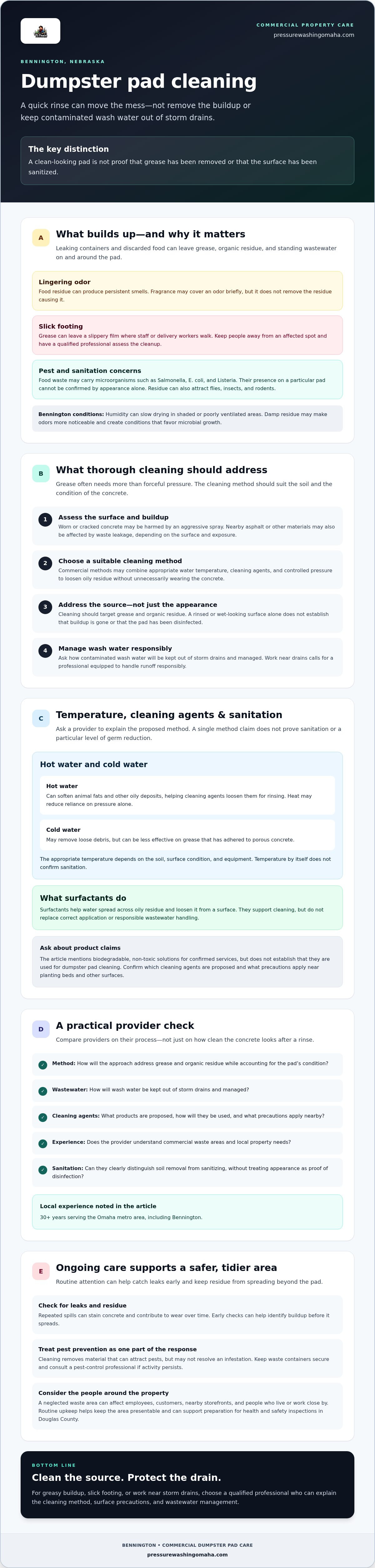
This guide explains what professional dumpster pad cleaning should involve, what to ask when comparing providers, and how responsible wastewater handling helps protect your property and the environment. You’ll also learn how routine attention to grease and residue can support a more sanitary waste area and help you prepare for health and safety inspections in Douglas County.
Key Takeaways
- Learn why grease and organic residue call for more than a quick rinse, and what thorough cleaning should address.
- Use this guide to compare dumpster pad cleaning Bennington providers, including the questions to ask about methods, experience, and wastewater handling.
- Understand why wash water needs careful management and why pressure washing near storm drains is a job best left to professionals equipped to handle runoff responsibly.
- Find out how local experience matters when selecting commercial property maintenance, including No Pressure Power Washing’s 30+ years serving the Omaha metro area, including Bennington.
- See how biodegradable, non-toxic cleaning solutions can support an approach that considers both your property and the surrounding environment.
Why Dumpster Pad Cleaning in Bennington is Essential for Business Health
A dumpster area can affect how customers and employees experience a business, even if it sits behind the building. Leaking containers and discarded food leave residue that can hold moisture and produce persistent odors. Professional cleaning addresses the buildup through degreasing and appropriate sanitation steps; simply making the concrete look wet or rinsed isn’t the same as removing what has accumulated.
Bennington’s seasonal humidity can slow drying in shaded or poorly ventilated waste areas. When damp residue lingers, unpleasant smells may become more noticeable and conditions can favor microbial growth. That matters especially near a restaurant’s staff entrance, where employees regularly pass between the waste area and food-preparation spaces. A clean exterior also supports customer confidence: a neglected back-of-house area can undermine the impression of care a business works to maintain indoors.
The Hidden Risks of Neglected Waste Areas
Food waste may carry microorganisms such as Salmonella, E. coli, and Listeria. Their presence on a particular pad can’t be confirmed by appearance alone, but residue near a food-service entrance deserves prompt attention. Grease can also leave a slick film where staff or delivery workers walk. If footing is uncertain, keep people away from the affected spot and have a qualified professional assess the cleanup rather than asking untrained employees to tackle it.
Repeated spills can stain concrete and, over time, contribute to wear. Waste leakage may also affect nearby asphalt or other surfaces, depending on the material and exposure. Routine checks help staff spot leaks early, before residue spreads beyond the pad or becomes harder to address.
Odor Control and Pest Management
Fragrance may cover a bad smell briefly, but it doesn’t remove the food residue producing it. Cleaning the source is a more practical way to reduce odor and remove material that can attract flies, insects, and rodents. It can support pest prevention, though it won’t resolve every infestation; secure waste containers and consult a pest-control professional if activity persists.
A tidy waste area is also a neighborly consideration. Persistent smells or visible pests can affect nearby storefronts and people who live or work close to the property. Consistent upkeep helps keep the area presentable and reflects care for the wider Bennington community.
The Science of Sanitization: Beyond Basic Pressure Washing
Pressure can remove loose dirt, but grease often needs more than a forceful rinse. Commercial cleaning methods may combine suitable water temperature, cleaning agents, and controlled pressure to loosen oily residue without unnecessarily wearing the concrete. For dumpster pad cleaning Bennington businesses are considering, ask the provider to explain the method and distinguish visible soil removal from sanitizing. A clean appearance alone doesn’t confirm that a surface has been disinfected.
Hot Water vs. Cold Water Performance
Animal fats and other oils can cool and cling to porous concrete. Hot water can soften greasy deposits, helping cleaning agents loosen them so they can be rinsed away. Cold water may remove loose debris, but can be less effective on adhered grease. The right temperature depends on the soil, surface condition, and equipment. Don’t treat a temperature claim by itself as proof of sanitation or a particular level of germ reduction.
Using heat can also reduce the need to rely on pressure alone. That matters on worn or cracked concrete, where an aggressive spray may worsen surface damage. A qualified contractor should inspect the pad and explain how the method will address buildup while accounting for the condition of the concrete.
Biodegradable Chemistry in Action
Surfactants help water spread across oily residue and loosen it from a surface, allowing the material to be rinsed away. They support cleaning, but don’t replace proper application or responsible wastewater handling. Ask a prospective provider which cleaning agents are proposed, how they’ll be used, and what precautions apply around nearby planting beds and other surfaces.
No Pressure Power Washing states that it uses biodegradable, non-toxic solutions for its confirmed services. However, dumpster pad cleaning isn’t among the company’s listed offerings, so don’t assume those products or methods are available for this specific job. Confirm service availability and scope directly before making a decision. For surrounding walls or delicate materials, ask whether a lower-pressure approach is appropriate; the method should suit the surface, not just the stain.
Evaluating Commercial Cleaning Contractors: A Bennington Buying Guide
A polished quote isn’t proof that a contractor understands commercial work. For dumpster pad cleaning Bennington businesses should compare the proposed process, safety practices, and wastewater plan, not just the final price. Treat labels such as “Solar Cowboy” as marketing, not evidence of skill. A reliable specialist should explain what the site needs, what equipment will be used, and what the cleaning can and can’t accomplish.
Ask for current proof of commercial liability insurance and workers’ compensation coverage, and confirm that the documents apply to the work being quoted. These protections matter if property is damaged or a worker is injured. Equipment is another useful conversation, but truck-mounted systems aren’t automatically better than portable units. Ask whether the actual equipment can deliver the heat, flow, and recovery needed for your pad, and how the contractor will protect nearby surfaces.
Checklist for Vetting Your Cleaning Partner
Use the quote discussion to check the contractor’s process, not simply the machine’s advertised pressure. Ask whether the system has commercial-grade hot-water capability, how wastewater will be contained and disposed of, and whether the proposed method suits your concrete’s condition. Request Bennington-area references or commercial case studies, then look for examples involving similar grease buildup and site constraints.
- Does the quote describe the cleaning method and its limits?
- How will wash water be captured and kept out of storm drains?
- Can the contractor provide proof of insurance and relevant local references?
No Pressure Power Washing brings more than 30 years of experience in the Omaha metro area, including Bennington. That local history can be valuable when discussing regional commercial property needs, but ask any prospective contractor for details that are relevant to your own site.
Comparing Maintenance and Restoration
Restoration cleaning describes an intensive initial service for a pad with years of accumulated grease, staining, and residue. It may improve the surface, but deeply set stains or existing material damage won’t necessarily disappear. A contractor should inspect the pad and set realistic expectations before work begins.
After a heavily soiled pad is addressed, a recurring schedule may help high-volume restaurants keep buildup from becoming difficult to remove. The right interval depends on use, spills, and site conditions; don’t accept a one-size-fits-all schedule without a discussion of your operation. For other hard surfaces around a facility, concrete cleaning services can help remove accumulated grime and support ongoing surface care. Confirm that any service you request is specifically included in the contractor’s written scope.
Risk Mitigation and Compliance for Douglas County Businesses
Wastewater is one of the most important parts of a commercial cleaning plan. Grease, food residue, and cleaning products can travel with wash water, so directing runoff toward a storm drain can create environmental and compliance problems. The Clean Water Act regulates pollutant discharges from point sources to waters of the United States, and a permit may be required for some discharges. Don’t assume that a nearby drain is safe to use.
EPA Compliance and Environmental Stewardship
Storm drains and sanitary sewers serve different purposes. Storm drains commonly carry runoff toward local waterways, while sanitary sewers convey wastewater for treatment. The route and local requirements can vary, so confirm the correct disposal method with the relevant authority before work begins. The EPA’s wastewater guidance is a useful starting point, but it doesn’t replace local direction or approval.
For dumpster pad cleaning Bennington businesses should ask how the contractor will contain, recover, and dispose of wastewater. A professional may be able to provide a useful paper trail, such as the service scope, date of work, and wastewater handling records. Keep those documents with your maintenance records. They can help show what was done, but they aren’t a guarantee of compliance or a substitute for following requirements that apply to your property.
The Douglas County Health Department conducts inspections of commercial establishments, including restaurants, and enforces applicable local and state health requirements. A waste area may be relevant to an inspection, but don’t assume every property or pad is assessed under the same rules. Ask the department or your regulatory contact which standards apply to your specific business, and address visible spills and sanitation concerns promptly.
Employee Safety and Liability
Grease left on concrete can create a slip hazard, but high-pressure cleaning brings its own risks. A pressurized stream can cause serious injection injuries, and contaminated runoff can spread beyond the work area if it isn’t controlled. Don’t assign untrained employees to operate pressure-washing equipment on a greasy commercial pad. Choose a qualified professional and ask how the work area, equipment, and wastewater will be managed.
Commercial cleaning requires attention to the surface, the water, and the people nearby. Careful methods used for heavy equipment cleaning illustrate why operators must match pressure and technique to the task, rather than relying on force alone. No Pressure Power Washing emphasizes environmental responsibility and uses biodegradable, non-toxic solutions, but cleaning products don’t remove the need to control runoff.
Professional Dumpster Pad Solutions with No Pressure Power Washing
Choosing a local cleaning company starts with knowing exactly what it offers. No Pressure Power Washing has more than 30 years of experience in the Omaha metro area, including Bennington, and uses biodegradable, non-toxic solutions as part of its environmentally responsible approach. Its confirmed services include concrete cleaning and graffiti removal, but dumpster pad cleaning isn’t listed among its offerings. Contact the company to confirm whether that work is available before treating it as part of a service plan.
That distinction matters. Cleaning a dumpster pad can involve grease removal, sanitization, and wastewater recovery, and a contractor should explain which of those tasks are included. A clean-looking surface isn’t necessarily disinfected, and no cleaning method can reverse existing damage to concrete. Ask for a written scope that describes the intended result, the cleaning method, and how runoff will be managed.
The No Pressure Difference: Quality Over Volume
Experience is most useful when it leads to careful decisions on site. Concrete, painted surfaces, and building siding don’t all tolerate the same pressure or treatment. No Pressure Power Washing serves the Omaha and Bennington communities and offers services such as commercial graffiti removal for storefronts. For any contractor you consider for a waste area, ask how its approach will protect nearby surfaces and what limitations to expect.
A local provider can offer familiarity with the area, but don’t choose on location alone. Compare the proposed process, insurance documentation, and wastewater plan. If a business needs cleaning at multiple locations or on a recurring basis, ask prospective providers whether they offer a schedule tailored to site use. Don’t assume a custom maintenance plan, a particular visit frequency, or dumpster-pad service is included unless it’s confirmed in writing.
Confirm the Scope Before Scheduling
Before arranging work, share practical details: the pad’s material, visible grease or staining, nearby drains, and any surrounding surfaces that need protection. Ask whether the contractor will inspect the site, how wastewater will be handled, what the estimate covers, and whether the quoted work is cleaning, sanitizing, or both. Confirm any estimate terms directly; don’t assume it’s free or carries no obligation.
For Bennington businesses comparing dumpster pad cleaning options, clear expectations are a better basis for confidence than broad promises. No Pressure Power Washing’s local experience and environmental approach may be relevant to the property services it confirms it can provide. Verify the scope before scheduling, and select a qualified provider for any high-pressure or wastewater-handling work.
Choose a Cleaning Plan That Protects Your Property
Effective dumpster pad cleaning Bennington businesses can depend on means more than removing visible grease. The contractor should explain the cleaning scope, how wash water will be managed, and what results are realistic for the pad’s condition. Comparing those details helps you make a considered choice and protect staff, customers, and neighboring properties.
No Pressure Power Washing has more than 30 years of experience in the Omaha metro area, including Bennington, and uses biodegradable, non-toxic solutions. However, dumpster pad cleaning isn’t among the company’s confirmed services, so contact them to verify availability and scope before proceeding. Ask any contractor you consider to provide proof of insurance and clarify what its estimate includes.
With clear expectations and a responsible plan, you can take a practical step toward a cleaner, safer commercial property.
Frequently Asked Questions
How often should a commercial dumpster pad be cleaned in Bennington?
Set the cleaning schedule according to how quickly grease, food residue, odors, or slick spots return. A high-volume restaurant may need more frequent attention than a business with little food waste, but there’s no single interval that suits every site. Inspect the pad routinely and note recurring spills or pest activity. No Pressure Power Washing’s listed services don’t include dumpster pad cleaning, so confirm availability with any provider you contact.
Is hot water really necessary for dumpster pad cleaning?
Hot water can help loosen grease and oily residue, so it may be useful for heavily soiled commercial pads. It isn’t a substitute for appropriate cleaning chemistry, careful rinsing, or responsible wastewater handling. Cold water may remove loose dirt, but can be less effective on stubborn grease. Ask a prospective contractor why its chosen temperature suits your pad and what results are realistic for the surface and stains.
Will professional cleaning remove old oil and grease stains from concrete?
It may reduce old grease and oil stains, but complete removal isn’t guaranteed. Oils can soak into porous concrete, and previous wear or damage can leave lasting discoloration even after cleaning. A qualified contractor should inspect the surface and explain likely results before work begins. Ask whether the estimate describes stain treatment separately from general cleaning, and be cautious of promises that every mark will disappear.
How do you handle the dirty water runoff during the cleaning process?
Wash water can carry grease, food residue, and cleaning products, so it should be contained and recovered rather than allowed to flow into a storm drain. Ask how the contractor will collect wastewater and where it will go. Discharge to a sanitary sewer may require prior approval, and disposal requirements depend on the site. Get the proposed runoff plan in writing before scheduling work.
Can dumpster pad cleaning help with fly and rodent problems?
Cleaning can remove food residue and other material that attracts flies and rodents, so it may support your pest-management efforts. It won’t guarantee pests will leave or resolve an established infestation. Keep waste contained, address leaks, and work with a pest-control professional if activity continues. In Bennington and nearby communities, a clean waste area also helps reduce odors and nuisances around neighboring businesses.
What is the difference between pressure washing and sanitizing a dumpster pad?
Pressure washing uses water force to remove dirt and residue from a surface. Sanitizing is a separate step intended to reduce microorganisms using an appropriate process; a forceful rinse alone doesn’t prove that sanitation has occurred. Ask the contractor to distinguish cleaning from sanitizing in the written scope, explain any products or methods used, and avoid unsupported claims about a specific level of germ reduction.
Do I need to be present while the cleaning service is being performed?
Ask the provider before booking. Whether you need to be present can depend on site access, business procedures, and the contractor’s requirements. Even if you won’t stay on site, arrange access and tell the provider about nearby storm drains, customer or delivery routes, and sensitive surfaces. Confirm who will review the completed work and how any concerns will be documented.
Are the cleaning solutions used safe for the environment and local wildlife?
Ask for the product name and information about its intended use, dilution, and precautions. “Biodegradable” or “non-toxic” doesn’t mean a product can be released into storm drains or is harmless to every plant and animal. No Pressure Power Washing uses biodegradable, non-toxic solutions for its listed services, but dumpster pad cleaning isn’t among those confirmed offerings. Verify availability, products, and wastewater practices before booking.


