

Those orange marks are often iron stains, not ordinary dirt. When fertilizer granules get wet, iron can react with the cement and leave rust-colored discoloration that reaches into concrete pores. Effective fertilizer stain removal from concrete in Bellevue depends on whether the stain is still near the surface or has penetrated deeper; pressure washing alone won’t remove rust.
It’s frustrating to see a lawn treatment leave a lasting mark on a driveway or walkway, especially when rinsing doesn’t shift it. The right cleaning approach depends on the stain’s age, depth, and the concrete’s finish, and harsh chemicals can alter the surface as well as the stain.
This guide explains why fertilizer can turn concrete orange, how to tell surface residue from deeper iron staining, and when professional cleaning may be appropriate. You’ll also learn what a specialist considers when selecting a treatment, so you can understand the process before deciding how to proceed.
Key Takeaways
- Wet fertilizer granules can leave orange marks when iron reacts with concrete, and the stain’s depth affects the right treatment.
- Set-in rust may call for a targeted remover, but acid cleaners can alter concrete if they’re used improperly.
- Surface discoloration and iron absorbed into concrete pores require different approaches; irrigation water can also cause recurring stains.
- Spot-testing helps reveal how a cleaner will affect the concrete before treatment is applied more broadly.
- Persistent stains, especially after repeated attempts or months on the slab, are a reason to consider professional concrete cleaning.
Why fertilizer granules leave rust-colored marks on concrete
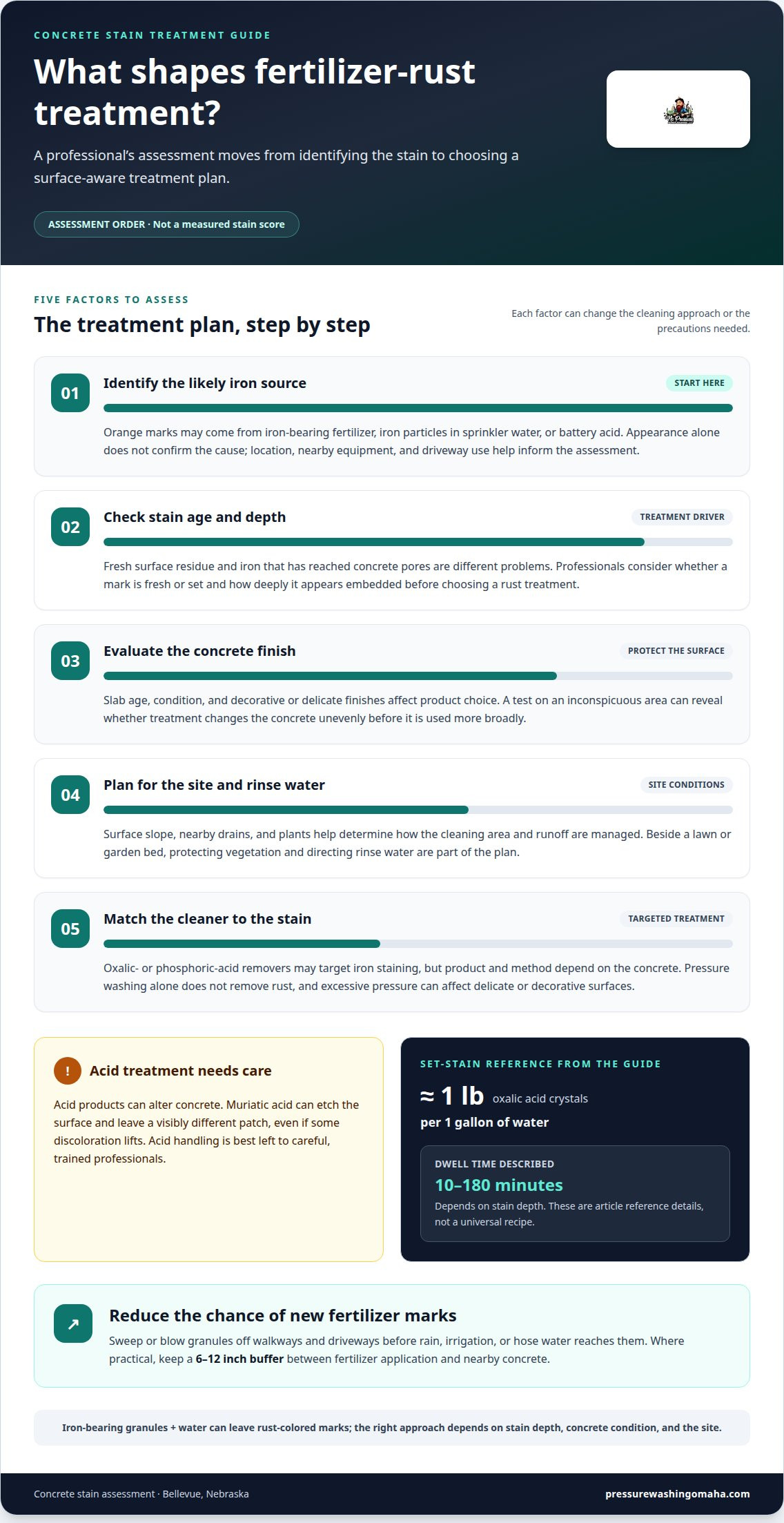
- Identify the likely iron source before choosing a treatment. Some fertilizers contain iron to support lawn growth. If granules remain on a driveway and get wet from rain or sprinklers, iron compounds can oxidize and leave orange or rust-colored marks. Water can also soften pellets and carry residue into concrete pores, making a spot harder to remove after repeated wetting.
- Match the rust treatment to the stain and the concrete. A professional considers whether the mark is fresh or set, how far it appears to have penetrated, and whether the slab is old or decorative. Oxalic- or phosphoric-acid removers may target iron staining, but the right choice depends on the surface and product. Testing an inconspicuous area first can show whether treatment changes the concrete unevenly.
- Plan for rinse water on a Bellevue, Nebraska, job. A professional considers the surface slope, nearby drains, and plants, then manages the cleaning area and runoff rather than letting rinse water flow unchecked. The approach depends on the site and cleaner. Beside a lawn, for example, protecting nearby vegetation and directing rinse water are part of the plan.
- Pressure washing alone does not treat rust. The iron discoloration requires an appropriate cleaning treatment, and excessive pressure can affect decorative or delicate concrete. Rust may persist, while harsh acid cleaners can permanently alter the surface. Muriatic acid can etch concrete, leaving a visibly different patch even if some discoloration lifts.
- Prevent granules from reaching wet concrete. Sweep or blow fertilizer off walkways and driveways before rain, irrigation, or hose water reaches it. Keep a 6-12 inch buffer between fertilizer application and nearby concrete where practical. For fertilizer stain removal from concrete in Bellevue, professionals also consider how the surface and surrounding landscape affect treatment and rinse-water control.
Many lawn fertilizers contain a small percentage of iron. Fertilizer can leave rust spots on concrete after it gets wet from rain or lawn watering. The sequence matters: iron-bearing fertilizer is present on the concrete, then water wets it, and rust-colored marks can appear. This connects the spots to both the product and the wetting, rather than treating the mark as an unrelated change in the slab. The small percentage of iron does not change the basic explanation; the key is that fertilizer granules remain on the concrete when rain or watering reaches them.
Water softens fertilizer pellets on concrete, allowing the chemicals to cause deep rust stains on and inside the concrete. In other words, the effect is not confined to the visible granules: softened pellets can leave staining that extends into the concrete as well as marking its surface. This explains why a rust-colored spot can remain after the fertilizer itself is no longer obvious. Rain and lawn watering are both ways the fertilizer can get wet, so leaving granules in place through either kind of wetting can lead to marks. The iron in the fertilizer and the water that softens the pellets together account for how these spots form.
Why do fertilizer stains turn concrete orange?
- Consider other possible sources before treating the stain. Orange or rust-colored marks can come from iron-bearing fertilizer, iron particles in sprinkler water, or battery acid. Their appearance alone does not confirm the cause. A professional considers the stain’s location, nearby equipment, and how the driveway is used before choosing a rust treatment.
- Wet iron compounds in fertilizer can oxidize and leave rust-colored deposits on concrete. Rain or sprinkler water may carry residue beyond the original granules. A professional examines the stain pattern and concrete finish, since a concentrated spot and broad discoloration may call for different treatment decisions.
- Assess set stains before using oxalic acid. A professional considers how deeply the iron appears embedded and how the concrete responds to a small test. A preparation ratio described for set stains is approximately 1 lb of oxalic acid crystals per 1 gallon of water. The solution’s dwell time may range from 10-180 minutes, depending on stain depth.
- Leave acid treatment to careful, professional handling. Oxalic acid is not a casual household cleaner, and acid products can pose health risks. A trained cleaner considers the slab’s condition, nearby plants, and the path of rinse water before proceeding. Beside a garden bed, those details matter as much as the orange mark.
- A store-bought acid cleaner may not lift the stain cleanly. Some products can leave a white cloud around a mark while the stain remains, permanently changing the concrete’s surface paste. This can create a visible patch against the surrounding finish. Careful product selection and a test area can help reduce the risk of replacing rust discoloration with surface damage.
- Do not use muriatic acid as a shortcut for fertilizer marks. It can etch concrete and leave the treated area visibly different from the rest of the slab. An aggressive application may damage the finish without removing the iron stain evenly. A professional selects a targeted rust treatment based on the likely source and concrete condition, rather than relying on harsh acid alone.
Professional cleaning for widespread or stubborn stains
- Start with a site assessment in Bellevue, Nebraska. A professional looks at where the fertilizer marks appear, whether they follow a scatter pattern, and how the slab drains. A concentrated patch beside a lawn may need a different treatment area from a broad stain across a driveway. The inspection also accounts for porous, worn, or decorative sections that may respond differently to cleaning.
- Distinguish light surface discoloration from stubborn, set staining. Fresh, faint marks may respond to gentle household cleaning, while dark or widespread areas can indicate that iron has moved farther into the concrete. A professional considers the stain’s appearance and history before choosing an application. Stronger treatment is not automatically better, especially on delicate finishes.
- Reserve vinegar and water for limited, fresh stains. A 50:50 mixture is recommended for light fertilizer rust, with a 5-10 minute dwell before scrubbing. This is not a reliable fix for every stain, and repeated treatment can be unhelpful when the mark remains unchanged. A professional can identify when a gentler approach fits and when it is unlikely to address the cause.
- Test the selected remover in an inconspicuous spot before treating a larger area. Concrete can respond unevenly, so a professional checks for surface changes as well as stain release. A hidden edge of a decorative driveway, for example, can show whether an application alters the finish. The test helps guide product choice and treatment before work reaches visible sections.
- Treat widespread stains methodically in smaller sections. Working in manageable areas helps maintain an even application and rinse, rather than leaving visible bands between treated and untreated concrete. A professional adjusts the process as each section responds. This is useful on a large driveway, where exposure, porosity, and stain depth can vary.
- Stop escalating household methods when careful cleaning makes no visible difference. Repeated chemical attempts can expose the concrete to unnecessary treatment without resolving iron below the surface. If a fertilizer stain remains after two or three attempts, professional cleaning is a sensible next step. The assessment can distinguish persistent surface residue from staining that has penetrated porous concrete.
Surface stains versus iron absorbed into concrete pores
- Look at where the orange color appears and how it responds to ordinary surface cleaning. A faint mark around loose granules may be near the surface, while discoloration that remains in the slab can indicate deeper iron staining. Appearance is a clue, not a definitive test. Concrete age, finish, and exposure all affect how a stain looks.
- Consider how fertilizer-related iron oxide forms at the concrete surface. Some fertilizers contain iron, and moisture can move residue from granules onto nearby concrete. The resulting orange fertilizer rust stains may appear in concentrated spots or spread along the path of runoff. A pattern beside a recently treated lawn can help explain the source without proving how far iron has penetrated.
- Look for recurring orange marks near sprinkler irrigation. Iron particles in irrigation water can deposit on walkways, patios, and driveway edges. Water with iron levels above roughly 0.3 parts per million can stain nearby hard surfaces. If discoloration reappears along the sprinkler’s reach after cleaning, ongoing water exposure may be contributing to the new staining.
- Compare the affected areas with surfaces that receive less water. A sheltered section may stay clear while a strip beside an irrigated lawn develops orange marks. That contrast can help distinguish a one-time spill from recurring exposure. The pattern matters because treating the visible stain alone will not address a continuing source of iron.
- A poultice may be considered when iron appears embedded in concrete pores. It stays over the affected area to draw staining material from within the surface. Depending on stain depth, a concrete poultice may remain in place for many hours or even days. Because it requires an extended dwell, a professional assesses the slab before choosing this method.
- Match the next treatment to both the stain and its likely source. A specialist considers whether iron is embedded, whether sprinkler exposure continues, and how the concrete finish may respond. For example, professional concrete cleaning can address the broader surface, while recurring irrigation-related marks also call for attention to the source of the iron.
When to hire a professional
- Arrange an assessment if fertilizer rust has remained on the slab for months. Long exposure can make the stain harder to diagnose by appearance alone. A professional can examine the affected area and concrete before selecting a treatment. For a Bellevue driveway with marks across several sections, the assessment can help distinguish one spill from multiple sources.
- Consider professional help when a stain covers a large or prominent area. Treating a broad surface without a consistent plan can leave visible differences between sections. A specialist can assess how the finish, exposure, and stain pattern vary across the slab. This is especially useful on a front walkway, where uneven results are easy to notice from the street.
- Stop experimenting if you are unsure which cleaner is suitable. Acid products require careful handling, and the wrong chemistry can change the concrete’s surface while fertilizer rust remains. A professional evaluates the surface and treatment before applying a cleaner. This is a sensible choice for homeowners unfamiliar with acid products or uncertain how runoff may affect nearby plants.
- Seek help when a stain resists two or more careful attempts. Repeating the same application may not reach iron below the visible surface. A professional can reassess the stain rather than simply increasing product strength or pressure washing intensity. On a decorative patio, that distinction helps protect the existing finish while determining what treatment is appropriate.
- Consider professional cleaning where pavers and concrete meet along a stained area. Different materials can respond differently to the same application. A specialist can account for both surfaces and their boundary, such as a concrete path beside a paver landing. A coordinated approach helps avoid an uneven transition.
- Bring in a professional when the cause of the stain is unclear. Iron fertilizer, irrigation water, and other sources can leave similar orange marks, but diagnosis matters before treatment. A stain that returns along one sprinkler’s reach, for example, suggests ongoing exposure. Understanding the pattern helps determine whether the focus should be the mark, its source, or both.
Professional application may be appropriate when removing fertilizer rust stains, particularly if the stain is deep or has resisted earlier treatment. Hiring a professional is advised when a fertilizer stain has been set for months, and professional help is worth considering when a concrete fertilizer stain has resisted two or more careful DIY attempts. Stop repeated household chemical treatments if two or three attempts do not change a fertilizer stain on concrete. Continuing with ineffective products can add effort without addressing the stain below the surface.
Cost is another consideration, but the total depends on the size and condition of the area, the treatments used, and local prices. Without comparing estimates and likely maintenance needs for a specific slab, it is not possible to say whether professional cleaning and sealing will cost less over three to five years than annual DIY cleaning. A professional can help select an approach that addresses the stain and protects the slab, rather than relying on recurring cleaning alone.
No Pressure Power Washing: Concrete Cleaning
- No Pressure Power Washing provides Concrete Cleaning for stained and weathered outdoor surfaces. For fertilizer stain removal from concrete in Bellevue, the assessment considers the mark, surrounding grime, and concrete finish. Cleaning the broader area can help reveal how much discoloration remains, since pressure washing alone doesn’t remove rust.
- The concrete’s condition guides the cleaning approach. A smooth driveway, older walkway, and decorative surface may respond differently. No Pressure Power Washing uses soft-washing, a low-pressure method, with biodegradable, non-toxic cleaning agents. This care matters near a decorative border or adjoining siding, where an unsuitable approach could affect the visible finish.
- Surface cleaning and iron-stain treatment are different tasks. If orange marks remain after surface soil is removed, a targeted treatment may be needed. The stain’s age, location, and apparent depth help determine the next step. Start by distinguishing ordinary buildup from persistent fertilizer discoloration.
- Nearby conditions can shape the cleaning plan. Fertilizer may scatter from lawn edges, while sprinkler water can leave recurring marks near driveways and walkways. Noting where discoloration appears helps identify the affected area and possible ongoing exposure. For fertilizer stain removal from concrete in Bellevue, this context helps focus attention on the surface and stain.
- No Pressure Power Washing’s Concrete Cleaning service can address outdoor concrete affected by staining or general buildup. If marks are old, widespread, or unchanged after careful cleaning, professional assessment can help determine an appropriate next approach. The goal is to match the cleaning to the concrete, rather than treating every orange spot as ordinary dirt.
- Before arranging service, note where the marks appear, whether they return after irrigation, and whether the concrete is decorative or worn. Those details help describe the surface and cleaning need. For persistent fertilizer marks on a driveway or walkway, contact No Pressure Power Washing about Concrete Cleaning in Bellevue.
Frequently Asked Questions
How do professionals remove Miracle-Gro stains from concrete?
A professional assesses the stain and concrete rather than choosing a treatment based on fertilizer brand alone. They consider the mark’s pattern, the surface finish, and whether discoloration remains after loose residue is removed. A small test area helps show how the concrete responds before wider treatment. If the stain is iron-related, targeted rust removal is more appropriate than treating it as ordinary dirt.
How do professionals remove fertilizer stains from concrete?
Professionals first determine whether the mark is fertilizer residue, iron staining, or another discoloration. They then select a treatment suited to the concrete and work across the affected surface in a controlled way. For example, scattered orange marks near a lawn edge may need a different plan from broad discoloration across a parking area. Cleaning surrounding soil can also help the treated area blend more evenly with adjacent concrete.
Which cleaners do professionals use to remove fertilizer stains from concrete safely?
The cleaner depends on the stain and the concrete’s condition. Products formulated for iron stains may include oxalic- or phosphoric-acid ingredients, which require careful selection and handling. No Pressure Power Washing uses biodegradable, non-toxic cleaning agents for exterior cleaning. The appropriate approach depends on the surface and the job, with methods selected for the material being treated.
How do professionals remove fertilizer stains from concrete without damaging it?
A professional assesses the finish, tests treatment in an inconspicuous spot, and chooses a method suited to the surface. No Pressure Power Washing uses soft-washing, a low-pressure cleaning method, rather than high-pressure washing. This matters for concrete near more delicate surfaces, such as a decorative border or adjoining siding. Targeted treatment and controlled rinsing help avoid using a more aggressive approach across the entire slab.
Are concrete cleaning services available in Bellevue, Washington, for fertilizer stains?
No Pressure Power Washing serves Bellevue, Nebraska, not Bellevue, Washington. Its Concrete Cleaning service addresses outdoor concrete, including driveways and walkways affected by staining. The company also serves Omaha, Papillion, Elkhorn, Gretna, Bennington, Valley, and Wahoo. For an orange fertilizer mark, the cleaning approach depends on the concrete’s condition and whether the discoloration is surface residue or persistent iron staining.


