

The stain isn't always the only damage: battery acid can etch concrete, so cleaning the surface may not restore its original appearance. Professional battery acid stain on concrete removal starts by assessing the affected area and choosing a treatment suited to the concrete and the contamination.
It’s understandable to expect a cleaner and a thorough rinse to make the mark disappear, but discoloration can remain or reappear after the concrete dries. This guide explains how professionals prepare the surface, select and dilute cleaners, treat and brush the stain, and rinse away residue. It also covers how contaminated materials are handled and why etched concrete may need more than cleaning to blend with the surrounding surface.
Key Takeaways
- Surface condition and concrete porosity help professionals choose an appropriate cleaner and dilution.
- Careful preparation and controlled brushing help treat the stain while limiting spread to surrounding concrete.
- A thorough rinse removes remaining cleaner, while the dried surface gives a clearer view of the result.
- Contaminated cleanup materials need safe, proper handling rather than casual disposal.
- Acid can etch concrete, so cleaning may not fully restore its original appearance; professional concrete cleaning can help assess the next step.
How professionals prepare concrete before treating battery acid stains
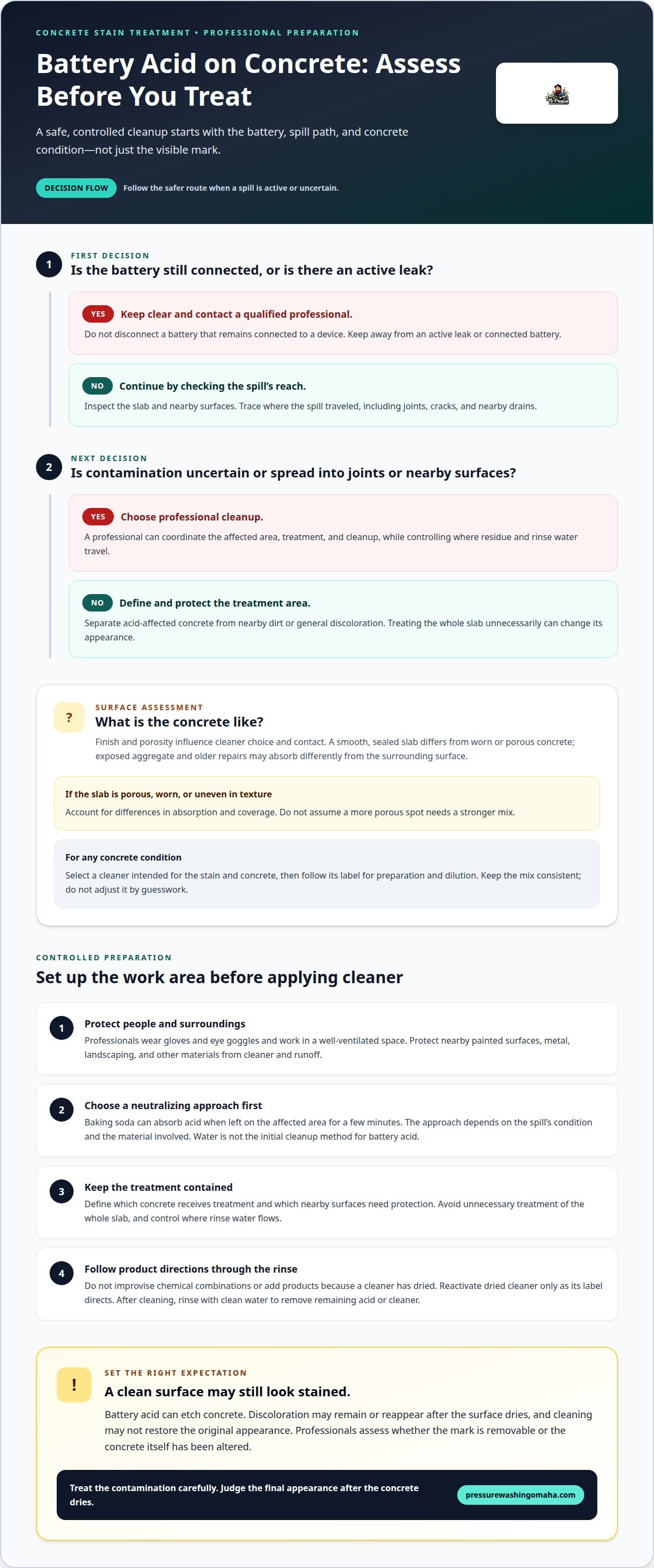
- Inspect the battery, slab, and nearby surfaces before setting up. If the battery remains connected to a device, keep clear of it and contact a qualified professional; do not disconnect it yourself. Note the spill’s path, including joints, cracks, and nearby drains. These details help professionals define the affected area instead of treating only the most visible mark.
- Establish a controlled work area around the concrete. Professionals wear gloves and eye goggles, and work in a well-ventilated space. They protect nearby materials from cleaner and runoff, especially where painted surfaces, metal, or landscaping could be affected. Keeping the work contained helps prevent residue from traveling beyond the original spill.
- Assess the concrete’s finish and condition before choosing a product. A smooth, sealed slab differs from worn or porous concrete, and a visible mark may include surface damage. Professionals use these observations to select a cleaner suited to the material and follow its label for preparation and dilution.
- Choose a neutralizing approach before applying a stain cleaner. Baking soda can absorb acid when left on the affected area for a few minutes. Professionals determine how to handle the spill based on its condition and the material involved. Water is not used as the initial cleanup method for battery acid.
- Prepare the surrounding area as carefully as the stain itself. A professional distinguishes acid-affected concrete from nearby dirt or general discoloration. Treating the whole slab unnecessarily can change its appearance, while ignoring adjacent residue may leave an uneven result. The preparation plan defines which concrete receives treatment and which surfaces need protection.
- Reactivate dried cleaner only as its label directs. Professionals don’t improvise chemical combinations or add products simply because the first application has dried. Once cleaning is complete, they rinse the concrete with clean water to remove remaining acid or cleaner, while controlling where the rinse flows.
- Choose professional cleanup for an active leak, uncertain contamination, or a spill extending into joints and nearby surfaces. Keep clear of an active leak or connected battery, and contact a qualified professional. A homeowner may overlook runoff or use a product unsuited to the slab. Professionals coordinate preparation, treatment, and cleanup as one job. They also distinguish a removable surface mark from concrete altered by acid, preventing unnecessary repeat applications.
How professionals brush and rinse battery acid stains on concrete
Professionals coordinate brushing and rinsing with the cleaner’s label directions. A consistent pattern helps keep treatment controlled across the marked area.
- Confirm the cleaner’s stated contact period before starting the brush work. Professionals organize the sequence so brushing begins at the appropriate stage, rather than letting one portion sit longer than another. This keeps the treatment consistent across the stain.
- Work in small, manageable sections instead of scrubbing the entire area at once. Complete one section before moving to the next, keeping each pass within the product-treated boundary. This method helps prevent missed patches and uneven brush coverage.
- Brush from the outside edge toward the center of the mark. Use steady, overlapping strokes, and keep the brush head in contact with the concrete. A controlled pattern gathers the work inward rather than pushing loosened material across a wider area.
- Maintain even pressure as the brush moves across the surface. Professionals avoid sudden forceful strokes that can scatter treatment or leave inconsistent marks. If the concrete texture changes within the stain, they adapt the stroke to follow the surface instead of forcing the same motion everywhere.
- Rinse each completed section in a deliberate sequence. Professionals direct clean water across the treated zone without sweeping it back over sections already finished. The rinse follows the brush path, helping clear the area in an orderly way.
- Use the cleaner’s directions to guide how much rinsing the surface needs. Professionals look for visible suds or product film and continue rinsing where these remain. They avoid adding another cleaner during this stage, keeping the treatment sequence straightforward.
- Pay attention to joints, edges, and changes in slab height during rinsing. These features can redirect water away from the intended work area. Professionals adjust the rinse path so water doesn’t cross untreated concrete or leave a strip untouched beside the stain.
- Finish with a final visual pass over the treated zone and its boundary. Check for missed brush tracks, visible cleaner film, or spots that did not receive an even rinse. This quality check catches uneven coverage before the work area is cleared.
How concrete porosity affects professional cleaner dilution
- Assess how quickly the concrete absorbs moisture before choosing a dilution. A porous, unsealed slab draws liquid into its surface faster than dense, finished concrete. That difference affects cleaner contact and coverage, but it doesn’t justify changing the product ratio beyond its label.
- Identify surface conditions that can change absorption. Worn patches, exposed aggregate, and older repairs may absorb cleaner differently from surrounding concrete. For example, a rough spot beside a smoother garage floor can dry unevenly. Professionals account for those changes before treating the stained area.
- Read the cleaner label and follow its dilution directions. Product strength is not adjusted by guesswork or by assuming more porous concrete needs a stronger mix. The label sets the permitted preparation and use. Professionals select a product intended for the stain and concrete, then keep the mix consistent.
- Test the selected cleaner on a discreet section of similar concrete. A small test helps show whether the surface absorbs the solution quickly or holds it at the top. Professionals observe the test area before treating the full stain, especially where a slab has mixed finishes or repairs.
- Apply the diluted cleaner evenly across the affected surface. Porous concrete can draw liquid down before it has worked across the stain, while dense concrete may keep more solution on top. Professionals control coverage and contact according to the label, rather than pouring extra cleaner into absorbent areas.
- Monitor how the surface responds during treatment. Uneven drying, rapid absorption, or cleaner pooling can signal differences in the concrete, not a reason to improvise a stronger dilution. Professionals adjust application technique within the product directions to maintain consistent contact across the stain.
- Keep the cleaner’s dilution separate from the stain’s severity. A deeper-looking mark may reflect acid etching rather than residue that needs a stronger chemical. More concentrated cleaner can affect the concrete without repairing an etched surface. Assessment helps distinguish the stain from physical surface damage.
- Rinse and evaluate after the product’s label-directed treatment. Porosity affects how cleaner reaches the surface, so residue may remain in rough texture if rinsing is incomplete. Professional concrete cleaning methods account for the slab’s finish and absorption, then assess the dry surface before deciding whether further treatment is appropriate.
How professionals handle and dispose of contaminated cleanup materials
Professionals wear gloves and eye protection and work in a well-ventilated area. These precautions help limit contact with acid and exposure to fumes.
- Identify every item that contacted the battery acid. This can include absorbent material, disposable tools, and debris removed from the concrete. Keep these items separate from clean supplies so residue doesn’t transfer to other surfaces.
- Collect contaminated solids carefully after treatment. Professionals avoid shaking, sweeping, or scattering absorbent material, which can spread residue beyond the work area. They gather it in a controlled manner and keep it apart from ordinary cleanup supplies.
- Separate reusable equipment from disposable cleanup materials. A brush or other tool that contacted the spill needs careful handling before reuse. Professionals keep it in the work area until it can be cleaned safely, rather than placing it among clean tools.
- Contain collected materials in a suitable, closed container. The container keeps residue from escaping during temporary storage and handling. Professionals label or otherwise identify its contents clearly, preventing confusion with uncontaminated waste.
- Manage rinse water as part of the cleanup, not as harmless leftover water. It may carry acid, cleaner, or loosened residue from the slab. Professionals control where it flows and keep it from spreading across nearby concrete or into the work area.
- Keep contaminated materials separate until they can be disposed of properly and safely. The appropriate handling depends on what contacted the acid and cleaner. Professionals account for absorbents, debris, and rinse water individually instead of combining everything without consideration.
- Follow the product label and applicable local waste-handling instructions for disposal. A cleaner’s directions can affect how its residue should be managed. Professionals use those instructions alongside the material involved, rather than assuming every cleanup item belongs in regular household waste.
- Check the work area and equipment after collection. Look for stray absorbent, splashes, or residue on tools before removing protective gear. This final pass helps prevent contamination from being carried onto a clean floor, vehicle, or storage surface.
Removing battery acid stains from concrete
Effective battery acid stain on concrete removal starts with identifying the mark and assessing the slab. The treatment needs to suit both the stain and the concrete’s condition.
-
Identify the Battery Acid Stain
Check the stain’s location against nearby battery equipment and look for white discoloration or a visibly changed surface. Those clues can point to acid exposure, but appearance alone can’t show how deeply the concrete is affected. Avoid applying a stronger cleaner to an unknown mark; other residues can resemble acid damage and need a different treatment.
-
How professionals remove battery acid stains from concrete
Have the stain and concrete assessed before choosing a treatment. For sulfuric acid spills, cleanup involves neutralizing the acid and cleaning the surface. A rust remover intended for battery acid stains may be used according to its label. The concrete’s finish and porosity, along with product directions, determine how to apply and dilute a cleaner. A stronger mixture is not necessarily more effective.
Let the surface dry before judging the result. A remaining mark may be etching rather than removable residue, so repeating cleaner applications may not help. Battery acid stain on concrete removal should account for the slab’s condition, not just its appearance while wet.
-
Assess Concrete Damage or Etching
After the concrete dries, look for a roughened or visibly changed patch. Battery acid may leave changes in concrete that ordinary cleaning does not remove. White discoloration may also return as the slab dries, so a wet surface is not a reliable measure of success. Distinguish residue from surface damage before deciding whether further treatment is appropriate.
If etching is present, the mark may remain unless the floor receives a coating. Grinding or resurfacing can alter the surface and affect the surrounding finish. Treating etching as an ordinary stain can lead to repeated chemical applications without restoring the changed concrete.
- Prevent another spill. Keep batteries upright and secure, and place them where leaks won’t reach bare concrete. Inspect the battery and nearby area during routine maintenance. If a leak occurs, arrange safe cleanup promptly rather than leaving residue on the slab. Prevention protects the surface but cannot undo existing etching.
Battery-acid spills should be assessed and handled by qualified professionals, especially when a spill is active or its extent is uncertain. Baking soda, gloves, and eye protection should not be treated as sufficient cleanup guidance. A visible mark does not show whether acid remains or how deeply the concrete is affected. Have the slab assessed after it dries before deciding on further treatment.
Reports about concrete damage reinforce the difference between residue and etching. A forum participant said battery acid can etch concrete. A homeowner reported that white discoloration returned after the concrete dried, and another forum participant said a battery-acid mark may remain unless the floor is covered with a coating. These reports support assessing the dry slab rather than judging only the wet, treated area. Consider a coating only after the surface condition has been assessed.
No Pressure Power Washing: Concrete Cleaning
No Pressure Power Washing provides concrete cleaning for property owners dealing with grime around a battery-stained area. It’s a practical next step after spill cleanup when the surrounding slab also needs attention.
Cleaning and repairing etched concrete are different tasks. A professional can clean grime from the slab, but cleaning cannot replace concrete removed or altered by acid. Set a practical goal: improve the surface’s cleanliness without expecting an etched mark to disappear.
Consider the wider area, not just the battery spot. Soil on a garage entrance, walkway, or patio can make one treated patch stand out. Cleaning the surrounding concrete can address the broader appearance issue, with the work tailored to the surfaces and their condition.
No Pressure Power Washing uses soft-washing methods and biodegradable, non-toxic cleaning agents for its exterior cleaning services. The appropriate approach depends on the surface being cleaned and its condition. For a driveway with general grime around a spill area, driveway cleaning may address the broader surface-cleaning need.
Before the work, explain where the battery leaked and what cleanup has already taken place. Say whether the mark is on a garage floor, outdoor walkway, or driveway. These details help define the cleaning area and clarify whether the goal is surface cleaning, not concrete repair.
Concrete cleaning is worth considering when the slab needs attention beyond the isolated mark. If etching caused the remaining discoloration, distinguish that from general cleaning. Clear expectations keep the work focused on the surface and the result you want.
Contact No Pressure Power Washing to discuss cleaning the affected concrete.
Frequently Asked Questions
How do professionals neutralize battery acid on concrete safely?
Qualified professionals assess the spill and handle neutralization and cleanup using appropriate materials and procedures. They manage residue and rinse water, wear gloves and eye protection, work in a ventilated area, and treat an active leak differently from a dried mark. The right approach depends on the spill and the product directions.
What does professional battery acid stain removal from concrete involve?
Professional treatment involves assessing the spill, neutralizing the acid, choosing a suitable cleaner, and treating the affected surface. For example, a mark beside a garage joint calls for attention to where liquid may have traveled. After cleaning, professionals assess the dry concrete for discoloration or etching. Battery acid stain removal from concrete depends on the slab’s condition, not just the visible size of the mark.
Which household cleaners, if any, are suitable for professional battery acid stain removal from concrete?
Household products aren’t interchangeable with cleaners made for battery-acid marks on concrete. Neutralization and cleanup should be handled by qualified professionals, not with baking soda, baking-soda paste, or household cleaners as DIY treatments. Professionals choose a cleaner suited to the stain and surface, then follow its label.
Can professionals use baking soda to remove battery acid stains from concrete?
Qualified professionals determine the appropriate method for neutralizing and cleaning battery acid; baking soda is not a DIY treatment recommendation. Neutralizing acid does not guarantee stain removal. If a pale mark remains after the concrete dries, it may be etching rather than leftover acid. Professionals distinguish residue from physical damage before choosing a treatment.
How do professionals dispose of battery acid cleanup materials safely?
Professionals keep contaminated absorbents, debris, tools, and rinse water separate from clean materials. Disposal depends on what contacted the acid and any cleaner used, so follow product directions and applicable waste-handling instructions. For a spill beside a garage drain, account for collected runoff as well as solid cleanup materials. Don’t casually mix contaminated items with ordinary waste or clean supplies.
Cost to remove battery acid stains from concrete professionally
The cost of professional service depends on the affected area, concrete condition, access, and whether the mark is residue or etching. A small surface stain and a larger damaged patch require different assessments and work. No Pressure Power Washing provides a free, no-obligation estimate for its services. The estimate is based on the specific concrete-cleaning needs, rather than assuming every battery-acid mark requires the same treatment.
What local disposal rules apply to professionals handling battery acid and contaminated cleanup materials?
Disposal requirements depend on the materials involved and local rules. Professionals determine the appropriate handling process for contaminated solids, cleaner residue, and rinse water rather than treating them as identical waste. This matters for work in Omaha, Papillion, Elkhorn, Gretna, Bennington, Bellevue, Valley, and Wahoo. The cleanup process should account for both the location and the materials.
Best commercial concrete cleaner for battery acid stains
Have a qualified professional select a cleaner suited to the concrete and stain, and follow the product label for preparation and dilution.


