

Your driveway isn't just a solid slab of rock; it's a porous sponge that actively absorbs every oil leak, rust drip, and organic spore it encounters. Most homeowners assume that a high-pressure blast is the only way to fix these eyesores, but that aggressive approach often does more harm than good. If you've ever worried about etching or leaving permanent scars on your walkways, your instincts are actually correct. Using the wrong equipment can strip the finished cream coat right off the surface, turning a simple cleaning project into an expensive repair.
We understand the frustration of looking at slippery mold or deep-set stains that just won't budge. This guide explains the professional science behind concrete cleaning services and why a chemical-first approach is safer and more effective than raw pressure. You'll learn how to achieve a deep restoration that protects your investment and keeps your home safe for kids and pets. We're going to dive into the specialized surfactants that lift grime from deep within the pores and the preservation techniques that keep those surfaces looking fresh for years to come.
Key Takeaways
- Understand why professional concrete cleaning services prioritize chemical emulsification over raw pressure to lift deep-seated contaminants safely.
- Learn how to identify the risks of surface etching and permanent scarring often caused by improper DIY equipment usage.
- Discover the specific treatments needed to neutralize rust and emulsify oil stains that standard power washing cannot reach.
- Identify which sealing methods best suit the Nebraska climate to close concrete pores and prevent future biological growth.
The Science of Concrete Deterioration: Why Surfaces Get Ugly
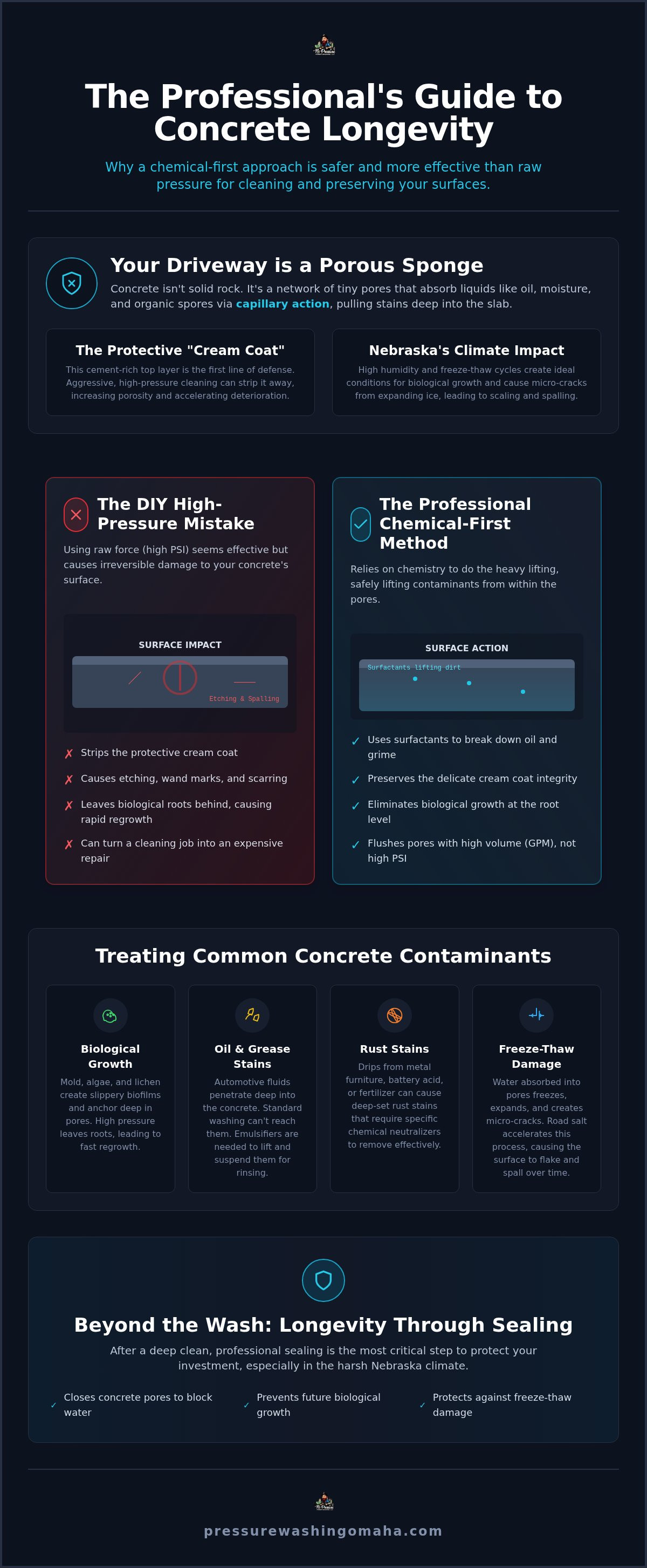
Concrete isn't the impenetrable barrier it appears to be. Under a microscope, your driveway or walkway is a complex network of tiny pores and interconnected capillaries. This sponge-like structure is constantly pulling liquids deep into the slab through a process called capillary action. When oil, tannins from fallen leaves, or moisture sit on the surface, they don't just stay there. They migrate into the core of the material. This is why professional concrete cleaning services involve more than just a quick rinse; we have to address the contaminants that have moved beyond the surface level.
The smooth finish you see on new concrete is known as the cream coat. This cement-rich top layer acts as the first line of defense for the heavier aggregate underneath. Once this layer is compromised by neglect or aggressive cleaning, the concrete becomes even more porous and susceptible to deep staining. In the Omaha area, our environment is particularly hard on these surfaces. High humidity and heavy shade create the perfect conditions for organic materials to take root and thrive within these microscopic voids.
Biological Growth: Mold, Algae, and Lichen
In the humid summers of Nebraska, shaded areas become breeding grounds for biological colonies. You've likely seen the black streaks or green velvet-like patches on north-facing concrete. This is often Gloeocapsa Magma, a hardy cyanobacteria, along with various molds and lichens. These organisms aren't just sitting on top; they're feeding on the minerals within the concrete. Their root systems, or hyphae, anchor themselves deep inside the pores. Simply using a high-pressure water spray might clear the visible growth, but it often leaves the roots behind, leading to rapid regrowth. Beyond the aesthetics, these colonies create a biofilm that becomes incredibly slippery when wet, posing a significant liability for homeowners and businesses alike.
Nebraska Climate Impact: Freeze-Thaw and Road Salts
Our local weather presents a unique challenge for surface preservation. Omaha’s freeze-thaw cycles are brutal on untreated concrete. When moisture is trapped within those capillaries and the temperature drops, the water expands. This internal pressure creates micro-cracks that eventually lead to scaling and spalling, where the top layer of the concrete flakes away. This damage is often accelerated by the road salts we use in winter. These salts are hygroscopic, meaning they attract even more water into the slab and can cause chemical reactions that weaken the concrete matrix. If your concrete looks drab or gray, it's often a sign that the protective cream coat is beginning to fail. Preserving this layer is the primary goal of our concrete cleaning services, as once the aggregate is exposed, the rate of deterioration increases exponentially.
Professional Cleaning Methodology: Chemistry vs. Raw Pressure
Effective concrete cleaning services aren't built on brute force. While a novice might reach for the highest PSI possible, professionals understand that excessive pressure is the enemy of structural integrity. We utilize a "No Pressure" philosophy that relies on chemistry to do the heavy lifting. This approach treats the concrete with the respect it deserves, ensuring we remove the grime without compromising the delicate cream coat of the slab. When you rely on science instead of high-pressure impact, you get a deeper clean that lasts longer.
The secret lies in the sophisticated use of surfactants and emulsifiers. Surfactants are agents that reduce water surface tension to lift deep-seated oils. When applied, these solutions penetrate the pores we discussed previously, surrounding oil and dirt molecules to break their physical bond with the concrete. Emulsifiers then hold these particles in suspension, allowing them to be rinsed away easily. This process requires "dwell time," which is a calculated period where the solution remains active on the surface. If a cleaner is rinsed too quickly, it never has the chance to reach the contaminants buried deep in the capillary structure. If you have questions about how these methods apply to your specific project, you can consult with a local specialist to find the best approach.
Water volume, measured in Gallons Per Minute (GPM), is far more important for a successful restoration than raw pressure (PSI). High GPM provides the necessary flow to flush out the pores, carrying away the suspended debris that the chemistry has loosened. Temperature control also plays a vital role. Warm water increases the kinetic energy of the cleaning molecules, making them significantly more efficient at breaking down stubborn grease and automotive fluids that have baked into the surface over time.
Eco-Friendly Surfactants and Biodegradable Agents
We prioritize the health of our local Omaha ecosystem by using biodegradable, non-toxic agents. Professional-grade degreasers are vastly different from the "all-purpose" jugs found at big-box hardware stores. Those retail products often contain harsh solvents that can damage nearby landscaping or pose risks to pets. Our specialized solutions are EPA-compliant and engineered to be aggressive on stains but gentle on the environment. They break down into harmless components shortly after application, providing peace of mind for families and neighbors.
The Role of Professional Surface Cleaners
The equipment used is just as critical as the chemistry. Using a standard handheld wand often results in "zebra stripes," which are uneven clean lines caused by the varying distance of the nozzle from the ground. Professional concrete cleaning services employ rotary surface cleaners. These tools feature multiple spinning nozzles housed under a circular deck, ensuring a perfectly consistent distance and pressure distribution. This prevents the "wand marks" that can permanently scar a driveway. Additionally, these units help manage wastewater and runoff more effectively, keeping the cleaning process tidy and controlled.
The Dangers of DIY Power Washing: Protecting Your Investment
Many homeowners view a weekend equipment rental as a cost-saving measure, but without the right training, a high-pressure wand becomes a destructive tool rather than a cleaning one. Concrete may feel like an indestructible slab of rock, but the surface is surprisingly fragile. When a high-pressure stream hits the slab at a close range, it can actually carve into the surface. This creates permanent "wand marks" or "zebra stripes" that no amount of scrubbing can fix. You aren't just removing dirt at that point; you're physically "writing" into the stone with water.
Beyond property damage, the safety risks of consumer-grade power washing are significant. A standard machine can produce enough force to cause severe skin lacerations or even "injection injuries," where water is forced deep into the tissue. This risk extends to your home's exterior as well. An unsteady hand can easily shatter a nearby window or strip the paint off your siding. When you consider these risks, the cost of professional driveway cleaning is significantly lower than the price of a full driveway replacement or an emergency room visit.
The "Cream Coat" and Aggregate Exposure
The thin, smooth top layer of your slab is known as the "cream coat." This cement-rich finish is essential because it seals the heavier aggregate rocks underneath and provides a uniform appearance. If you use excessive pressure, you strip this layer away. This leads to a "sandy" surface that feels gritty underfoot and looks mottled as the internal rocks become exposed. Once the cream coat is gone, the structural integrity is compromised. The concrete becomes even more porous, allowing moisture to penetrate deeper and accelerating the freeze-thaw damage we see during Omaha winters.
When to Hire a Professional vs. Attempting DIY
Assessing the severity of the situation is the first step in protecting your property. If your driveway has deep-set oil stains, rust from irrigation systems, or thick biological growth, DIY methods will likely fail. Consumer machines lack the heat and chemical delivery systems required to emulsify these contaminants. Furthermore, concrete cleaning services must account for local environmental regulations. In many areas, including Omaha, it's illegal to allow wash water containing oils or detergents to enter the storm drain system. Professionals use recovery systems and biodegradable agents to ensure compliance with EPA standards. If your project involves working near delicate landscaping or expensive siding, the specialized soft-wash techniques used by experts are the only way to ensure a safe, thorough result without the risk of collateral damage.
Identifying and Treating Common Concrete Contaminants
Restoring a surface requires more than just a general detergent. To provide effective concrete cleaning services, we have to diagnose the specific chemistry of each stain. A treatment that works for organic growth will likely do nothing for an oil leak or a rust spot. Identifying these contaminants early prevents them from becoming permanent fixtures in your slab's capillary structure. Each type of blemish requires a unique approach to ensure the concrete returns to its original state without suffering damage from improper chemical use.
- Oil and Grease: These are hydrophobic, meaning they repel water and cling to the concrete pores. We use specialized emulsifiers during driveway cleaning to surround the oil molecules and lift them to the surface.
- Rust Stains: Iron oxide doesn't just sit on top; it bonds with the concrete matrix. We use acid-based cleaners to neutralize the rust, essentially "unlocking" the stain so it can be safely rinsed away.
- Tannins and Organic Stains: In local areas like Elkhorn and Papillion, fallen leaves and acorns often create "leaf tea." These organic dyes sink deep into the pores, leaving dark brown or yellowish silhouettes that require specific oxygen-based boosters to clear.
- Efflorescence: This is a white, powdery salt deposit that migrates to the surface as moisture evaporates. It’s a sign of salt movement within the slab and needs to be treated to prevent further scaling.
Hard Water and Fertilizer Stains
Many Omaha irrigation systems pull water with high iron content, leading to unsightly orange streaks along walkways. Similarly, stray fertilizer pellets can cause small, concentrated orange spots or even "pitting" where the chemicals react with the concrete finish. We use professional-grade neutralizers to restore the original pH and color of the slab. These solutions are much more effective than consumer products because they are designed to target the mineral bond without eating away at the cement cream coat.
Graffiti and Industrial Grime
Commercial surfaces face unique challenges, particularly when it comes to graffiti removal. Spray paint is designed to be permanent, and removing it without leaving a "ghost image" or shadow requires precision. We use specialized solvents that soften the paint layers without driving the pigment deeper into the stone. For larger facilities, our commercial property maintenance techniques handle the heavy accumulation of industrial soot and rubber marks that standard cleaning methods can't touch.
Beyond the Wash: Longevity Through Sealing and Maintenance
Restoring your concrete to its original luster is a rewarding process, but professional concrete cleaning services are only half of the preservation equation. Once we've successfully flushed out the contaminants and biological growth, the concrete’s capillary structure remains open and vulnerable. Think of it like washing your face with a deep cleanser; if you don't follow up with a protectant, the pores will quickly fill back up with dirt and oils. Sealing is the critical second step that locks out moisture and ensures your investment stays protected for the long term.
In our Nebraska climate, choosing the right sealer is essential. You'll generally choose between penetrating sealers and topical coatings. Topical coatings sit on the surface like a layer of plastic, which can be beautiful for decorative concrete but often struggles with the moisture vapor that naturally moves through a slab. In Omaha, where we experience extreme temperature swings, these films can peel or turn cloudy. Penetrating sealers are often the superior choice for driveways and walkways. They dive deep into the pores to create a hydrophobic barrier that doesn't change the appearance of the stone but prevents water from entering the slab entirely.
This protection is your best defense against the freeze-thaw damage we analyzed in the first section of this guide. When water can't get into the concrete, it can't expand and cause the micro-cracking that leads to spalling. By closing off those microscopic entry points, you're effectively stopping the cycle of deterioration before it begins next winter.
The Benefits of Professional Concrete Sealing
A high-quality seal provides several layers of protection beyond just moisture control. First, it creates a surface that is much easier to maintain. Because oil and automotive fluids can't penetrate the sealed pores, they sit on the surface where they can be easily wiped away. Second, sealing provides critical UV protection. This is particularly important for stamped or colored concrete, as it prevents the "whitening" or fading caused by constant sun exposure. Finally, a sealed surface inhibits the growth of mold and algae by removing the damp environment these organisms need to survive.
Seasonal Maintenance Checklist for Omaha Homeowners
Maintaining your concrete between professional visits doesn't have to be a chore. A few proactive steps each season can significantly extend the life of your seal. In the spring, take time to inspect your surfaces for any signs of winter salt damage or new organic growth in shaded areas. In the fall, be diligent about removing leaves and acorns promptly. As we discussed in the previous section, these organics can leave deep tannin stains if they're allowed to sit and rot on the slab. For a more detailed schedule on keeping your entire exterior in top shape, refer to our Professional Pressure Washing in Omaha Guide. Consistent care, combined with periodic concrete cleaning services, ensures your property remains safe, beautiful, and durable for decades.
Protecting Your Property's Foundation for Years to Come
Your concrete is more than just a functional surface; it's a significant investment in your property's curb appeal and structural health. We've explored how the porous nature of stone requires a careful balance of chemical emulsification and precision equipment to avoid the permanent scarring caused by high-pressure DIY attempts. By choosing professional concrete cleaning services, you ensure that every oil stain and organic spore is addressed at the root while the delicate finish of your slab remains intact.
With over 30 years of local experience in the Omaha area, we take pride in being a locally owned and fully insured partner for your home maintenance. Our team uses biodegradable, eco-friendly solutions that are safe for your family and pets. We don't just wash away dirt; we provide the deep restoration and sealing necessary to withstand our harsh Nebraska winters. Investing in the right care today prevents the expensive repairs of tomorrow.
Take the first step toward a cleaner, safer, and more durable property today. We look forward to helping you restore and preserve the surfaces that welcome you home every day.
Frequently Asked Questions
Is professional concrete cleaning worth the cost?
Professional concrete cleaning services are an investment in preventative maintenance that far outweighs the high cost of slab replacement. By removing corrosive contaminants and biological growth, we preserve the structural integrity of the cream coat. This prevents the micro-cracking and spalling that typically lead to a total driveway failure. While DIY rentals might save money upfront, the risk of permanent surface etching often results in a net loss for the property owner.
Will pressure washing my driveway damage my lawn or plants?
Your landscaping will remain safe as long as the technician follows professional pre-soak and post-rinse protocols. We use biodegradable, non-toxic cleaning solutions specifically chosen to be gentle on Omaha lawns and garden beds. By saturating nearby plants with fresh water before and after the application, we ensure that any runoff is sufficiently diluted. This protective approach allows us to achieve a deep clean without compromising your home's greenery.
Can you remove old oil stains that have been there for years?
We can often remove or significantly lighten old oil stains, though total restoration depends on how deep the oil has traveled into the concrete's capillary structure. Our process uses professional emulsifiers to break the molecular bond between the oil and the stone. While we can't always guarantee 100% removal for stains that have sat for decades, our methods are vastly more effective than standard household degreasers or cold-water pressure.
How often should I have my concrete professionally cleaned in Omaha?
Most Omaha homeowners find that a professional cleaning every 18 to 24 months is ideal for managing our local environmental challenges. Our region’s high humidity and intense freeze-thaw cycles accelerate the buildup of mold and the penetration of road salts. Regular maintenance prevents these factors from causing permanent structural damage. If your property has heavy tree cover or high vehicle traffic, you might benefit from an annual touch-up to maintain curb appeal.
What is the difference between power washing and pressure washing for concrete?
The primary difference is the use of heated water. Power washing utilizes a heating element to reach high temperatures, which is essential for melting away grease and automotive fluids. Pressure washing relies solely on the mechanical force of the water. For most residential concrete cleaning services, we use a combination of temperature control and specialized chemistry to lift stains without needing to use dangerous levels of raw pressure.
How long does it take for a driveway to dry after a professional cleaning?
Your driveway will typically be dry enough for foot traffic within 1 to 3 hours, depending on Omaha's humidity levels and sun exposure. However, we recommend waiting at least 24 hours before parking vehicles back on the surface. This ensures the concrete is completely dry throughout its porous structure. If we have applied a penetrating sealer, the cure time may vary, and your technician will provide specific instructions for that application.
Can concrete cleaning remove rust stains from fertilizer or metal furniture?
Yes, rust stains from fertilizer pellets or metal patio furniture can be removed using specialized acid-based neutralizers. These stains are actually a chemical bond of iron oxide within the concrete pores, so they won't budge with standard soap and water. We apply a targeted solution that breaks this chemical bond, allowing the orange discoloration to be rinsed away safely. This process restores the slab's original pH balance and appearance.
Do I need to be home when the concrete cleaning service is performed?
You don't need to be home for the service as long as we have access to a functioning exterior water spigot. We ask that you ensure all vehicles are moved from the work area and that pets remain safely indoors. Our team will perform a thorough walk-through before and after the job. We can communicate via phone or email to provide updates and confirm the completion of your surface restoration.


