

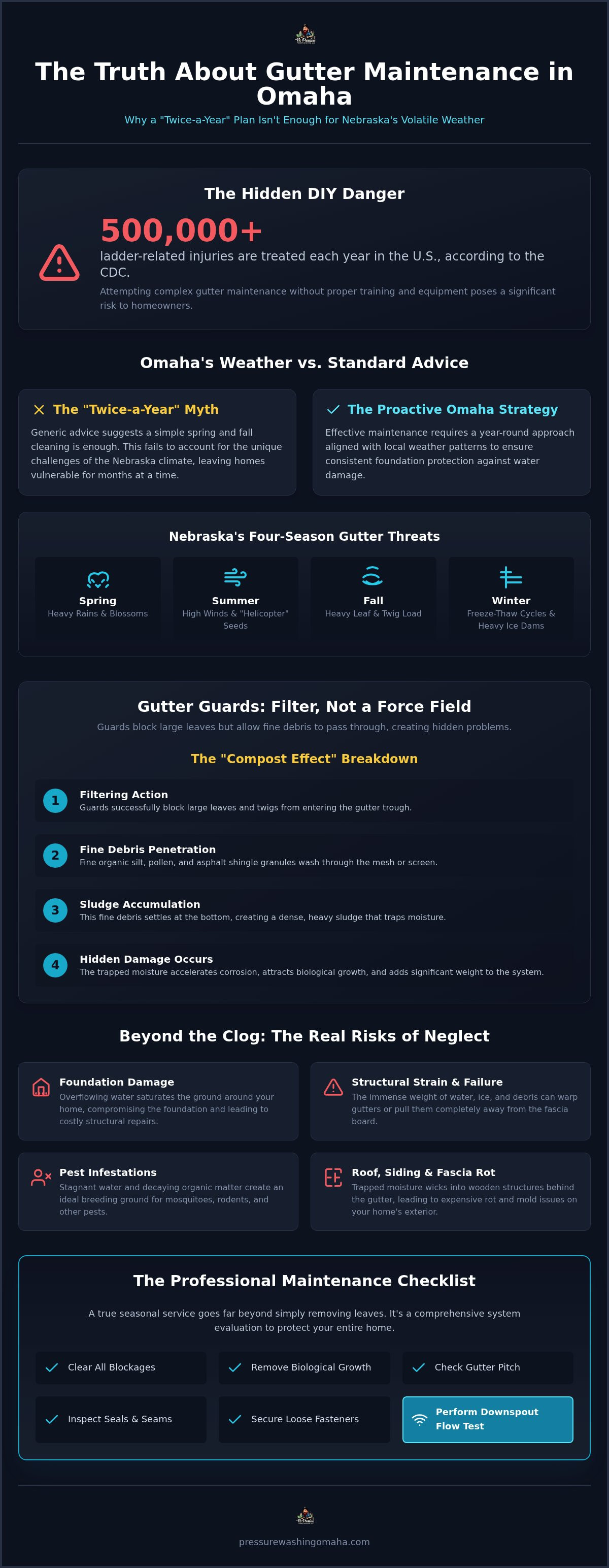
Did you know that the Centers for Disease Control and Prevention reports over 500,000 people are treated for ladder-related injuries every year in the United States? For many Omaha homeowners, the annual ritual of climbing a shaky extension ladder feels like a necessary chore to keep the home safe. We often assume that basic seasonal gutter maintenance is just about clearing out a few handfuls of leaves before the heavy Nebraska spring rains arrive. It's natural to feel that a quick DIY sweep is sufficient, especially if you've already invested in gutter guards that promised to solve the problem for good.
We understand the desire to protect your investment while staying safe on the ground. This article will reveal the truth behind common gutter myths and explain how a professional seasonal maintenance strategy protects your Omaha home from foundation failure. You'll discover why "set it and forget it" solutions often fail in our specific climate and how a thorough, expert assessment of both mechanical blockages and biological growth ensures your property remains a secure sanctuary for your family.
Key Takeaways
- Discover why Omaha’s volatile weather requires a more proactive approach than the standard twice-a-year rule for seasonal gutter maintenance.
- Uncover the reality of the "compost effect" where fine debris breaks down inside gutter guards and creates hidden, heavy blockages.
- Learn how standing water acts as a breeding ground for biological growth that can quickly spread from your gutters to your home's exterior surfaces.
- Recognize the safety risks associated with residential ladder falls and the potential for high-pressure water to damage delicate gutter seals and roofing.
- Find out why a professional downspout flow test is the most effective way to ensure your home’s foundation remains protected from water damage.
The "Twice-a-Year" Myth: Why Omaha Weather Demands a Proactive Schedule
Many national home improvement blogs suggest cleaning your gutters every spring and fall, but this generic advice doesn't account for the unique volatility of the Nebraska climate. True seasonal gutter maintenance is a comprehensive system evaluation rather than a simple debris removal task. It involves checking the pitch of the troughs, ensuring downspouts are clear, and verifying that the entire drainage system is structurally sound. Relying on a rigid twice-a-year schedule often leaves Omaha homes vulnerable during the gap months when severe weather strikes without warning.
Effective maintenance requires a proactive approach that aligns with our local weather patterns. Each season brings a different threat to your home's exterior. Spring brings heavy rains and blossoms, while summer introduces violent wind events and heavy thunderstorms. Fall delivers the obvious leaf load, but winter presents the most structural risk through ice accumulation. By staying ahead of these cycles, you ensure consistent Omaha foundation protection, keeping water away from your basement and crawlspace.
Nebraska’s Freeze-Thaw Cycle: The Hidden Gutter Killer
Omaha is famous for rapid temperature swings that can see a forty-degree drop in a single afternoon. These shifts cause metal gutters to expand and contract rapidly, which puts immense stress on the mounting brackets and seals. Clogged gutters can also lead to stagnant water that remains trapped as the temperature plummets. This water turns into heavy ice, creating a massive weight load that can warp the trough or pull the gutter completely away from the fascia board. Additionally, shingle grit from aging roofs often settles in the bottom of the channel, acting like sandpaper under the ice. Regular roof cleaning helps mitigate this by removing loose granules before they can accumulate and cause structural blockages.
Summer Storms and the Mid-Season Inspection
While most homeowners worry about autumn leaves, Omaha’s summer thunderstorms present a significant challenge. These storms often carry high winds that strip "helicopter" seeds from maple trees and snap small twigs that bypass most gutter guards. A mid-season inspection is vital to clear these obstructions before they become compacted by the heat. High winds also tend to loosen fasteners over time. A professional check ensures that every spike or screw is tight, preventing the system from sagging during the next heavy downpour. This level of attention to detail is what separates a basic cleaning from a true seasonal gutter maintenance strategy that preserves your home's value.
Myth vs. Reality: Do Gutter Guards Eliminate Maintenance?
Many homeowners believe that installing guards marks the end of their ladder-climbing days. It’s a common misconception fueled by aggressive marketing promises of a "maintenance-free" home. In reality, seasonal gutter maintenance remains a requirement because guards are filters, not force fields. They block large oak leaves but allow fine organic silt, pollen, and roof granules to pass through. Over time, this material settles at the bottom of the trough, creating a dense, nutrient-rich sludge. This "compost effect" traps moisture against the metal, accelerating corrosion and attracting biological growth that can eventually affect your house siding.
Guards actually increase the technicality of the job. While you might clean them less often, the process is more labor-intensive. A technician must often unscrew or unclip sections of the guard to reach the debris trapped underneath. If you attempt this yourself, you face significant risks. Following proper ladder safety for gutter cleaning is essential, but most homeowners find that managing heavy guard panels while balanced on a ladder is a recipe for an accident. It's often safer and more cost-effective to have a professional handle these complex systems.
The Silt and Sludge Problem
The most persistent enemy of a "protected" gutter is shingle grit. As asphalt shingles age, they shed small granules that wash into the gutters. These granules are too small for most mesh screens to stop. They sink to the bottom and mix with dust to form a heavy, cement-like sludge. This sludge is far more dangerous than dry leaves because it doesn't blow away and it completely blocks the flow to the downspouts. Regular roof cleaning can reduce the volume of granules entering your system, but the gutters still require periodic flushing to ensure the water has a clear path to the ground.
Hidden Damage: What You Can’t See Under the Screen
Gutter guards act as a mask for underlying structural issues. Because the trough is covered, you won't see the early signs of rust, small leaks at the seams, or brackets that have pulled away from the fascia. By the time you notice water overflowing, the damage to your fascia or foundation is already well underway. Professional technicians don't just look at the top of the guards; they inspect the integrity of the entire system. They also look for evidence of bird or pest nesting. The space beneath a gutter guard is a warm, dry, and protected environment that is highly attractive to wasps, mice, and even small birds. If you aren't sure what's hiding under your screens, a professional gutter inspection can provide the peace of mind you need before the next big storm.
Beyond the Clog: The Biological Risks of Standing Water
While a physical blockage is a mechanical problem, the resulting stagnant water creates a biological one. In the humid Nebraska summer, a gutter filled with decaying organic matter acts as a perfect incubator for mold and mildew. This isn't just an eyesore. It's a living colony that can compromise the health of your home. Effective seasonal gutter maintenance must address these biological threats to prevent long-term damage to your property's exterior and preserve its overall value.
We view your home's exterior as an interconnected system. When one part fails, the rest follows. By addressing the biological growth inside the troughs, we stop the spread of spores before they can colonize your roof or walls. This proactive care is what defines our role as a trusted guardian of your property.
Mold Spores and Your Home’s Exterior
Decaying leaves and twigs provide a nutrient-rich "starter kit" for algae and mold. Once these colonies establish themselves in the gutter, they don't stay there. Wind and water carry spores upward onto your soffits and fascia, eventually migrating to your house siding. This biological growth feeds on the organic dust and pollen that settle on your home. Simple high-pressure water is often ineffective because it only removes the surface layer of the mold. It leaves the roots or spores behind, allowing the colony to return within weeks. We utilize specialized soft-wash systems that apply non-toxic, biodegradable cleaning solutions to kill the spores at the source. This method is gentle on your home’s surfaces and safe for your surrounding Omaha landscaping.
Pest Management and Stagnant Water
Stagnant water is the primary breeding ground for Omaha’s mosquito population. Even a small amount of trapped water can support hundreds of larvae. According to the CDC, standing water and decaying organic matter attract pests that carry diseases like West Nile Virus. Beyond insects, neglected gutters offer a sheltered environment for wasps to build nests and for rodents to find bedding. These animals can chew through roof components or find their way into your attic. Ensuring your system is clear also means checking that downspouts direct water effectively toward concrete surfaces or drainage tiles. When water overflows due to biological blockages, it pools at the foundation, leading to the very structural failures we aim to prevent. Consistent care is the only way to ensure your home remains a sanctuary rather than a habitat for local pests.
The DIY Danger: Why Ladders and Pressure Washers Don’t Mix
Let's talk about the real cost of a DIY approach. While we've discussed the general risks of ladder work, it's vital to see how these dangers manifest during seasonal gutter maintenance. A fall doesn't just result in a minor bruise. It often leads to long-term physical impairment and overwhelming medical expenses. We often see neighbors trying to save a few hundred dollars by doing it themselves, only to realize too late it's a "false economy" when a single slip leads to a $10,000 hospital bill or worse. OSHA safety standards exist for a reason. They provide a framework for managing high-risk tasks that most homeowners aren't equipped to handle on their own.
Ladder Safety: A Serious Omaha Concern
Omaha's landscape presents specific challenges for ladder stability. Our local soil can be soft or uneven, especially after the heavy spring rains we experience in Nebraska. Setting up an extension ladder on shifting ground is inherently dangerous. When you're balanced twenty feet up and leaning over to reach a stubborn clog, your center of gravity shifts. This makes a tip-over much more likely. Professionals utilize specialized stabilizers and leveling equipment that aren't typically found in a home garage. We also never work solo. Having a second set of eyes on the ground is a basic safety requirement. Beyond physical safety, our professional insurance is a critical shield for you. It removes the homeowner’s liability if an accident occurs on your property, providing a layer of protection that DIY work simply can't offer.
Professional Soft-Wash vs. Consumer Pressure Washers
It's tempting to grab a consumer pressure washer to blast out debris, but this often causes more harm than good. High-pressure water can easily blow out delicate gutter seals or strip the protective granules off your shingles. Even more concerning is the risk of water intrusion. High pressure can force water upward, driving it behind your house siding or directly into attic vents. Once water gets into those spaces, you're looking at hidden rot and mold growth. Our specialized soft-wash system takes a different approach to seasonal gutter maintenance. We use low pressure combined with non-toxic, biodegradable solutions to sanitize the entire system. Instead of just "moving dirt," we kill the biological roots of algae and mildew. This gentle, methodical process is why we're known as a "trusted guardian" of your home’s exterior. Combining this with professional roof cleaning ensures that your entire drainage system remains functional without the structural risks associated with high-pressure cleaning.
The Professional Checklist: Protecting Your Omaha Foundation
Professional care is more than a bucket and a pair of gloves. When we perform seasonal gutter maintenance, we treat your home’s drainage as a critical engineering system. A professional visit is an audit of your home’s ability to withstand the next Nebraska deluge. We look for the subtle signs of failure that a quick DIY sweep misses, such as the slight misalignment of a hanger or a hairline crack in a seam that only leaks under pressure. This methodical approach is how we've protected local properties for over 30 years.
The cornerstone of our service is the downspout flow test. This isn't just a quick rinse. We simulate a high-volume rain event to ensure that water doesn't just enter the gutter, but exits the system exactly where it should. If water pools at the base of a downspout or leaks from a mid-pipe joint, your foundation is at risk. This test is the ultimate proof of success, giving you peace of mind that your basement will stay dry when the clouds turn green over Omaha.
The Multi-Point Inspection Process
Our team follows a methodical checklist developed through decades of local industry experience. We verify the pitch and slope of every trough. Even a half-inch of sag can cause water to back up, leading to the biological growth and structural weight issues we discussed in previous sections. We also inspect every seal, seam, and hanger to ensure the system remains firmly attached to your fascia boards. Finally, we look for early signs of foundation erosion. If we see soil displacement or splash marks on your siding, it's a clear signal the gutters are failing to direct water away from the home. This holistic view is part of a total property maintenance strategy designed to preserve your home’s long-term value.
Scheduling Your Seasonal Protection
Timing is everything in the Midwest. Our spring and fall schedules fill up quickly because proactive homeowners know that waiting until a clog is visible is often waiting too long. To provide the best value, many of our clients choose to bundle their gutter care with other specialized services like driveway cleaning. This ensures your entire exterior is sanitized and structurally sound in a single visit. We invite you to experience the security that comes with professional guardianship of your property. Don't leave your home’s safety to chance or a shaky ladder.
Securing Your Home’s Future with Professional Care
Your home is likely your most significant investment, and its defense starts at the roofline. We've explored how Omaha’s unique climate makes standard advice insufficient and why even the most advanced gutter guards can't replace a thorough system audit. By prioritizing seasonal gutter maintenance, you aren't just clearing debris. You're actively preventing foundation erosion and biological colonization on your siding. Trading the physical risks of ladder work for a methodical, expert approach ensures that your drainage system remains a reliable shield against the elements.
Our team of fully insured technicians brings over 30 years of local expertise to every property. We utilize eco-friendly, biodegradable solutions that protect your landscaping while ensuring your system operates at peak efficiency. It’s time to move past the myths and embrace the peace of mind that comes with professional guardianship. We look forward to helping you protect your Omaha home and preserve its value for years to come.
Frequently Asked Questions
How often do gutters really need to be cleaned in Omaha?
Most Omaha homes require service at least twice a year, though properties with heavy tree cover often need attention every three months to prevent overflow. Nebraska's climate introduces unique challenges like spring blossoms and heavy autumn leaves that can quickly overwhelm a drainage system. Regular inspections ensure that debris doesn't sit and rot, which helps prevent the biological growth that leads to fascia damage and attracts unwanted pests to your roofline.
Can I clean my gutters without a ladder?
While various ground-level "gutter vacuum" tools exist, they are often ineffective at removing the heavy, wet sludge that settles at the bottom of the troughs. These tools also cannot perform the necessary structural inspections of brackets, seals, and pitch. For a truly safe and thorough result, hiring a professional with the right safety equipment and insurance is the only way to ensure the job is done correctly without risking a dangerous fall.
Do gutter guards actually work in Nebraska winters?
Gutter guards can actually exacerbate ice damming during harsh Nebraska winters if they aren't maintained properly. While they block large debris, they often trap snow and ice on top of the mesh, which prevents meltwater from entering the gutter. This leads to heavy ice loads that can pull gutters away from the fascia. Professional seasonal gutter maintenance includes verifying that guards are clear of the fine silt that contributes to these winter blockages.
Will professional gutter cleaning damage my landscaping?
Professional gutter cleaning will not damage your landscaping when performed by experts using specialized soft-wash techniques. We utilize non-toxic, biodegradable solutions that are specifically designed to be safe for plants, pets, and children. Our team takes great care to pre-rinse your landscaping and uses gentle methods rather than high-pressure water. This approach ensures that your home’s exterior is sanitized without harming the delicate flowers or shrubs that surround your foundation.
What happens if I don’t clean my gutters for a year?
Neglecting your gutters for a full year allows organic debris to decompose into a heavy, acidic sludge that can corrode metal and rot wood fascia boards. The added weight of this material, combined with stagnant water, puts immense strain on your home’s structural fasteners and brackets. This neglect often leads to water overflowing directly into your foundation, which can cause costly cracks and basement moisture issues that are far more expensive to repair than routine care.
How do I know if my downspouts are clogged?
The most obvious sign of a clogged downspout is water overflowing from the top of the gutter trough during a rainstorm. You may also notice water leaking from the joints of the downspout or a visible lack of flow at the exit point on the ground. A professional downspout flow test is the most reliable way to confirm that the entire vertical run is clear of hidden obstructions like bird nests or compacted shingle grit.
Is soft-washing safe for all types of gutters?
Soft-washing is the safest method for all gutter materials, including aluminum, copper, and vinyl, because it uses low pressure to deliver cleaning agents. Unlike traditional high-pressure washing, which can blow out seals or damage the finish, soft-washing kills mold and algae at the root. This specialized seasonal gutter maintenance technique preserves the integrity of your drainage system while achieving a level of cleanliness that mechanical scrubbing or high-pressure blasting simply cannot match.
Does seasonal gutter maintenance prevent basement flooding?
Seasonal maintenance is one of the most effective ways to prevent basement flooding by ensuring water is moved away from your foundation. When gutters are clogged, water spills over the sides and pools directly against your foundation walls. Over time, this hydrostatic pressure forces moisture through tiny cracks in the concrete. By directing water through clear downspouts, you significantly reduce the risk of water intrusion and structural damage to your crawlspace or basement.


