

What if the safest first step in cleaning dirt dauber nests from eaves is to leave the scraper on the ground? Before disturbing a mud nest, check what it looks like and whether wasps are still coming and going. A small nest may seem simple to reach, but working overhead can turn a routine cleanup into a fall risk, and scraping or spraying can mark delicate trim or siding.
It’s reasonable to want the nest gone without provoking insects or damaging the exterior. Dirt daubers are generally solitary, but don’t assume every mud nest is empty or harmless to disturb. If you see insect activity, have a sting allergy, can’t reach the spot securely, or aren’t sure what you’re looking at, stop and get professional help.
This guide explains how to recognize common nest clues, assess the immediate risk, and approach cleanup cautiously when conditions are suitable. You’ll also learn when not to proceed and how gentle exterior cleaning, after nest activity is resolved, can help protect nearby eaves and trim. No cleaning method is a substitute for pest control or a guarantee against future nests.
Key Takeaways
- Learn to distinguish a mud dauber nest from loose mud, exterior stains, and cobwebs before deciding what to do.
- For cleaning dirt dauber nests from eaves, check for insect activity and safe access first; know when to stop rather than risk a sting or fall.
- Understand why removing nest material and cleaning the mark it leaves are separate steps, and why the surface affects the approach.
- Use ground-level visual checks to notice new mud deposits without making risky ladder inspections.
- See when careful exterior cleaning can address suitable eave surfaces after nest activity has ended, and when professional help is the safer choice.
Why Dirt Dauber Nests Appear Beneath Eaves, and How to Recognize Them
A mud-like lump under an eave may be more than ordinary dirt. It could be a nest attached to the soffit, fascia, or trim, where the sheltered underside gives mud-built structures a place to adhere. Before considering cleaning dirt dauber nests from eaves, identify what you can from the ground. Don’t touch, scrape, or climb up simply to get a closer look.
Dirt daubers are solitary wasps that build nests from mud. Depending on the species, a nest may look like several narrow tubes grouped together or a compact, lumpy cluster of cells. Those shapes are clues, not proof of what made a particular structure. A brief look may not establish the insect species, and a nest’s appearance alone can’t confirm whether insects remain inside.
What does a dirt dauber nest look like?
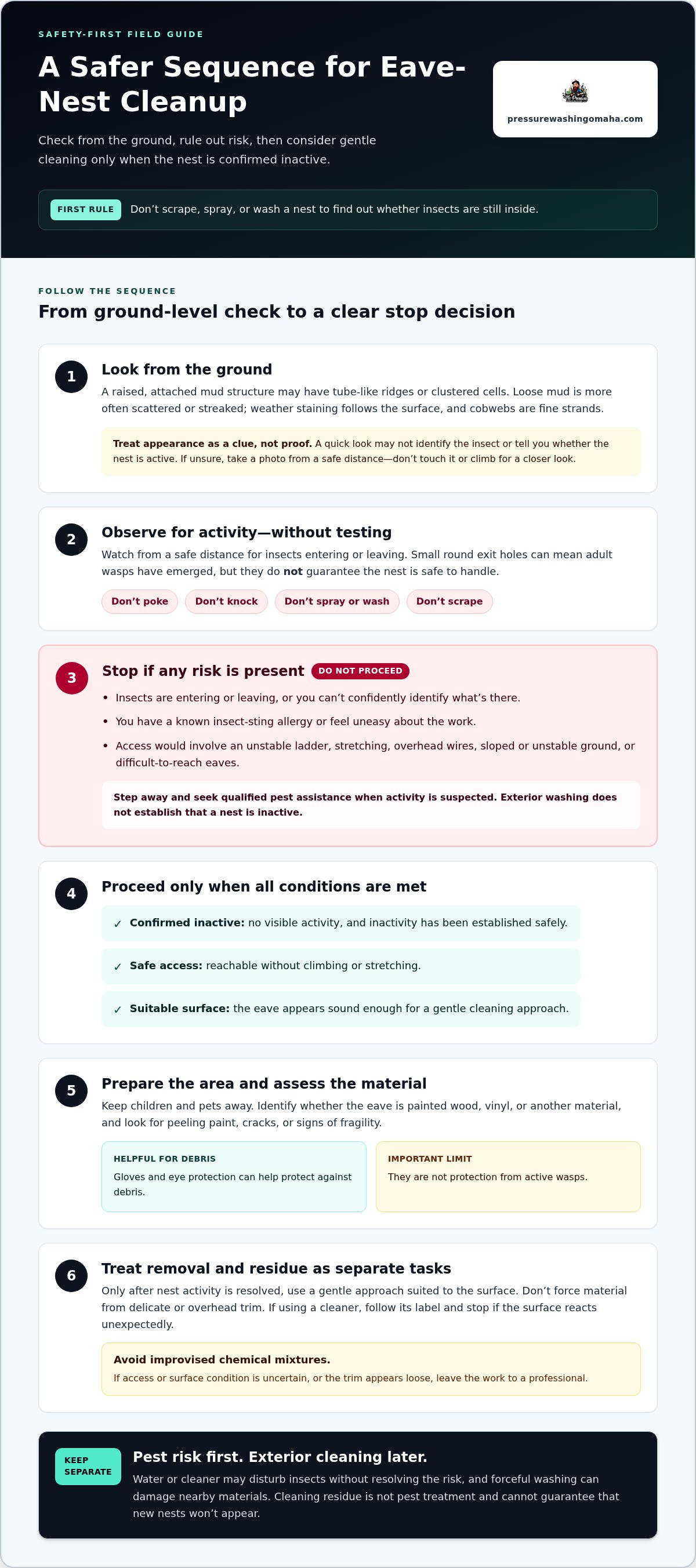
Look for raised material that appears attached to one spot, with tube-like ridges or clustered cells. Loose mud is more likely to be scattered or streaked, while weather staining tends to follow the surface rather than form a built-up structure. Cobwebs are fine strands, not solid mud tubes. If the difference isn’t clear, take a photo from a safe distance and avoid disturbing it.
Omaha and Nebraska are useful context for homeowners, but local species or nesting-season claims shouldn’t be guessed from a nest’s appearance. A structure beneath an eave can also be awkward to inspect: soffits are overhead, rooflines may be high, and the angle can make it hard to see whether the material is attached to trim or tucked into a corner. Those same features make later removal and surface cleaning less straightforward.
Is a nest active, abandoned, or difficult to identify?
Appearance alone may not tell you whether insects remain inside. Small round exit holes can be a sign that adult wasps have emerged, but don’t treat that clue as a guarantee that the nest is safe to handle. Avoid poking, knocking, spraying, or scraping to test for activity. If you see insects entering or leaving, stop and seek qualified help rather than approaching the nest.
Once activity has been safely resolved, cleaning residue is a separate task from removing nest material. The right approach depends on the condition of the trim or siding, especially if the surface is delicate or weathered. For exterior maintenance around the roofline, see the roof cleaning approach; cleaning should protect the surface, not serve as pest treatment.
Before Cleaning Dirt Dauber Nests from Eaves, Check Safety First
Before cleaning dirt dauber nests from eaves, decide whether it’s safe to approach at all. Use this stop-or-proceed check:
- Stop if insects are entering or leaving, or you can’t confidently identify what’s present. Don’t spray or wash the nest to test activity.
- Stop if you have a known insect-sting allergy, feel uneasy about the work, or would need to reach from an unstable ladder.
- Proceed cautiously only if the nest is confirmed inactive, access is safe without stretching or climbing unsafely, and the surface appears suitable for cleaning.
Exterior washing doesn’t establish that a nest is inactive. Water or cleaner may disturb insects without resolving the risk, and forceful washing can damage nearby materials. If activity is suspected, leave the nest alone and seek qualified pest assistance. Exterior cleaning is a separate step, appropriate only after nest activity has been safely resolved.
When should you avoid removing a nest yourself?
Don’t approach a nest with visible insect activity. Overhead work adds fall risk, and a sudden movement near the nest can make someone shift their weight or lose balance. Avoid ladder work near overhead wires, on sloped or unstable ground, or where the eaves are difficult to reach. If you have a known sting allergy or simply don’t feel safe, step away and seek qualified help.
What should you prepare before safe cleanup?
Only consider ground-level cleanup if the nest is confirmed inactive and reachable without climbing or stretching. Keep children and pets away from the work area. Gloves and eye protection can help protect against debris, but they aren’t protection from active wasps. Before choosing a cleaning method, check whether the eave is painted wood, vinyl, or another material, and look for peeling paint, cracks, or signs that the surface may be fragile.
Use a gentle approach suited to the material. Don’t force nest material from delicate or overhead trim, and avoid improvised chemical mixtures. If you use a cleaner, follow its label and stop if the surface reacts unexpectedly. When access or surface condition is uncertain, leave the work to a professional.
After nest activity is resolved, careful exterior cleaning may address residue on suitable eave surfaces. No Pressure Power Washing uses soft-wash methods for delicate exterior surfaces as part of its house washing service. For surface cleaning rather than active insects, get in touch about your exterior cleaning needs.
How to Remove Nest Material and Clean Eave Residue Without Damage
Removing a nest and cleaning the mark it leaves are separate tasks. First, the nest must be confirmed inactive and safely reachable. Then assess the eave itself: painted wood with peeling edges needs a gentler approach than a sound, washable surface. If reaching the nest requires stretching from a ladder, or the trim shifts when touched, stop and leave the work to a professional.
A cautious sequence for a confirmed inactive nest
Proceed only if there’s no visible insect activity and you can work without unsafe climbing or overhead strain. If conditions are suitable, use a hand tool with a smooth edge and apply light pressure at the nest’s base. Don’t force it or lever against the soffit. The goal is to release loose mud, not pry at the underlying material. If the nest resists, the surface moves, or insects appear, stop.
Collect pieces as they come away instead of brushing them aside. Debris can fall into soffit vents, gutters, or planting beds, where it may be difficult to retrieve. Avoid inserting a tool into seams or gaps. Nest material near an edge may be attached to a vulnerable part of the trim, and levering against it can loosen paint or damage the finish.
How to clean the remaining mud mark
After removing the nest material, start with a small test in an inconspicuous area. On a suitable surface, try water and a soft brush with gentle strokes. Let the area dry before judging the result, since wet trim can look different from dry trim. If the mark remains, don’t assume more force will solve it. The mud may be bonded to the finish, or the paint may already be worn.
Skip abrasive pads, harsh chemicals, and improvised mixtures. Don’t direct high-pressure water at soffits, trim, vents, or loose exterior materials. A concentrated stream can lift paint, loosen components, or drive water behind siding. Follow cleaner labels if you use a product, and stop if the surface changes, flakes, or softens.
Surface condition should guide cleaning pressure and method. For delicate or weathered eaves, a controlled soft-wash approach may be more suitable than aggressive scraping or forceful spray. The house washing service addresses suitable exterior surfaces after nest activity has been resolved. Exterior cleaning is not pest treatment, and washing can’t establish whether a nest is inactive.
Preventing New Dirt Dauber Nests Around Omaha-Area Eaves
Routine observation is more useful than repeated ladder inspections. From the ground, scan the eaves, soffits, and fascia for fresh mud deposits, loose trim, or debris near openings. Check after weather has passed and conditions allow a clear view, but don’t climb or reach overhead just to inspect a spot. If you can’t see an area safely, leave it for a qualified professional.
What can homeowners check during routine exterior maintenance?
Keep an eye on the same areas where you’ve noticed nest material before. A quick phone photo or written note can help you compare locations over time without touching the surface. Look at nearby gutters and downspouts too: accumulated debris or overflowing water can complicate exterior maintenance, even though clearing it isn’t a way to control wasps. For related upkeep, see this guide to professional gutter and downspout cleaning.
Keep vents and other designed openings clear. Don’t seal or cover them to discourage nesting, since blocking ventilation can create a separate problem for the home. Clean, well-maintained eaves make new deposits easier to spot, but cleanliness alone doesn’t stop insects from nesting. Omaha’s changing weather can make periodic exterior checks a sensible part of home maintenance; there’s no need to assume a precise local nesting calendar to keep an eye on the roofline.
Which prevention claims deserve caution?
Be skeptical of claims that a particular coating, scent, or cleaning schedule will guarantee daubers won’t return. Exterior washing can remove suitable surface residue and make inspection easier, but it isn’t pest control and doesn’t promise prevention. If you’re considering professional pressure washing in Omaha, think of it as part of broader surface maintenance, not a treatment for active insects.
For any new mud deposit, return to the same careful process: observe from a safe distance, assess the surface, and don’t disturb a nest if insects are active or its status is unclear. Cleaning dirt dauber nests from eaves is only one part of caring for the exterior; preserving trim, siding, and clear drainage matters too. For suitable exterior surfaces, professional house washing uses a soft-wash approach designed for delicate materials.
When Professional Eave Cleaning Is the Safer Next Step
Professional exterior cleaning and pest treatment are different jobs. If insects are active, or you can’t tell whether a nest is occupied, don’t ask a washing crew to resolve that uncertainty. Have the nest assessed and activity safely addressed first. Once it’s no longer active, an exterior-cleaning professional can evaluate whether the remaining mud marks and surrounding eave surfaces are suitable for cleaning.
What can professional exterior cleaning help with?
High eaves, delicate siding, peeling paint, and trim that shifts or appears damaged are good reasons to avoid a do-it-yourself approach. Reaching overhead can put you at risk, while scraping or using forceful water may loosen material or drive water behind the exterior surface. A professional can assess the surface and choose a suitable cleaning method rather than treating every eave as if it were the same.
No Pressure Power Washing serves Omaha and surrounding communities and brings more than 30 years of area experience to residential house washing. Its soft-wash methods are used for delicate exterior surfaces, with biodegradable, non-toxic cleaning solutions. After nest activity is resolved, this approach may help clean suitable eave surfaces and residual marks. It isn’t pest control, doesn’t remove active wasps, and can’t guarantee that new nests won’t appear.
Roof edges and adjoining exterior materials need care, too. A cleaning method that works on one surface may not suit nearby trim or siding, so surface condition should guide the approach. The goal is to address appropriate exterior residue while preserving the surrounding materials, not to force a mark away at any cost.
How to take the next safe step
Keep the decision simple: identify the suspected nest from a safe distance, avoid disturbing it if insects are active or its status is uncertain, and consider whether access and surface condition make cleaning appropriate. A request for house washing is about exterior surfaces after nest activity has been resolved. It isn’t a request for insect removal or nest treatment.
For suitable exterior-cleaning needs around the home, explore professional house washing. If reaching or cleaning the eaves feels unsafe, leave the ladder and surface work to a professional.
Protect Your Eaves With a Careful Next Step
Cleaning dirt dauber nests from eaves starts with identifying what you’re seeing and checking safety before anything is disturbed. If insects are active, access is awkward, or the trim may be fragile, don’t force a do-it-yourself cleanup. Once nest activity has been resolved, remove residue only with a method suited to the surface, and treat routine inspections as a way to spot new deposits, not a guarantee against future nests.
For eaves and nearby exterior surfaces that are suitable for washing, No Pressure Power Washing brings more than 30 years of Omaha-area experience to residential house washing. Its soft-wash methods are used for delicate exterior surfaces, with biodegradable, non-toxic cleaning solutions. This is exterior cleaning, not pest treatment, and it won’t determine whether a nest is active.
A cautious assessment protects both your safety and your home’s exterior. Take the next step only when the nest is no longer active and the cleaning approach fits the surface.
Frequently Asked Questions
How do you remove dirt dauber nests from eaves?
Remove a nest only after it’s confirmed inactive and safely within reach. Wear gloves and eye protection, gently loosen the mud with a suitable hand tool, and stop if it resists or the trim shifts. Collect debris instead of brushing it into vents or gutters. Clean any remaining mark separately with a gentle method suited to the surface. If insects are active or access is unsafe, leave the nest undisturbed and seek qualified help.
Are dirt dauber nests dangerous to remove?
Dirt daubers are generally solitary and less defensive than social wasps, but disturbing a nest can still expose you to a sting, and the nest may be misidentified. Overhead work also brings ladder and falling-debris risks. Don’t handle a nest if you have a known sting allergy, see insects entering or leaving, or feel unsafe reaching it. Have suspected active nests assessed by qualified pest professionals before arranging any exterior cleaning.
Can I pressure wash dirt dauber nests off my eaves?
Don’t use high-pressure water to dislodge a nest. A concentrated stream can damage paint, trim, soffits, vents, or loose siding, and it won’t tell you whether insects are still inside. First address nest activity safely. Afterward, remove material cautiously only if the nest is inactive and access is secure. For remaining residue, test a gentle, surface-compatible cleaning method; delicate or uncertain surfaces are better assessed by an exterior-cleaning professional.
How can I tell whether a dirt dauber nest is active?
Watch from a safe distance for insects entering or leaving the structure. That activity means you shouldn’t approach or disturb it. Small round exit holes may suggest adults have emerged, but appearance alone can’t confirm a nest is empty. Don’t poke, knock, spray, or wash it as a test. If you’re unsure what made the nest or whether insects remain, stop and seek qualified pest assistance before any cleaning begins.
Will removing a dirt dauber nest leave a stain on the eaves?
It can. Mud may leave a mark, and removing the nest can reveal a difference between the covered area and surrounding paint or trim. The result depends on the surface material, finish, age, and condition, so there’s no single cleaning method that suits every eave. After activity is resolved, try a small, gentle test on a suitable surface. Avoid abrasive scrubbing or forceful water, which can worsen damage rather than remove discoloration.
How do I keep dirt daubers from building nests under eaves?
There’s no cleaning schedule, coating, or scent that can guarantee nests won’t return. Keep eaves maintained so new mud deposits are easier to notice, and check from the ground during routine exterior care. Look at nearby trim, gutters, and vents, but don’t block openings designed for ventilation. Periodic observation helps you spot changes early; it isn’t pest control. For homes in the Omaha area, a ground-level photo can help track recurring locations.
Should I remove dirt dauber nests from high eaves myself?
No. High eaves, steep or unstable ground, nearby overhead wires, and awkward roofline access make DIY removal unsafe. Don’t stretch from a ladder or lean over a roof edge to reach a nest. If insects are active or the nest’s status is unclear, seek qualified pest help first; cleaning is a separate step after activity is resolved. No Pressure Power Washing serves Omaha, Papillion, Elkhorn, Gretna, Bennington, Bellevue, Valley, and Wahoo with residential house washing.


