

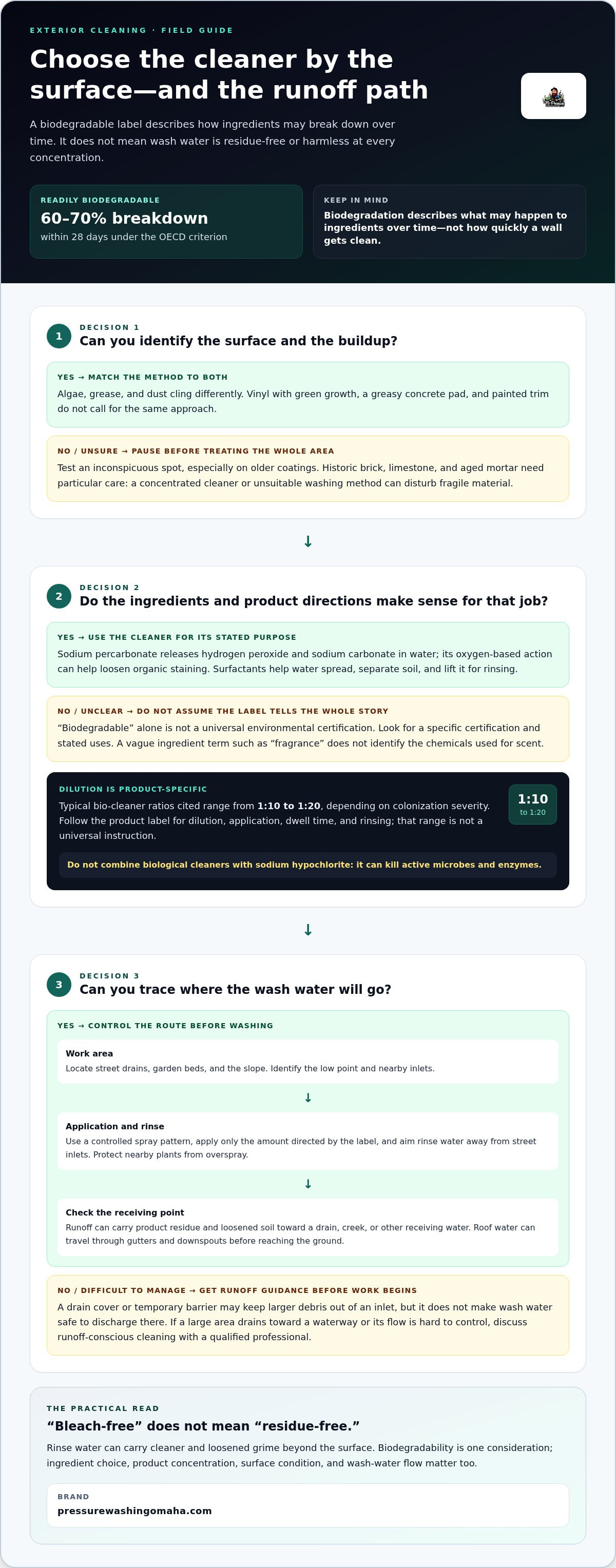
Biodegradable exterior cleaning solutions use ingredients that microorganisms can break down into water, carbon dioxide, and biomass. “Biodegradable” doesn’t mean a cleaner disappears as soon as it reaches runoff, or that it’s harmless to aquatic life at every concentration. For a product described as readily biodegradable, the OECD criterion is at least 60-70% breakdown within 28 days.
Choosing a bleach-free cleaner may seem more considerate of nearby waterways, but the ingredients matter as much as the label. This guide explains how common biodegradable cleaners work on exterior grime, what their ingredients do, and how wash water can carry residue toward stormwater drains. It also explains why biodegradability is only one part of a cleaner’s environmental impact.
Key Takeaways
- Learn how sodium percarbonate and biodegradable surfactants contribute to exterior cleaning, and why their roles differ.
- See why a bleach-free label alone doesn’t explain what may reach stormwater; ingredient choice and wash-water flow matter too.
- Understand what to look for in cleaner ingredient lists, including how vague labeling can make product composition harder to assess.
- Compare biodegradable cleaners with bleach and conventional detergents by considering cleaning action alongside potential environmental effects.
- Explore when professional house washing can help address exterior buildup with care for the property and its surroundings.
Sodium percarbonate and biodegradable surfactant chemistry
Biodegradable exterior cleaning solutions can work through several actions. Sodium percarbonate releases hydrogen peroxide and sodium carbonate when dissolved in water. This oxygen-based action can help loosen organic staining, while surfactants help water spread and lift soil. The right approach depends on the surface and the buildup: algae, grease, and dust cling differently to siding, masonry, and painted trim.
Biodegradable surfactants help separate soil from a surface so rinsing water can carry it away. Microorganisms, including bacteria and fungi, can break biodegradable substances into water, carbon dioxide, and biomass. That describes what may happen to ingredients over time, not how quickly a wall gets clean. Read the ingredient list carefully: a vague term such as “fragrance” doesn’t identify the chemicals used for scent.
For routine exterior cleaning, match the method and product to the material and soil. A vinyl wall with green growth needs a different approach from a greasy concrete pad or painted porch rail. Sodium percarbonate may suit some organic stains, but it isn’t a universal solution. If you’re unsure how a finish will respond, test an inconspicuous area, especially on older coatings.
Historic brick, limestone, and aged mortar require particular care. A concentrated cleaner or unsuitable washing method can disturb a fragile surface, even if the product is biodegradable. Consider the material, existing wear, and type of stain before choosing how to clean it. On a historic façade, preserving the masonry and mortar matters more than removing every visible mark.
In the United States, requirements depend on a cleaner’s composition, intended use, and claims. The word “biodegradable” alone doesn’t identify an environmental certification. Look for a specific certification and the product’s stated uses rather than assuming the term represents one universal standard.
There’s no single amount of product needed for every application. Concentration, dilution, surface area, and soil all affect use. For exterior cleaning service, No Pressure Power Washing provides a free, no-obligation estimate based on the project.
Breakdown time varies with the formula and conditions after use. Biodegradable means microorganisms can break down the substance; it doesn’t mean the cleaner disappears during washing. Keep this distinction in mind when considering runoff from a surface toward a garden or drain.
Mixing directions vary by product. Typical bio-cleaner ratios range from 1:10 to 1:20, depending on how severe the colonization is. Follow the specific label for dilution, application, dwell time, and rinsing. Don’t treat that general range as a universal manufacturer instruction, or combine biological cleaners with sodium hypochlorite, which can kill active microbes and enzymes.
The surface determines the cleaning method: painted siding, historic masonry, and equipment each have different needs. Grease on equipment calls for attention to soil removal, while weathered brick calls for a gentler approach. Matching the cleaner and method to the surface helps limit unnecessary product use and protect the finish.
Bleach-free cleaning and stormwater runoff
Bleach-free cleaning still produces wash water that can carry loosened soil and product residue. Consider where it will flow, especially when paved areas slope toward street drains or waterways.
Runoff Near Waterways
Runoff is wash water flowing from a work area toward a drain, creek, or other receiving water. Its route matters because bleach-free doesn’t mean residue-free: rinse water can carry cleaner and loosened grime beyond the surface.
Before washing, trace the flow from the work area. A driveway sloping toward a curb may send rinse water to a street inlet; a patio beside a creek may have a shorter route. The surface and its grade determine where water travels. For driveway cleaning, identify the low point and nearby drains before selecting where to direct the rinse.
A drain cover or temporary barrier may help keep larger debris out of an inlet, but it doesn’t make wash water safe to discharge there. Consider the cleaner label, the amount used, and what the water picks up. Rinsing algae from a walkway, for example, can carry residue and loosened organic matter downhill. Keep concentrated product and packaging away from drainage paths, and contain spills instead of rinsing them toward a storm drain.
Reducing Runoff and Overspray
Runoff reduction means controlling where wash water flows; overspray control keeps droplets on the intended surface. Both matter: spray can reach nearby plants, while rinse water can carry residue across pavement.
Start by locating drains, garden beds, and the slope of the surface. Use a controlled spray pattern, apply only the amount directed by the product label, and aim rinse water away from street inlets. On concrete cleaning, work direction matters: rinsing toward a low edge can send soil and cleaner toward the nearest drain. A garden beside the work area may need protection from overspray.
Roof runoff follows another route. Water can travel from the roof into gutters and downspouts, then discharge beside the foundation or toward paved areas. Consider that path before roof cleaning, particularly where a downspout empties near a drain or garden. Avoid directing spray beyond the target area, and follow product instructions for application and rinsing.
These steps help limit unnecessary product use and unintended exposure, but they don’t eliminate runoff. If a large surface drains toward a waterway or its flow is difficult to manage, discuss runoff-conscious exterior cleaning before work begins.
Common biodegradable cleaner ingredients
A cleaner’s ingredient list can explain how its formula tackles soil, grease, and residue. Water carries active ingredients, while surfactants help lift grime so rinse water can remove it. In a biodegradable formula, an ingredient’s cleaning role and environmental behavior are separate considerations. Look for ingredient information clear enough to distinguish cleaning agents from scent or packaging claims.
Surfactants are active ingredients in many detergents. They help water spread across painted siding or concrete instead of beading around dirt. This action can loosen oily soil from a driveway; rinsing then carries the detached material away. “Biodegradable” describes a breakdown property, not a cleaner’s strength or suitability for every material.
Sodium percarbonate is an oxygen-based ingredient used in some cleaners. In water, it releases hydrogen peroxide and sodium carbonate, which can help address organic staining. It isn’t a universal surface cleaner: a solution suitable for stained concrete may not suit delicate paint or aged masonry. Match the product to the surface and finish, and follow its label directions.
Some formulas use enzymes or microbial ingredients to target particular organic soils. An enzyme acts on specific material, so its role depends on the formula and stain. Don’t assume every biodegradable product contains enzymes, or that “natural” means harmless at any concentration. The full ingredient list matters more than a broad front-label description.
Fragrance may be included for scent rather than cleaning. Vague wording such as “fragrance” may not identify the compounds, so compare the ingredient details and product purpose. A kitchen degreaser, for example, is formulated for a different task than a detergent intended for exterior grime. The product name alone doesn’t establish how either will behave in runoff.
- Surfactants: help water spread and lift soil from materials.
- Sodium percarbonate: provides oxygen-based action for some organic stains.
- Enzymes: target particular soils when included in the formula.
- Fragrance: adds scent, but doesn’t explain cleaning performance.
Before choosing a product, check its ingredient panel. Look for named cleaning agents, the intended surface, and directions for dilution and rinsing. Don’t treat “biodegradable” as a complete ingredient disclosure. Packaging can affect how easily you store and dispense concentrate, but it doesn’t show what the formula contains or how it performs.
A greasy concrete patch may need a surfactant-led detergent, while a biological stain may call for a different active ingredient. Using a product outside its intended purpose can leave residue or affect the finish. The ingredients, application, and direction of rinse water all influence what remains on the surface and what may enter runoff.
Environmental and aquatic-life impacts
A cleaner’s environmental effect depends on its ingredients, the amount used, and where it goes after washing. Biodegradability describes breakdown, but doesn’t establish how a product affects aquatic life before that process occurs. Runoff from a concrete walkway, for example, can carry cleaner residue and loosened organic material toward a storm drain.
According to the Organisation for Economic Co-operation and Development (OECD), a product meets the readily biodegradable criterion if at least 60-70% breaks down within 28 days. That measure describes biodegradation under the criterion, not the concentration reaching a creek or the product’s immediate effects there. Read the claim alongside the product’s ingredient information and directions for use.
Exposure depends on the route wash water takes. A sloped driveway leading toward a drain creates a different runoff path from a contained work area. Near a waterway, residue may travel with rinse water before biodegradation occurs. Choosing a biodegradable formula can inform the decision, but application amount and runoff control still matter.
Ingredient names need context. Surfactants help cleaning agents lift soil, while sodium percarbonate provides oxygen-based action in some formulas. Neither ingredient name alone reveals a finished cleaner’s full environmental profile. Essential oils may provide scent, but “plant-derived” or “natural” wording doesn’t establish how the complete product behaves in water.
Compare products by intended use, not just familiar labels. Laundry detergent, industrial degreaser, and exterior surface cleaner serve different tasks. Their formulas and directions can differ, so don’t assume a product intended for one use suits another. Check the label for stated surfaces, application method, and rinsing instructions.
General environmental claims can hide important distinctions. A “readily biodegradable” claim concerns a defined breakdown measure; it doesn’t mean the product vanishes immediately or that every ingredient breaks down in the same way. Using concentrated cleaner on a small algae stain, for example, differs from washing a large paved area.
For a more informed choice, use this short review:
- Identify the cleaner’s named active agents and intended surface.
- Read biodegradability claims as one part of the product information.
- Consider where rinse water will travel from the work area.
- Use the label directions to avoid unnecessary product application.
These checks help distinguish a product’s breakdown claim from the broader question of environmental impact. Near a storm drain or creek, the formula, amount applied, and runoff route all matter.
How do biodegradable exterior cleaners compare with bleach and conventional detergents?
These cleaners differ in their active ingredients and cleaning action. Traditional commercial soft-wash cleaning is described as using 6-12% sodium hypochlorite. Biodegradable formulas may instead use surfactants, sodium percarbonate, enzymes, or other ingredients. That difference affects how a cleaner tackles a stain, but the label alone doesn’t establish the best method for every surface.
Sodium hypochlorite is used to treat biological growth, while surfactants help lift soil so rinsing can carry it away. An algae-stained exterior and a greasy concrete spot, for example, present different cleaning problems. A biodegradable detergent may help release soil, but its ingredients and intended use determine whether it suits the task. Match the product to both the stain and the material.
Conventional detergents are a broad category, not one uniform formula. A laundry detergent doesn’t automatically suit outdoor masonry; the surfactants, other active ingredients, and directions matter. Biodegradable products also vary: one may rely on surfactants, while another uses sodium percarbonate or biological ingredients. Compare stated surfaces and application directions instead of treating either category as interchangeable.
Runoff is another point of comparison, but “biodegradable” doesn’t mean residue disappears during rinsing. The word describes breakdown over time, while immediate runoff depends on where wash water flows and what it carries. On a sloped driveway, product residue and loosened grime can travel toward a drain. Use only the amount directed and manage rinse water with either type of cleaner.
Never mix biological cleaners with sodium hypochlorite. Bleach kills active microbes and enzymes, defeating the intended biological action. Keep the products separate and use each according to its label. This is especially important when a property has different cleaning tasks, such as organic staining on siding and grease on pavement.
Choose a method based on the soil, finish, and wash-water path. A porous surface, delicate coating, or heavy buildup may need a different approach from routine cleaning. Don’t assume a bleach-free formula works on every stain or that sodium hypochlorite is appropriate for every material. Assessing the surface helps prevent damage and unnecessary product use.
For concrete with embedded grime or staining, choose an approach suited to the material rather than assuming one cleaner fits every job.
No Pressure Power Washing: House Washing
No Pressure Power Washing cleans home exteriors using soft washing with zero risk of high-pressure damage. For siding with dirt, algae, or weather-related grime, the method should suit the material and account for where rinse water flows, especially near garden beds, drains, or sloped ground. The company prioritizes the environment by using biodegradable and non-toxic cleaning agents.
Choosing biodegradable exterior cleaning solutions is only one part of the decision. The surface, stain, application, and runoff path also shape how the work should be done. Professional cleaning can help when you’re unsure how a finish will respond or how to manage wash water around your property.
If your home’s exterior needs attention, contact No Pressure Power Washing to discuss house washing.
Make Your Next Exterior Cleaning Decision With Care
Your next step is to match the cleaning method to the surface and the property’s drainage. A stained wall, weathered deck, or marked driveway can call for different considerations. Identifying the material, buildup, and route rinse water will take helps shape a practical plan before work begins.
Biodegradable exterior cleaning solutions may inform that discussion, but the product label is only one consideration. Tell No Pressure Power Washing what needs cleaning and whether garden beds, drains, or waterways are nearby. The company uses soft washing with zero risk of high-pressure damage for Residential House Washing, Deck Cleaning, and Concrete Cleaning, with biodegradable and non-toxic cleaning agents.
It’s worth making a careful choice before exterior buildup becomes harder to address. A clear conversation can help you understand the work your property needs and decide on a sensible next step.
Give your exterior a thoughtful start by considering both the surface and its surroundings.
Frequently Asked Questions
What Does Biodegradable Cleaning Products Mean?
For a homeowner, the term describes a product attribute, not a promise about cleaning speed or the finished appearance. A cleaner may break down over time yet still be a poor match for a particular stain or finish. Keep those decisions separate: evaluate environmental claims independently from whether the product can address the buildup on your specific exterior surface.
What Makes a Product Eco-Friendly (or Not)?
“Eco-friendly” is a broad description, not a single measure of performance. Consider the product’s intended use, packaging, application needs, and the amount required. A ready-to-use product may avoid measuring concentrate, while a concentrate may reduce packaging volume. Neither detail alone establishes overall impact; the relevant comparison depends on the full product and how it’s used.
What makes exterior cleaning “eco-friendly,” and what doesn’t?
An environmentally considerate approach accounts for the building material as well as the cleaner. A method that strips paint or roughens a finish can create avoidable repair work, even if the product carries an environmental claim. Match the method to the siding, deck, or masonry instead of assuming a stronger application is better. The goal is to address the buildup while protecting the surface.
Will bleach-free results last as long as a bleach wash?
There’s no universal answer because results depend on the cause of a stain and the conditions that follow. A shaded, damp wall may develop visible growth again sooner than a surface with less moisture and shade. Cleaning removes or loosens existing buildup, but doesn’t change the conditions that encouraged it. Compare the same surface, stain, and exposure when assessing different methods.
What ingredients make an exterior cleaning solution biodegradable?
No single ingredient makes an entire formula biodegradable. Formulation matters: ingredients are combined for a particular cleaning purpose, and one component’s properties don’t establish the behavior of the others. When comparing products, look for information about the complete formula rather than inferring performance from one familiar ingredient. Also consider a product’s environmental properties separately from whether it suits the material you plan to clean.
Which biodegradable cleaners work best for siding, roofs, decks, and concrete?
There isn’t one best cleaner for all four surfaces. Siding may be painted or vinyl, roofs have material-specific cleaning needs, decks may be wood or composite, and concrete can hold embedded grime. Identify the material and stain, then choose a product intended for that application. On delicate or aging surfaces, a professional assessment can help avoid an unsuitable method.
Are biodegradable exterior cleaners safe for plants, pets, and waterways?
“Biodegradable” alone doesn’t establish that a product is safe for every plant, animal, or waterway exposure. Before cleaning, move pet bowls, toys, and portable garden items away from the work area. Follow the product’s directions on contact and re-entry, and keep people and animals clear of the treated area as directed. If a label identifies a hazard, follow its warning.
How can homeowners verify biodegradable claims and read cleaner product labels?
Look for a claim tied to the exact product, not just general green wording on the front of the bottle. If a certification is named, compare the product with the certifier’s listing and check that the claim applies to that formula. Keep the container or product record so you can match any technical documents to the product used.


