

Rust removal is a chemical reaction, not a mechanical one; success in Omaha depends on balancing pH levels rather than simply increasing water pressure. You've likely spent hours scrubbing those stubborn orange streaks from your driveway, only to find they remain as vibrant as ever. It's exhausting to watch your curb appeal suffer while fearing that the wrong store-bought acid might permanently etch your expensive masonry. With Omaha home prices reaching a median of $296,000, maintaining a pristine exterior isn't just about pride; it's about protecting a significant financial asset.
This guide explains exactly how to remove rust stains from concrete Omaha residents deal with daily, from irrigation runoff to fertilizer overspray. We'll show you how to achieve a bright, clean surface using expert-approved methods that won't damage your property or violate local environmental regulations regarding runoff. You'll learn the difference between surface cleaning and deep-pore restoration, along with the specific steps needed to prevent these unsightly marks from returning to your sidewalks and patios. We're going to move past ineffective DIY scrubbing and look at the science of safe, eco-friendly concrete care.
Key Takeaways
- Concrete is porous, so understanding how Omaha's iron-rich water creates deep chemical bonds is the first step toward effective removal.
- You'll discover how to remove rust stains from concrete Omaha properties frequently develop without using aggressive acids that eat away at your driveway's protective cream coat.
- Safety is paramount, so we've outlined the necessary protective gear and pre-wetting techniques to ensure your cleaning process is safe and compliant with local runoff laws.
- Some orange marks aren't simple rust but are actually caustic burns; we'll help you identify when it's time to call in a specialist to avoid permanent masonry damage.
- Long-term success relies on prevention through high-quality penetrating sealers and minor adjustments to your home's irrigation system.
Understanding the Root Causes of Rust Stains on Omaha Concrete
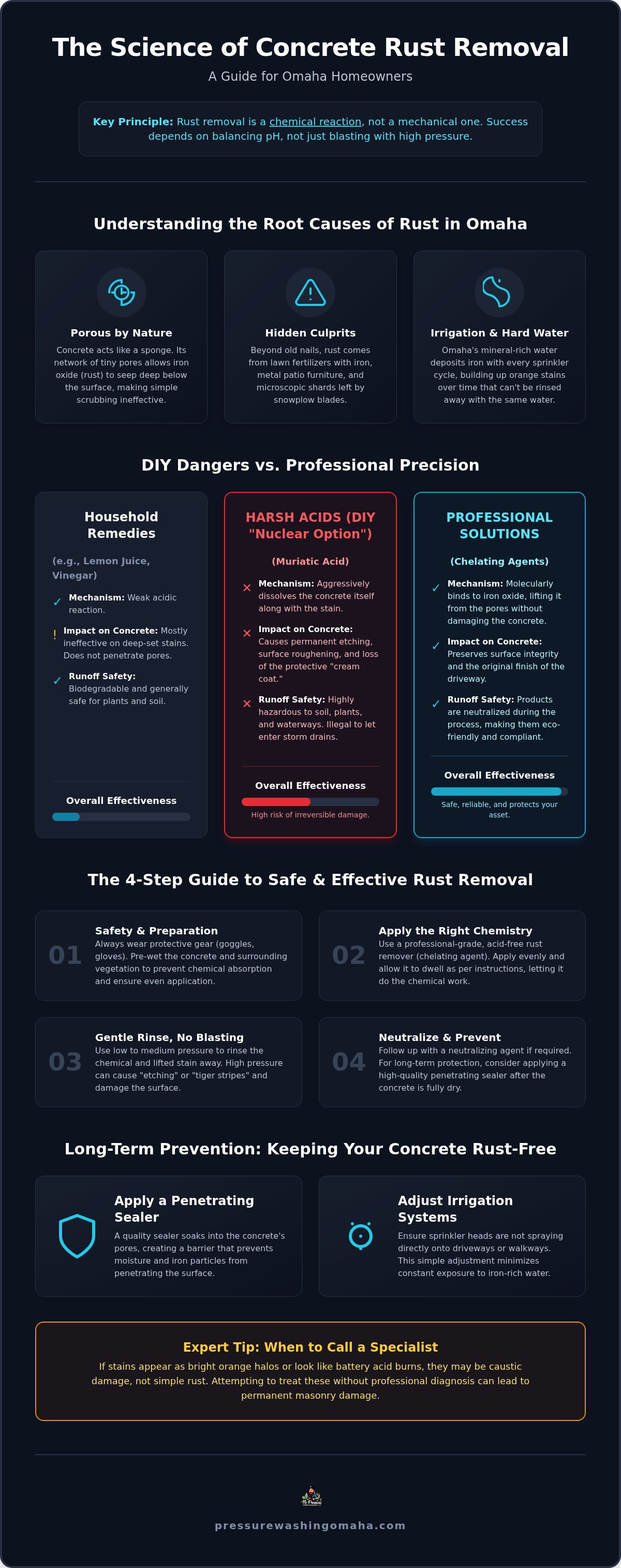
Rust isn't just a surface-level smudge; it's a persistent chemical bond. When iron, oxygen, and moisture meet, they create iron oxide. This compound doesn't just sit on your driveway. It anchors itself within the material. In our region, homeowners often search for how to remove rust stains from concrete Omaha properties develop because our local environment provides a perfect recipe for oxidation. While a rusty nail or an old metal bucket is an obvious culprit, many stains come from less visible sources. Common lawn fertilizers, metal patio furniture, and even the steel edges of snowplow blades during Nebraska winters all contribute to the problem.
The Porous Nature of Concrete
Concrete may look solid, but it's actually a highly porous material. If you looked at it under a microscope, you'd see a network of tiny capillaries and voids. This structure allows it to act like a dense sponge. When metallic particles from fertilizer or patio furniture sit on the surface, moisture pulls the iron oxide deep into these pores. This is why a simple scrub brush rarely works. In older Omaha neighborhoods, like those in Benson or Dundee, decades of freeze-thaw cycles have often opened these pores even further. This makes the concrete more susceptible to deep-set leaching than a newly poured pad in West Omaha.
Irrigation and Hard Water Staining
One of the most common calls we receive involves orange halos or fan-shaped stains along the edges of a driveway. This is often caused by Omaha's mineral-rich water. If your irrigation system uses well water or even municipal water with high iron content, every sprinkler cycle deposits a microscopic layer of minerals. Over time, these layers build up, creating a finish that mimics the look of a battery acid burn. Many well-meaning homeowners try to rinse these spots away, but using the same hard water only feeds the oxidation process. Understanding this chemical cycle is critical before attempting driveway cleaning or professional-grade restoration.
Lawn maintenance is another frequent contributor. Many high-quality fertilizers contain iron to help grass achieve that deep green color. If these granules land on your concrete and get wet, they blossom into tiny orange spots that are notoriously difficult to lift. Similarly, winter maintenance can leave behind metallic tracks. Steel snowplow blades or even the metal components of snowblowers can scrape the concrete, leaving behind microscopic shards that oxidize as soon as the snow melts. Identifying these specific triggers helps in choosing the right approach for concrete cleaning without resorting to guesswork.
DIY Methods vs. Professional Rust Removal Solutions
Homeowners often begin their search for how to remove rust stains from concrete Omaha with a trip to the kitchen pantry or the hardware store tool aisle. While lemon juice or a high-pressure nozzle might seem like a logical first step, these methods often ignore the chemical reality of oxidation. Rust isn't just dirt; it's a metallic bond that requires a specific pH shift to release. Blasting the surface with water often results in "tiger striping," where the concrete's top layer is stripped away while the orange stain remains embedded in the pores. Understanding the difference between surface-level cleaning and chemical restoration is key to protecting your driveway's longevity.
| Treatment Method | Chemical Mechanism | Impact on Concrete | Runoff Safety |
|---|---|---|---|
| Household Acids (Lemon/Vinegar) | Weak Acidic Reaction | Minimal (Often ineffective) | Safe/Biodegradable |
| Muriatic Acid (DIY Nuclear Option) | Aggressive Dissolving | Severe Etching / Loss of Cream Coat | Hazardous to Soil & Drains |
| Professional Chelating Agents | Molecular Binding | Preserves Surface Integrity | Eco-Friendly / Neutralized |
The Problem with Hardware Store Muriatic Acid
Many DIY forums suggest muriatic acid because it's inexpensive and works quickly. However, it achieves results by dissolving the concrete's cement paste. This leaves the surface rough and sand-like, which actually makes it easier for dirt and biological growth to take hold later. It's a permanent change to your driveway's texture that can't be undone. Beyond the masonry damage, the runoff from muriatic acid can devastate your lawn and violate Omaha municipal regulations regarding storm drain contamination.
Professional Grade Chelating Agents
Professional restoration at No Pressure Power Washing relies on a process called chelation. These specialized agents "grab" the iron molecules and pull them out of the concrete pores without attacking the masonry itself. This preserves the smooth "cream coat" of your slab while delivering a much deeper clean than household remedies can provide. We always follow these treatments with a pH neutralizer to stabilize the slab and ensure it's safe for your family and pets. If you're managing large-scale staining or delicate decorative pads, opting for Professional Concrete Cleaning Services is the only way to guarantee the job is done safely. If you're unsure which chemical path is right for your property, it's best to reach out to a local specialist for an expert evaluation.
Step-by-Step Guide to Safe Rust Removal
Removing stubborn oxidation requires a methodical approach that prioritizes both personal safety and material integrity. Before you begin learning how to remove rust stains from concrete Omaha homeowners should gather the right personal protective equipment (PPE). Even biodegradable cleaners can cause skin or eye irritation, so heavy-duty chemical-resistant gloves and wrap-around safety glasses are essential. You'll also want to wear old clothing and closed-toe boots. Start by clearing the area of all loose debris, leaves, and dirt. Once the surface is clear, pre-wet the concrete with clean water. This step is vital because it saturates the pores, preventing the cleaning solution from soaking in too deep and allowing it to focus its energy on the metallic bonds at the surface.
When you're ready to apply the cleaner, do so evenly to avoid creating "clean streaks" that look just as bad as the original stain. Use a synthetic stiff-bristle brush for agitation. Many DIY guides suggest using a wire brush, but this is a significant mistake. Steel wire brushes can leave behind microscopic metal fragments embedded in the concrete. These fragments will inevitably oxidize, leading to a whole new round of rust spots within weeks. A high-quality synthetic brush provides enough friction to lift the stain without introducing new contaminants to your driveway.
Test Spotting and Dwell Time
Never apply a chemical treatment to your entire driveway without performing a test spot in an inconspicuous corner. This ensures the cleaner won't discolor your specific concrete mix or leave a ghosting effect. Once you apply the solution, let it sit for the recommended "dwell time." This is where the chemistry happens. You'll often see the orange stain change color or begin to fade as the chelating agents break the iron oxide bond. Don't let the solution dry out completely; if it starts to evaporate, mist it lightly with water to keep the chemical reaction active.
Proper Rinsing Techniques
If the chemistry has done its job, you won't need high-pressure blasting to finish the task. A low-pressure rinse is usually sufficient and much safer for your masonry's cream coat. Be mindful of where the water goes. Omaha municipal regulations prohibit allowing water containing cleaning agents or solvents to enter the storm sewer system, as these drains flow directly into local waterways. Direct your runoff toward grassy areas that can act as a natural filter, or use absorbent berms to contain the liquid. For larger properties or severe leaching, professional Driveway Cleaning Services ensure that all wastewater is handled according to local environmental standards and permit requirements.
Why Some Stains Require Professional Restoration
Not all orange marks are created equal. While standard oxidation from a garden tool is a common nuisance, "battery acid" burns are a different beast entirely. These occur when sulfuric acid leaks from a vehicle or golf cart battery, creating a bright orange or yellow stain that's actually a caustic burn. Figuring out how to remove rust stains from concrete Omaha properties requires distinguishing between these types because a caustic burn has already structurally altered the concrete surface. Simple cleaning agents won't fix the underlying damage to the masonry's integrity.
Decorative and stamped concrete present another layer of complexity. These surfaces often feature topical sealers or integrated colors that react poorly to hardware store acids. One wrong move can strip the pigment or leave a permanent white ghosting effect. There's also the risk of "tiger striping." This happens when homeowners attempt to compensate for weak chemicals by using high-pressure tips. Consumer-grade pressure washers can easily gouge the cream coat, leaving permanent wand marks that no amount of cleaning can fix.
Deep Penetration and Large Surface Areas
If a stain has moved more than 1/16th of an inch into the slab, surface scrubbing is largely useless. The metallic bond has anchored itself deep within the concrete's capillary system. For large commercial walkways or extensive residential driveways, the physical toll and chemical volume required make DIY efforts impractical and often ineffective. You can learn more about these complexities in our Professional Concrete Cleaning Services Pillar. Professionals use commercial-grade equipment that ensures even application across massive surface areas without leaving behind uneven patches.
Environmental and Safety Liability
Managing chemical waste is a serious responsibility in the Omaha metro area. Local regulations are strict regarding runoff into municipal storm sewers, which lead directly to our local waterways. Professionals utilize specialized reclaim equipment to capture wastewater, ensuring compliance with EPA standards and city ordinances. Chelation is the specialized chemical process used by professionals to safely bind iron molecules and lift them from the concrete without dissolving the masonry itself. Hiring a licensed specialist ensures your property restoration meets these legal and environmental standards while protecting your surrounding landscaping.
Long-Term Prevention: Keeping Your Concrete Rust-Free
Once you've successfully navigated the process of how to remove rust stains from concrete Omaha properties often require, the focus shifts to preservation. Protecting your investment means addressing the environmental factors that caused the staining in the first place. In our region, this starts with your lawn care routine. If you utilize fertilizers to keep your turf lush, always sweep or blow any stray granules off your driveway and sidewalks immediately. Many high-quality fertilizers contain iron that will blossom into orange spots the moment they meet moisture. Similarly, adjusting your irrigation heads to ensure they don't overspray onto your concrete can prevent the slow buildup of mineral deposits from Omaha's hard water.
Nebraska’s variable climate, with its intense summer heat and brutal freeze-thaw cycles in winter, puts significant stress on masonry. Establishing a regular maintenance schedule is the best way to catch small issues before they become deep-set chemical bonds. A simple seasonal rinse with clean water can remove metallic dust and debris before it has the chance to settle into the pores of your slab.
Concrete Sealing Benefits
The most effective defense against future oxidation is a high-quality penetrating sealer. Unlike topical sealers that create a shiny film on the surface, penetrating sealers move into the concrete's capillary system to create a hydrophobic barrier. This prevents water and dissolved minerals from entering the pores. This level of protection simplifies future Paver Cleaning and general maintenance because contaminants stay on the surface rather than leaching deep into the material. In the Midwest, we generally recommend re-sealing every two to three years to maintain this protective shield against the elements.
Gutter and Drainage Management
Your home's drainage system plays a surprising role in concrete health. Clogged or poorly positioned gutters often lead to concentrated water runoff that carries metallic particulates from roof flashings or old metal brackets. This concentrated flow creates distinct, stubborn rust streaks on both your siding and the concrete below. Ensuring your system is clear is a critical step in property preservation, as detailed in our Professional Gutter Downspout Cleaning Article. Redirecting downspouts away from high-traffic concrete areas ensures that water moves safely to your lawn or drainage tiles rather than pooling on your driveway.
Restoring Your Property's Pristine Appearance
Maintaining your home's exterior requires more than just water and effort; it requires an understanding of how metallic bonds interact with porous masonry. You've learned that successful restoration involves precise chemistry like chelation rather than damaging high pressure. By addressing root causes like irrigation overspray and utilizing penetrating sealers, you can protect your investment against Nebraska's harsh freeze-thaw cycles. Knowing how to remove rust stains from concrete Omaha homeowners encounter most frequently starts with choosing the right methodology for your specific surface.
No Pressure Power Washing brings 30+ years of local experience to every driveway and walkway we treat. We prioritize your peace of mind by using eco-friendly, non-toxic solutions that are safe for your family, pets, and the local watershed. As a fully licensed and insured specialist, we take pride in acting as the trusted guardian of your property's long-term value. We handle the technical complexities of chemical balance and runoff management so you don't have to worry about DIY risks or environmental compliance.
Your home deserves a clean, bright entrance that reflects the care you put into it. We look forward to helping you restore that beautiful curb appeal and providing the expert guidance your Omaha property needs to stay rust-free.
Frequently Asked Questions
Will a standard pressure washer remove rust stains from my concrete?
A standard pressure washer is rarely effective for rust removal because oxidation is a chemical bond rather than surface debris. Using high pressure often results in permanent etching or tiger striping on your driveway without actually lifting the orange stain. To achieve a clean finish, you must use specialized cleaning agents that neutralize the iron oxide. We recommend a chemical-first approach to preserve your masonry's integrity while ensuring a thorough restoration of the surface.
Is it safe to use muriatic acid on my driveway for rust removal?
Using muriatic acid is generally unsafe for residential driveways because it is a highly corrosive substance that dissolves the concrete's top layer. While it may remove the rust, it leaves the surface rough and porous, making it more susceptible to future staining and biological growth. Additionally, this acid poses significant risks to your skin, eyes, and surrounding landscaping. Professional methods utilize safer, more precise chemistry that targets the iron without destroying the masonry itself.
What is the best household cleaner for light rust spots on concrete?
For very light, surface-level spots, white vinegar or lemon juice are the most effective household options. These mild acids can sometimes break down minor oxidation if allowed to dwell for several minutes before a gentle scrub. However, these solutions lack the strength to penetrate deep pores or handle heavy leaching from fertilizers. If a household remedy doesn't show immediate results, avoid aggressive scrubbing and consider how to remove rust stains from concrete Omaha properties require for deep-set mineral deposits.
Why do orange stains keep reappearing on my Omaha sidewalk?
Reappearing stains on your Omaha sidewalk are typically caused by iron-rich irrigation water or seasonal fertilizer applications. Omaha's local water supply can contain high mineral content that deposits microscopic layers of iron every time your sprinklers run. Similarly, if fertilizer granules aren't swept away, they will continue to oxidize with every rainstorm. Sealing your concrete and adjusting your sprinkler heads are the most effective long-term solutions to break this cycle of recurring stains.
Can rust stains be removed from stamped or colored concrete without fading it?
Rust stains can be removed from stamped or colored concrete, but the process requires extreme precision to avoid fading the integrated pigment. Harsh hardware store acids will often bleach or strip the color, leaving permanent white patches. Professionals use pH-balanced chelating agents that specifically bind to the iron molecules without reacting with the concrete's dyes or sealers. This targeted approach ensures the orange is lifted while the aesthetic finish of your decorative masonry remains perfectly intact.
Are the chemicals used by professional rust removal services safe for my lawn?
Yes, the professional solutions used by No Pressure Power Washing are biodegradable and non-toxic. We prioritize the health of your Omaha landscape by pre-wetting surrounding grass and using neutralizing agents to ensure the runoff is safe for your plants. Our methodology follows strict environmental guidelines to protect the local watershed. This careful process provides peace of mind for homeowners who want a clean driveway without risking the health of their lawn or family pets.
How much does professional rust removal cost in the Omaha area?
The cost of professional rust removal varies based on the severity of the oxidation and the total square footage of the affected area. Factors such as the depth of the stain penetration and whether the surface is standard or decorative concrete also influence the final estimate. While we don't provide specific dollar amounts here, we offer personalized assessments to determine the most effective treatment plan for your property. Scheduling a professional evaluation ensures you receive an accurate quote tailored to your specific needs.
Can battery acid stains be treated the same way as iron rust?
Battery acid stains are fundamentally different from iron rust and cannot be treated with the same cleaning agents. While they both appear orange or yellow, battery acid is a caustic burn that has chemically altered the concrete's composition. Treating these marks requires a specialized multi-step neutralization process to stabilize the surface before any restoration can begin. Attempting to treat a battery acid burn with standard rust removers can often worsen the damage or lead to permanent discoloration of the slab.


