

You might think the only way to blast away that stubborn green layer on your vinyl is with maximum water pressure, but that high-force blast is often the worst thing you can do when you want to remove mold from house siding. It's a common misconception that more power equals a deeper clean. In reality, aggressive pressure can force moisture behind your boards or cause permanent surface cracks. We understand the frustration of seeing biological growth return just weeks after a DIY attempt, and we know the anxiety that comes with trying to reach high peaks safely without the right equipment.
This guide will teach you the exact eco-friendly solutions and gentle techniques that local experts rely on for a long-lasting finish. By shifting your focus from brute force to the right biological balance, you can protect your investment while achieving a truly spotless exterior. We'll walk through the specialized soft wash method, the best non-toxic cleaners for the job, and professional tips for maintaining your home's beauty without the risk of damage. You'll gain the peace of mind that comes from knowing your home is clean, safe, and protected for the seasons ahead.
Key Takeaways
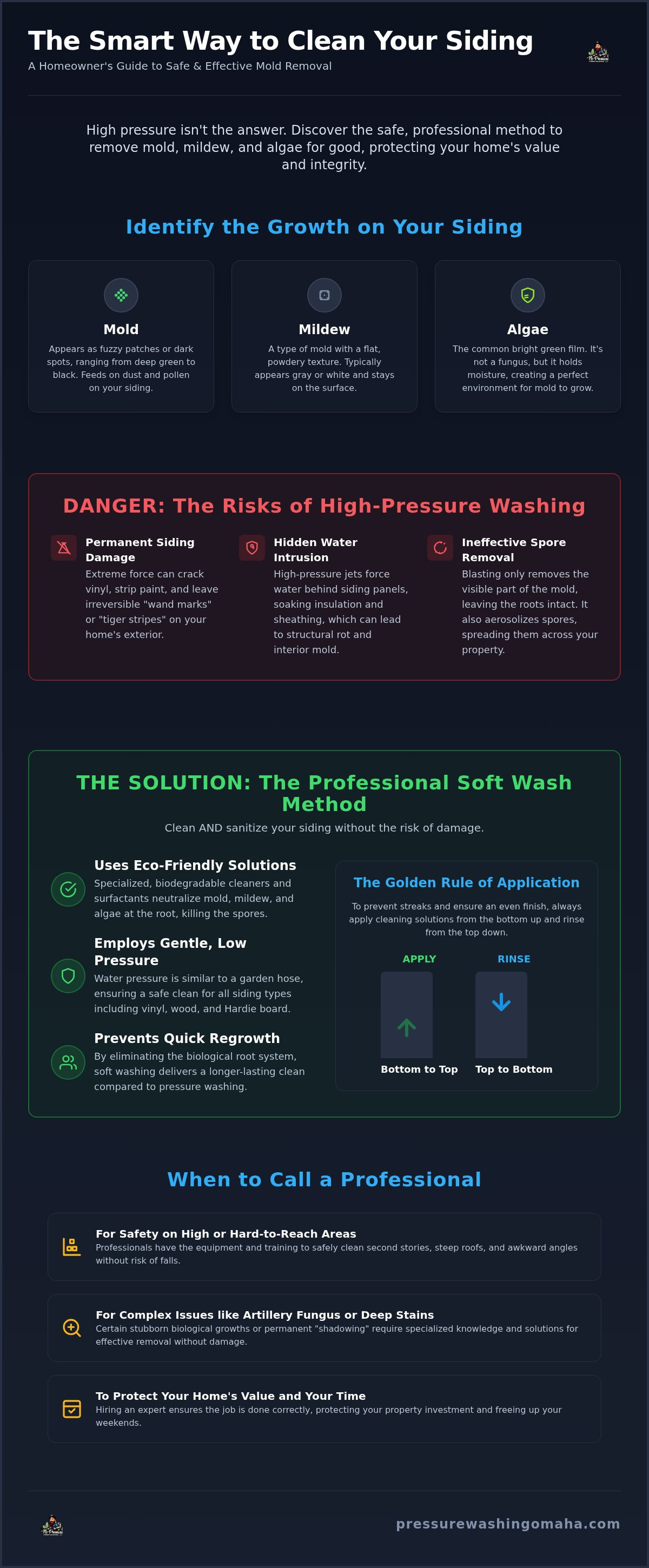
- Differentiate between mold, mildew, and algae to target the specific biological growth affecting your Omaha home.
- Understand why the professional soft-wash method is the safest way to remove mold from house siding while avoiding costly water intrusion.
- Learn the importance of using surfactants and eco-friendly solutions to neutralize spores rather than just moving them around.
- Master the bottom-up application technique to prevent permanent streaking and ensure an even, restored appearance.
- Recognize when safety risks or complex issues like artillery fungus make professional intervention the most responsible choice for your property.
Understanding Mold and Mildew Growth on Omaha Siding
Living in the Omaha metro area means dealing with a climate that mold absolutely loves. Our proximity to the Missouri River valley creates a natural humidity trap, turning the exterior of your home into a greenhouse for biological growth. Before you try to remove mold from house siding, it's helpful to know exactly what you're looking at. While many homeowners use the terms interchangeably, there are distinct differences between the green and black streaks on your walls.
- Mold: Typically appears as fuzzy patches or dark spots. It's a fungus that can range from deep green to "Omaha black."
- Mildew: A specific type of mold that usually grows in a flat, powdery pattern. It's often gray or white and stays on the surface.
- Algae: That bright, neon green film common in Nebraska. It's not a fungus, but it creates the perfect damp environment for mold to follow.
In neighborhoods across Papillion and Elkhorn, the north-facing side of a home is almost always the first to show these signs. Because these walls receive the least amount of direct sunlight, they stay damp long after the morning dew has evaporated from the rest of the house. This constant moisture, combined with the organic "food" that settles on your siding, creates an ideal breeding ground. Mold doesn't actually eat your vinyl or wood; it feeds on the microscopic layers of dust, agricultural pollen, and dirt trapped against the surface.
Why Mold Thrives on Vinyl and Hardie Board
Vinyl siding is a popular choice for its durability, but it carries a slight static charge. This charge acts like a magnet for airborne organic matter. Once this dust is stuck, mold spores find a steady food source. Fiber cement products, like Hardie board, often feature a deep wood-grain texture. While beautiful, these tiny ridges provide microscopic anchor points where spores can take root and resist a simple garden hose rinse. Without consistent UV exposure to act as a natural disinfectant, these colonies can double in size in just a few humid weeks.
The Hidden Dangers of Ignoring Siding Mold
Ignoring that green haze is more than just a cosmetic mistake. If left untreated, mold can eventually migrate behind the siding panels and into the wall cavity. Once moisture and spores reach the wooden sheathing or insulation, the repair costs can skyrocket. In vibrant communities like Gretna or Bennington, curb appeal is a vital part of maintaining property value. Beyond the look, certain types of biological growth can actually "etch" or permanently stain the finish of delicate siding materials. When you finally decide to remove mold from house siding that has been neglected for years, you might find a permanent "shadow" left behind in the material's finish.
The Risks of Traditional Pressure Washing for Mold Removal
It is a common sight across Omaha during the spring: a homeowner standing on a ladder, struggling with a high-pressure rental unit. The assumption is that more power leads to a cleaner home. However, using high-PSI water to remove mold from house siding is often a recipe for long-term property damage. Residential siding, whether it is vinyl, wood, or fiber cement, was never designed to withstand the concentrated force of several thousand pounds of pressure per square inch. This aggressive approach can easily crack aged vinyl or strip the protective paint and primer from high-quality wood siding.
The most significant danger is one you cannot see immediately. Siding is engineered to shed water that falls vertically, like rain. It is not a waterproof seal against horizontal, high-pressure jets. When you blast water directly at the seams or the "weep holes" in vinyl, you are forcing moisture behind the panels and into your home's wall cavity. This trapped water can soak into insulation and wooden sheathing, creating a hidden environment for structural rot and interior mold growth. Additionally, high pressure often interacts poorly with "oxidation," the chalky layer that forms on siding over time. Uneven pressure leaves permanent wand marks or "tiger stripes" that remain visible even after the surface is dry.
Why High Pressure Fails to Kill Spores
Using brute force to clean is fundamentally flawed because it only addresses the symptoms of biological growth. High pressure acts like a lawnmower; it cuts the "head" off the mold or algae but leaves the root system deeply embedded in the siding's pores. Because the spores are not neutralized, they begin to regrow almost immediately. Furthermore, the act of "blasting" mold can actually aerosolize the spores. You might clear one patch of green only to spread millions of microscopic spores to your deck, your roof, or your neighbor's property. The professional logic is simple: use science and chemistry to kill the growth at the cellular level rather than using force to move it around.
Common DIY Mistakes in Omaha Neighborhoods
We frequently see homeowners in Elkhorn and Papillion taking unnecessary risks by using high-pressure wands while standing on ladders. The "kickback" from a pressure gun is significant and can easily lead to a dangerous fall. It is also easy to overlook the technical details of your home's exterior, such as the vital weep holes that allow your siding to breathe. If you are unsure which approach is best for your specific material, you can read more in our comparison of Soft Wash vs. Power Wash: Choosing the Right Method for Your Omaha Home. To ensure your home is treated with the care it deserves, feel free to reach out for a professional siding assessment. Taking the time to remove mold from house siding safely will protect your investment for years to come.
Ingredients and Solutions: What Actually Kills Mold?
Effective cleaning is a matter of chemistry, not brute force. To truly remove mold from house siding, you need a solution that neutralizes spores at their source rather than just moving them around. Professionals primarily rely on a carefully balanced mixture of sodium hypochlorite and specialized surfactants. Sodium hypochlorite acts as the sanitizing agent, breaking down the cellular structure of mold, mildew, and algae. While household bleach contains similar base ingredients, professional-grade solutions are specifically buffered to protect your siding's finish while remaining potent enough to eliminate deep-seated biological growth.
Surfactants are the unsung heroes of the soft wash process. Without them, any liquid applied to a vertical wall would simply run off before it had time to work. These agents break the surface tension of the water, allowing the cleaning solution to "cling" to the siding. This extended dwell time is what permits the chemistry to penetrate the microscopic roots of the mold rather than just clearing the surface. While DIY enthusiasts often try using standard dish soap, these products lack the chemical stability and rinsing properties of professional-grade detergents.
Homeowners often experiment with vinegar or baking soda mixtures based on online advice. While vinegar is mildly acidic and can kill some surface mold, it often lacks the strength to tackle large-scale exterior infestations common in Nebraska's humidity. More importantly, vinegar can react poorly with certain siding finishes if not handled correctly. Professional detergents are engineered for the specific task of biological remediation on vertical surfaces, providing a level of thoroughness that household staples simply cannot match.
The Science of Surfactants and Neutralizers
The goal is a deep clean that respects the integrity of your property. By using non-toxic, biodegradable agents, we ensure that the process is safe for Papillion gardens and local pets. These solutions are pre-buffered to prevent the etching or dulling that can occur with raw, unmanaged chemicals. It's a precise science that balances cleaning power with material preservation. This specialized approach ensures that the root of the biological growth is eliminated, which is the only way to effectively remove mold from house siding for the long term.
Environmentally Responsible Practices
Protecting the local Omaha ecosystem is a priority for every project. A critical step in our process involves pre-wetting all surrounding landscaping. By saturating the soil and leaves with fresh water first, we create a protective barrier that prevents plants from absorbing any runoff. This is followed by a meticulous final rinse of the entire work area to ensure no residue remains. No Pressure Power Washing is committed to these environmentally responsible practices, ensuring that your home's restoration doesn't come at the expense of your lawn or the wider Metro environment.
Step-by-Step Guide: How to Safely Remove Mold from House Siding
Executing a successful exterior clean requires a methodical approach that prioritizes the safety of your home and your landscaping. While the chemistry does the heavy lifting, the sequence of your actions determines whether you achieve a professional finish or leave behind unsightly streaks. To effectively remove mold from house siding, you must move beyond the "point and spray" mentality and follow a structured workflow that protects every component of your property.
Phase 1: Preparation and Safety Check
A professional clean always begins with a detailed perimeter inspection. Walk around your home and look for loose vinyl panels, cracked wood, or gaps in the caulking around windows. These are entry points where water can bypass the siding. Before you mix any solutions, ensure all windows are tightly closed and outdoor electrical outlets are covered. Personal safety is equally important; high-alkaline cleaners can irritate the skin and eyes, so wearing gloves and wrap-around eye protection is a requirement. Finally, protect your Omaha lawn by saturating all nearby plants, shrubs, and grass with fresh water. This creates a moisture barrier that prevents the foliage from absorbing any cleaning runoff.
Phase 2: The 'No Pressure' Cleaning Technique
The most effective way to apply your cleaning solution is from the bottom of the wall moving upward. This bottom-up application prevents the cleaner from running down dry siding, which is the primary cause of permanent "clean streaks" that are nearly impossible to remove later. You can use a downstream injector on a low-pressure setting or a dedicated pump sprayer to mist the surface. Once applied, watch for the "kill signals." As the solution neutralizes the biological growth, you'll see the bright green algae or dark mold turn a light brown or become translucent. This dwell time usually takes five to ten minutes. If you're working on a heavily shaded north-facing wall in Elkhorn or Papillion, you may need a "rinse and repeat" cycle for deep-seated infestations.
Phase 3: Post-Cleaning Inspection
Rinsing is the only stage where you work from the top down. Using low-pressure, high-volume water, wash the debris toward the ground to ensure no mold spores remain trapped in the overlapping joints of the siding. Pay close attention to the weep holes at the bottom of vinyl panels; ensure they're clear of soap and organic matter so the siding can breathe properly. A final rinse of the windows is essential to prevent mineral spotting as the house dries. If you find that the height of your peaks or the complexity of the mold growth is more than you're comfortable handling, you can always rely on Professional House Washing in Omaha to restore your home's original beauty safely.
When to Call a Professional for Siding Mold Removal
While the steps to remove mold from house siding are straightforward, certain challenges require specialized intervention to protect both your safety and your property. For many homeowners, the deciding factor is the "Two-Story Rule." Managing a pressure wand while balanced on a ladder is a significant safety risk. The recoil from a spray gun can easily shift your center of gravity, leading to a dangerous fall. Professional teams use high-reach equipment that allows them to clean peaks and soffits while keeping their feet safely on the ground.
Another common reason to seek expert help is the presence of "artillery fungus." These tiny black dots, often mistaken for mold or "spider droppings," are actually sticky spores that launch from nearby mulch. Standard DIY methods often fail to budge these spots without damaging the siding's finish. Professionals use specific surfactants and temperature controls that break the bond of the fungus without the need for high-PSI blasting. This level of precision is difficult to achieve with standard retail equipment.
Professional-grade systems also offer a technical advantage that consumer-grade rentals cannot match. Our equipment prioritizes high water volume over high pressure. This allows the cleaning solution to be thoroughly rinsed away, ensuring a 100% kill rate of all biological spores. When you remove mold from house siding using a professional soft-wash approach, you aren't just cleaning the surface; you're sanitizing the material to prevent regrowth from occurring just a few weeks later. This thoroughness is what provides long-term value for your home's exterior.
The 30-Year No Pressure Advantage
With over 30 years of local experience, we understand that your home is your largest investment. Soft-washing is often the only cleaning method that preserves manufacturer siding warranties, as high-pressure washing can be cited as "improper maintenance" if damage occurs. For busy families in Bellevue or Elkhorn, this "set it and forget it" approach provides the peace of mind that the job is done right the first time. You can learn more about these standards in our Professional Pressure Washing in Omaha: The Complete Property Maintenance Guide (2026).
Getting a Free Estimate in the Omaha Metro
A professional consultation is about more than just a price tag. It's an opportunity for a local expert to assess the specific environmental factors affecting your property, from Missouri River humidity to local pollen counts. Choosing a licensed and insured specialist ensures that your property is protected throughout the entire restoration process. We take pride in being the trusted guardians of Omaha's exteriors, treating every home with the same meticulous care we would our own. Our goal is to provide a stress-free experience that leaves your home looking its absolute best.
Get your free house washing estimate today
Protecting Your Home’s Curb Appeal for the Long Term
Maintaining a beautiful exterior in the Omaha metro area is a continuous process that requires the right balance of safety and science. You've learned that the most effective way to remove mold from house siding isn't through brute force, but through the gentle application of 100% biodegradable solutions that neutralize spores at the root. By choosing specialized soft-wash technology over aggressive high-pressure methods, you protect your siding's warranty and prevent the hidden dangers of water intrusion. This methodical approach ensures your home stays cleaner for much longer than a standard DIY blast ever could.
Whether you decide to tackle the lower levels yourself or prefer the peace of mind that comes with 30+ years of local experience, the priority remains the same: preservation. A clean home is a protected home, and taking a conscientious approach to exterior maintenance ensures your property remains a source of pride for years to come. We are here to help you navigate these environmental challenges with precision, care, and the high standards your investment deserves. Your home is your sanctuary, and it's our privilege to help you keep it looking its absolute best.
Frequently Asked Questions
Is mold on my siding dangerous to my family?
While mold on the exterior is primarily a cosmetic and structural issue, it can become a health concern if spores enter your home through windows or HVAC intakes. For those with respiratory sensitivities or allergies, high concentrations of spores near entry points can trigger discomfort. Removing growth promptly prevents these biological particles from migrating into your living spaces, ensuring your family enjoys a cleaner, safer environment both inside and out.
Can I use household bleach to clean my vinyl siding?
Household bleach can kill surface growth, but it's often too aggressive for the finish on your vinyl and dries too quickly to be effective. Professionals use sodium hypochlorite that is pre-buffered and blended with surfactants. These additives help the solution stick to vertical surfaces, allowing it to penetrate the roots of the mold. Without these professional stabilizers, you risk dulling your siding or leaving behind streaks that are difficult to fix.
How often should I have my house siding cleaned in Omaha?
For most properties in the Omaha metro area, a professional cleaning every 12 to 24 months is ideal for maintaining the siding's integrity. Our local humidity and proximity to the Missouri River create a high-growth environment for biological spores. If your home has significant tree cover or a large north-facing wall, you might notice green film returning sooner, requiring more frequent attention to prevent permanent staining or etching of the material.
Will professional mold removal damage my plants or flowers?
No, professional mold removal is safe for your landscape when the proper precautions are taken. We use 100% biodegradable solutions and follow a strict "pre-wetting" protocol for all nearby flowers and shrubs. By saturating the soil and leaves with fresh water first, we create a protective barrier that prevents the plants from absorbing the cleaning agents. A thorough final rinse ensures your garden remains as healthy as your newly cleaned siding.
What is the difference between green mold and black dots on siding?
Green growth is typically algae or mildew that thrives in damp, shaded areas, while small black dots are usually artillery fungus. Algae is a surface-level issue that responds well to standard soft-washing. In contrast, artillery fungus is a sticky spore launched from mulch that "glues" itself to your siding. While algae is easily neutralized, those black dots often require specialized treatment and manual care to remove without damaging the underlying surface.
Can I remove mold from my siding without a pressure washer?
Yes, the soft-wash method is the safest way to remove mold from house siding without using a high-pressure washer. This approach relies on specialized, non-toxic chemistry to neutralize biological growth at the source. Because it uses low-pressure, high-volume water, it eliminates the risk of cracking vinyl, stripping paint, or forcing water behind your siding panels. It is the preferred professional standard for both efficiency and long-term property protection.
How much does it cost to professionally remove mold from siding?
Professional cleaning costs are determined by several factors, including the total square footage of the home, the height of the peaks, and the severity of the mold infestation. Every property presents unique challenges, such as accessibility or the type of siding material involved. To get an accurate understanding of the investment required for your specific home, we recommend requesting a personalized estimate from a local specialist who understands Omaha's environmental conditions.
Does vinegar really kill mold on house siding?
Vinegar is a mild antimicrobial that can kill some mold species, but it's generally ineffective for large-scale exterior cleaning. It lacks the surfactants needed to "cling" to vertical siding, meaning it often runs off before it can neutralize the spores. For a complete kill rate that prevents rapid regrowth, professional-grade detergents are necessary. These solutions are engineered to penetrate the textured surfaces of your siding where vinegar simply cannot reach.


