

What if the very tool you think is cleaning your home is actually eroding its foundation one mortar joint at a time? Many homeowners in our community believe that high-pressure water is the only way to blast away years of Nebraska grime, but for those seeking professional brick exterior cleaning Elkhorn residents can trust, that approach often does more harm than good. You've likely seen the results of aggressive cleaning: blown-out mortar, etched brick faces, or that frustrating white efflorescence that seems to return just weeks after a wash. We understand the hesitation to hire a service when your home's structural integrity is on the line.
It's entirely possible to restore your home's vibrant, original color without risking the masonry or your landscaping. This guide explains the professional soft-wash methodology we've refined since 1994 to safely eliminate organic growth and salt deposits. We'll walk you through the science of why Nebraska humidity fuels algae, how to stay compliant with Chapter 32 of the Omaha Municipal Code regarding wastewater discharge, and why a chemical-first approach is the only way to ensure your brick truly breathes again.
Key Takeaways
- Understand why a "chemical-first" methodology is safer than high pressure for preserving the structural integrity of your home's mortar joints.
- Discover the science behind efflorescence and how to effectively treat the white salt streaks that often plague Nebraska masonry.
- Learn the precise steps involved in brick exterior cleaning Elkhorn professionals use to remove deep-seated agricultural dust and organic growth.
- Identify the benefits of using biodegradable surfactants that eliminate algae at the root for a longer-lasting, more uniform restoration.
- Gain insights into critical pre-inspection checks, such as clearing weep holes, that prevent accidental water intrusion during the cleaning process.
Why Brick Exterior Cleaning in Elkhorn Requires a Specialized Approach
Elkhorn sits at a unique crossroads in Western Douglas County. Having served this community since 1994, we've seen how local environmental factors dictate the health of your home. Brick isn't a solid, impenetrable shield; it's a living system of pores and mortar. When we perform brick exterior cleaning Elkhorn residents often realize that surface dirt is just the beginning. Fine prairie dust and agricultural runoff from nearby fields migrate deep into the masonry, creating a nutrient-rich environment for organic growth.
Understanding The Science of Masonry is essential for any restoration project. Brick is a "breathing" substrate. If those pores are clogged by pollutants, the brick can't shed moisture effectively. While a clean home certainly boosts property value, the primary reason for a professional wash is long-term preservation. Curb appeal is a benefit, but structural durability is the goal. We've spent three decades perfecting a process that respects these materials while removing stubborn Nebraska grime that standard garden hoses can't touch.
There's a significant difference between surface-level dust and deep-seated infestations. Surface dirt is mostly an aesthetic issue, easily rinsed away. However, organic growth like moss and lichen actually anchors itself into the brick's pores. These organisms secrete mild acids that can slowly weaken the brick and mortar over time. By the time you see a green tint or black streaks, the root systems are already established. Treating these requires a specialized approach that goes beyond a simple rinse to ensure the life of the wall isn't compromised.
Nebraska's Freeze-Thaw Cycle and Your Brick
Nebraska winters are notoriously hard on masonry. When grime accumulates, it acts like a sponge, holding moisture against the brick face. As temperatures drop, that trapped water expands with immense force. This pressure causes spalling, where the brick face begins to flake and crumble. A thorough house washing removes these moisture-trapping barriers before the frost sets in, protecting your home's structural integrity.
Common Biological Growths in the Elkhorn Area
If you see black streaks or green patches, you're looking at living organisms like Gloeocapsa Magma. Elkhorn's humidity, fueled by local waterways, creates a perfect breeding ground. Simply spraying water doesn't kill the root systems. During brick exterior cleaning Elkhorn homeowners often find that without specialized solutions, these growths return quickly. We use a "No Pressure" approach to kill the roots safely without forcing water into the masonry.
The Science of Masonry: Understanding Porosity and Mortar Integrity
To understand why we treat masonry with such care, you first have to realize that brick is essentially a hard sponge. It's what professionals call a "porous substrate." Unlike vinyl or metal siding, brick contains millions of microscopic pathways. These pores allow your home to "breathe" by letting internal moisture escape, but they also act as entry points for external contaminants. When we perform brick exterior cleaning Elkhorn residents often ask why we don't just "blast" the dirt away. The answer lies in the delicate balance of these pores.
Mortar is designed to be the "sacrificial" element of your wall. It's intentionally softer than the brick because it's meant to absorb the stress of building movement and environmental expansion. If you compromise the mortar, you're removing the primary defense mechanism of your home's structural shell. High-pressure water doesn't just remove dirt; it can physically erode this sacrificial layer. Forcing water into the wall cavity behind the brick veneer can lead to hidden mold growth and structural rot that you won't see until it's a major expense.
The Danger of High PSI on Aged Brick
Aged brick has a protective "fire skin" created during the kiln-firing process. High-pressure washing often etches or strips this layer away. Once that skin is gone, the softer, more absorbent interior of the brick is exposed. This makes the surface more abrasive, which actually causes it to trap dirt and organic growth faster than before. We've seen many DIY attempts result in "blowouts," where chunks of mortar are blasted entirely out of the joints. If you're noticing these white streaks or crumbling mortar, it's best to have a professional evaluate your home's exterior before the next season hits.
Efflorescence and Secondary Staining
Those unsightly white, powdery streaks you see are called efflorescence. This happens when water moves through the masonry, dissolves internal salts, and carries them to the surface. As the water evaporates, the salt remains. A proper guide on How to Safely Clean Brick Exteriors explains that you can't just rinse these salts away; you must neutralize the pH of the brick to prevent them from returning. In Nebraska, we also frequently encounter iron and manganese stains from our mineral-rich soil. These require specific, biodegradable detergents to lift safely. This same salt migration often affects walkways, which is why we frequently integrate concrete cleaning into our full-property restoration plans.
Soft Washing vs. Pressure Washing: Which Is Right for Elkhorn Bricks?
Homeowners often use the terms "pressure washing" and "soft washing" interchangeably, but in the world of professional masonry care, they are polar opposites. Standard pressure washing relies on sheer mechanical force, often reaching 1,500 to over 5,000 PSI, to strip contaminants from a surface. While this works for some materials, it's often too aggressive for the porous nature of Nebraska masonry. For effective brick exterior cleaning Elkhorn residents need a method that prioritizes chemistry over brute force. Soft washing utilizes high water volume at a much lower pressure, typically in the 200 to 300 PSI range, which is roughly equivalent to a strong garden hose.
The real heavy lifting in a soft wash is done by biodegradable surfactants and algaecides. These solutions penetrate the microscopic pores of the brick to emulsify dirt and kill the root systems of organic growth. Think of pressure washing as "mowing the lawn" where you only take off the top of the weeds. Soft washing is more like pulling the weed out by the root; it ensures the growth doesn't return just a few weeks later. This method is significantly safer for the seals around your windows and the delicate mortar joints that hold your home together. It's a methodical process that keeps your bricks cleaner for longer while protecting your Elkhorn landscaping from the high-velocity water damage common with DIY attempts.
The Soft Wash Methodology Explained
Our "No Pressure" approach is designed to protect your home's thermal envelope. When high pressure is applied to a vertical wall, water can be forced behind the brick veneer, soaking the insulation and creating a breeding ground for internal mold. By sticking to low-pressure applications, we avoid these structural risks entirely. This philosophy aligns with the National Park Service guide to masonry cleaning, which emphasizes using the gentlest means possible to achieve a clean result without altering the masonry's physical properties. It's about restoration, not just rinsing.
When (and When Not) to Use Pressure
There are rare instances where moderate pressure is appropriate, but these are almost exclusively reserved for horizontal hardscapes. For example, dense concrete surfaces like driveways can withstand higher PSI to lift deep oil stains or tire marks. However, even paver cleaning requires a nuanced touch to avoid displacing the stabilizing sand between the joints. Vertical brick siding should almost never see high PSI. The risk of permanent etching or mortar blowout is simply too high for the minor time savings a high-pressure wand might offer. We've spent 30 years learning these boundaries so you don't have to learn them through a costly repair bill.
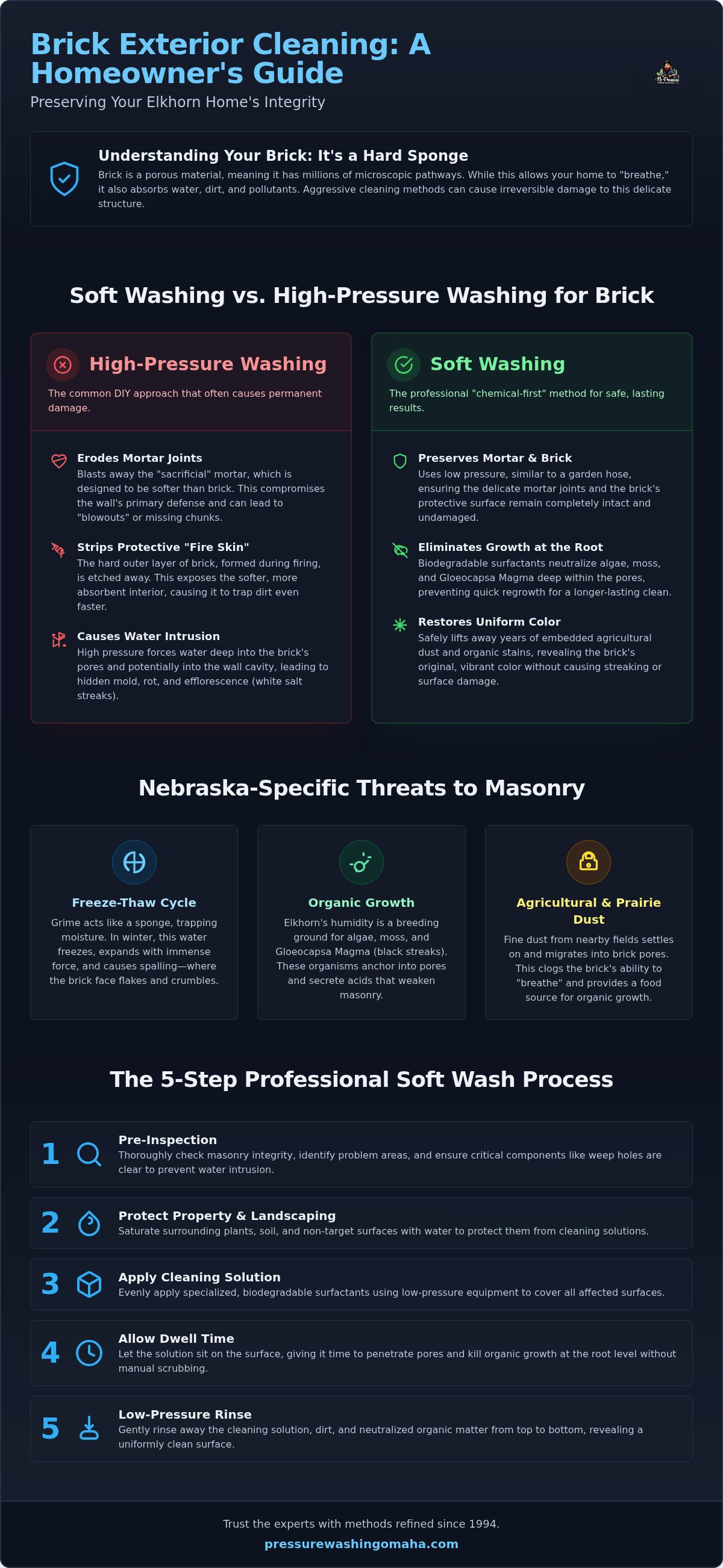
How to Safely Clean Brick Exteriors: A Step-by-Step Professional Process
Restoration is a methodical science that requires more than just a wand and a bucket. When performing brick exterior cleaning Elkhorn homeowners often notice that our most intensive work happens before the water even starts flowing. A professional approach treats your home as a complete assembly, where protecting the mortar and the surrounding environment is just as vital as removing the stains. We've spent 30 years refining a sequence that ensures years of Nebraska grime are lifted without compromising the structural integrity of your masonry.
Step 1-3: Preparation and Protection
We begin with a rigorous pre-inspection, specifically looking for loose mortar or obstructions in your "weep holes." These small gaps are essential for drainage; if they're blocked, moisture gets trapped behind the brick, leading to rot. To safeguard your property, we cover all outdoor outlets and lighting fixtures. A critical, often overlooked step is saturating your landscaping with fresh water. Plants are naturally thirsty. By pre-soaking them, we ensure their root systems are "full," which prevents them from absorbing any cleaning solutions that might reach the soil.
We also perform a "pre-wet" of the brick itself. Dry brick is highly absorbent and will pull cleaning chemicals deep into its core, making them difficult to rinse out. By saturating the masonry first, we keep the detergents on the surface where they can effectively break down pollutants. We always test our customized solution on an inconspicuous area to ensure the perfect chemical balance for your specific brick type before proceeding with the full house washing process.
Step 4-6: Application, Dwell, and Low-Pressure Rinse
Our application process moves from the bottom up to prevent "streaking" from chemical run-down. We use a specialized surfactant blend that targets carbon, algae, and salt deposits. Dwell time is where the real restoration happens; we monitor the brick closely to ensure the solution stays wet and active. If it dries, it can leave a film that's difficult to remove. Once the organic growth is emulsified, we use a high-volume, low-pressure rinse (typically under 300 PSI) to gently sweep the contaminants away. This method ensures we don't violate Chapter 32 of the Omaha Municipal Code by allowing improper runoff into the storm sewer system.
Post-Cleaning Assessment
After the final rinse, we conduct a walkthrough to inspect the mortar joints. This is the best time to identify if your home needs tuckpointing or minor repairs, as the clean surface reveals the true condition of the masonry. We also verify that all cleaning agents are neutralized to maintain a safe pH balance for your brick. The final rinse is the most critical step for property safety because it ensures all cleaning agents are fully neutralized and flushed away from sensitive masonry and landscape root zones.
Choosing an Elkhorn Expert for Your Brick Restoration
Selecting a contractor for brick exterior cleaning Elkhorn homes requires more than just comparing the lowest prices. It's about finding a specialist who understands the unique architectural history of Western Douglas County. Since approximately 1994, we've lived and worked in this community, witnessing firsthand how our local soil and humidity patterns affect masonry. This 30-year history isn't just a number; it's a deep archive of knowledge that allows us to distinguish between a simple surface stain and a structural warning sign. When you hire a local expert, you're investing in someone who views your home as a vital part of the community's fabric.
Safety remains our primary metric for success. We exclusively use non-toxic, biodegradable cleaning solutions that are safe for your children, pets, and the sensitive landscaping we've discussed in previous sections. These surfactants effectively eliminate organic growth without leaving behind harsh chemical residues that can linger in the soil. When you're reviewing estimates, transparency is key. A professional quote should clearly outline the scope of work, include proof of liability insurance, and account for Nebraska's specific tax regulations on building maintenance services. This level of detail protects you from the hidden costs often associated with fly-by-night operations.
Many homeowners find that a total property refresh yields the most satisfying results. Combining masonry restoration with a comprehensive house washing ensures that dirt from your siding or gutters doesn't wash down onto your freshly cleaned bricks during the next heavy rain. It's a holistic approach that protects your entire investment and provides a uniform, "like-new" appearance across all exterior surfaces.
The 'No Pressure' Difference
Our business name is more than a slogan; it's a technical promise to our neighbors. We've invested in specialized equipment designed specifically for residential masonry, allowing us to deliver high water volume without the destructive PSI of a standard power washer. We prioritize preservation over speed. While some national chains might rush through a job to meet a high-volume quota, we take the time to ensure every mortar joint is respected and every garden bed is protected. We're "trusted guardians" of your property, focused on doing the job correctly the first time.
Ready to Restore Your Elkhorn Home?
Whether you're in the heart of Elkhorn or in the growing neighborhoods of Gretna, getting started is simple. Our service appointments are designed to be steady and methodical, mirroring the careful nature of the work we perform. We provide free, no-obligation assessments that give you a clear understanding of your brick's current condition and the long-term results you can expect from a professional restoration.
Schedule your professional brick cleaning estimate today!
Protect the Integrity of Your Elkhorn Masonry
Your home's brickwork is a significant investment that deserves a preservation-first mindset. We've explored how brick functions as a porous system and why high-pressure water is often the enemy of structural mortar. By prioritizing a soft-wash methodology, you ensure that organic infestations are eliminated at the root without forcing moisture into your home's thermal envelope. This careful balance is what defines professional brick exterior cleaning Elkhorn residents have relied on for decades.
Our team brings over 30 years of local expertise to every project. We use specialized equipment and eco-friendly, non-toxic cleaning solutions to deliver a thorough restoration that is safe for your family and your landscaping. As a fully insured, locally owned business since 1994, we take pride in being the trusted guardians of our community's properties. We're ready to help you remove years of Nebraska grime and restore your home's original, vibrant character.
We look forward to providing the expert guidance and meticulous care your home deserves. Let's ensure your masonry remains beautiful and durable for many years to come.
Common Questions About Brick Restoration in Elkhorn
Is brick pressure washing safe for older homes in Elkhorn?
Standard high-pressure washing is rarely safe for older masonry because it can strip the protective kiln-fired surface and erode soft mortar. Instead, we utilize a "No Pressure" soft-wash system that relies on biodegradable cleaners to do the work. This specialized approach for brick exterior cleaning Elkhorn residents prefer ensures the structural integrity of historical homes remains intact while removing decades of environmental buildup.
How often should I have my brick exterior cleaned in Nebraska?
Most Nebraska homes benefit from a professional cleaning every two to three years. However, this timeline varies based on your property's specific microclimate, such as proximity to local waterways or heavy tree canopies that increase shade and moisture. Regular maintenance prevents organic growth from anchoring deep into the pores, which simplifies future cleanings and extends the life of your mortar joints.
Will the cleaning chemicals harm my lawn or landscaping?
Our cleaning solutions are biodegradable and non-toxic, designed to be safe for your plants and pets when applied by trained technicians. We take the added precaution of saturating your landscaping with fresh water before and after the application. This "pre-wetting" process ensures that plant root systems are fully hydrated, preventing them from absorbing any of the cleaning agents used during the restoration.
Can you remove the white powdery stains (efflorescence) from my brick?
Yes, we can effectively treat efflorescence, though it requires a specific chemical neutralization rather than just a rinse. These white salt deposits are common in our mineral-rich Nebraska soil and occur when moisture carries internal salts to the surface. We use professional-grade surfactants to dissolve the salts and balance the brick's pH, which helps prevent the powdery streaks from returning soon after.
How long does the professional brick cleaning process take?
A standard residential project typically takes between four and eight hours to complete. The exact duration depends on the total square footage of the masonry and the severity of the organic growth or carbon staining. Because we prioritize thoroughness over speed, we allow for proper dwell times to ensure the root systems of algae and moss are completely eliminated before the final low-pressure rinse.
Do I need to be home while you clean my brick exterior?
You don't need to be present while we perform the service as long as we have access to an exterior water source. We ask that you ensure all windows and doors are securely closed and that any sensitive items are moved away from the work area. Our team follows a methodical safety checklist to protect your property, allowing you to return home to a fully restored exterior without any interruption to your day.
What is the difference between soft washing and standard power washing for brick?
The fundamental difference is the reliance on chemistry versus brute force. Standard power washing uses water pressure exceeding 1,500 PSI to blast away surface dirt, which can easily damage porous brick. Soft washing uses high water volume and low pressure (under 300 PSI) combined with surfactants to kill organic growth. This ensures a deeper, longer-lasting clean for brick exterior cleaning Elkhorn homeowners can rely on without risking masonry damage.
Can professional cleaning help me identify if I need tuckpointing?
Absolutely, as removing layers of dirt and moss is the only way to accurately assess the condition of your mortar. Grime often hides cracks, gaps, and "soft spots" where the mortar has begun to fail. Once the brick is clean, we perform a post-service walkthrough to point out any areas where the sacrificial mortar has eroded, giving you the information needed to schedule timely masonry repairs before water intrusion occurs.


