

You pull into your garage and notice a dark, shimmering pool where your guest’s car was parked just an hour ago. It’s a sinking feeling because you know that oil doesn't just sit on the surface; it begins a slow, destructive soak into the pores of your concrete. If you don't act quickly, that spot becomes a permanent shadow that tracks into your home and invites unwanted attention from the HOA. Effective oil stain removal driveway restoration is about more than just hiding the mess; it’s about protecting your property's value and structural integrity.
We understand the frustration of scrubbing for hours only to see the stain return as soon as the concrete dries. You likely agree that a "good enough" cleaning isn't sufficient when oil is tracking onto your carpets or devaluing your Omaha home. This guide promises to help you master the science of lifting these spots, ensuring you achieve a complete restoration rather than just a faded mark. We will preview the latest 2026 eco-friendly cleaners, discuss the city's prohibited discharge regulations under the Omaha Municipal Code, and explain why professional hot-water methods are often the only way to save a heavily saturated slab.
Key Takeaways
- Concrete acts like a hard sponge, wicking oil deep into its structure through microscopic capillaries. Understanding this porosity is the first step toward effective restoration.
- Learn how to manage fresh spills using blotting techniques and absorbent materials to simplify the oil stain removal driveway process before the liquid bonds to the surface.
- Discover why common household remedies like phosphoric acid can permanently etch your concrete and which non-toxic alternatives actually work.
- See why professional-grade hot water pressure washing is essential for emulsifying deep-set grease that cold water and standard garden hoses can't touch.
- Explore how to protect your investment with high-quality sealants while staying compliant with Omaha’s strict runoff and environmental regulations.
The Science of Concrete: Why Oil Stains Are So Persistent
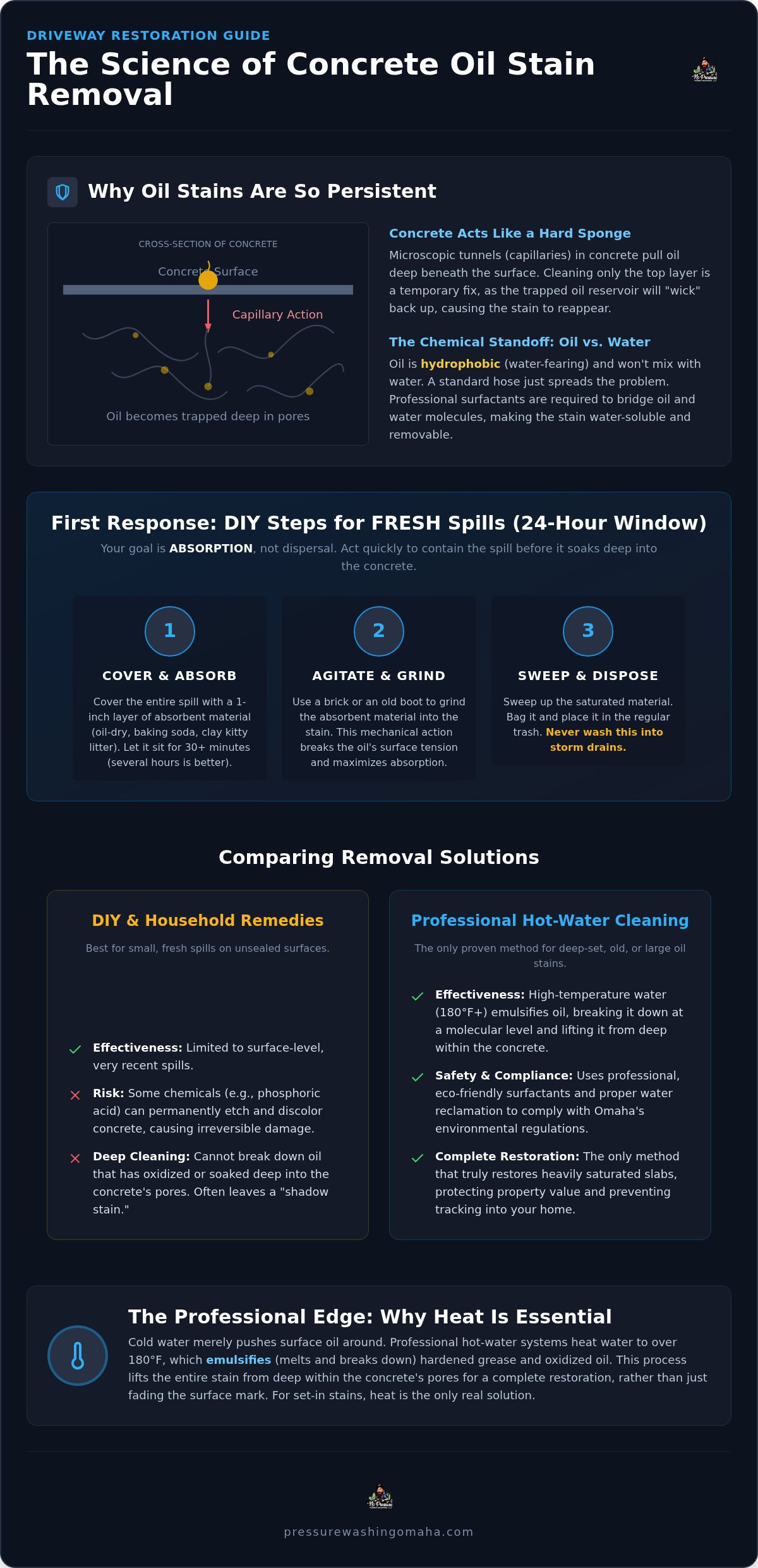
Most homeowners view their driveway as a solid, impenetrable slab of stone. In reality, concrete is a complex network of microscopic voids and capillaries. When a vehicle leaks, these tiny tunnels pull petroleum products deep beneath the surface through a process called capillary action. This is why oil stain removal driveway projects often fail when you only address the surface level. You might scrub away the top layer, but the reservoir of oil trapped in the pores will eventually "wick" back up to the top, causing the spot to reappear days later.
Capillary Action and Concrete Porosity
Think of your driveway as a very hard, very dense sponge. Petroleum products have a low surface tension, which allows them to seep into the smallest cracks and voids created during the concrete's curing process. Once the oil enters these capillaries, it creates what we call a "shadow effect." This happens because the oil has permanently altered the way the concrete reflects light and absorbs moisture. Even if the surface feels dry to the touch, the internal structure remains saturated. For a truly deep-pore restoration, professional concrete cleaning is required to draw those contaminants out of the microscopic tunnels rather than just washing them over the side of the slab.
Chemical Breakdown: Oil vs. Water
Oil is hydrophobic, a term that literally means "water-fearing." On a molecular level, oil and water molecules refuse to bond or mix. This chemical standoff is the reason a standard garden hose is largely ineffective for cleaning a leak. You're essentially trying to push a dense, sticky substance with a fluid that slides right over it. The Science of Stain Removal dictates that we must change the chemistry of the oil to make it water-soluble before it can be removed.
This is where surfactants come into play. Surfactants act as the bridge between oil and water for extraction, possessing one end that attaches to oil and another that bonds with water. In Omaha, our local climate adds another layer of difficulty. Our high-humidity summers can slow the evaporation of lighter oil fractions, giving the fluid more time to sink deeper into the driveway. As the oil sits, it begins to oxidize and "dry out," turning from a liquid into a resin-like solid that bonds to the cement paste. Once this oxidation occurs, the stain is no longer just a spill; it’s a part of the concrete's chemical makeup, requiring professional-grade heat and chemistry to break those bonds.
Step-by-Step DIY Oil Removal for Fresh Spills
If you spot a fresh leak on your concrete, the clock is ticking. You have a window of roughly 24 hours before the oil migrates from the surface into those microscopic capillaries we discussed earlier. Your primary goal during this phase is containment. Never spray a fresh oil spill with a garden hose; this only spreads the petroleum across a larger surface area and pushes it deeper into the concrete pores. Instead, you need to blot the liquid. This immediate response is the most effective form of oil stain removal driveway maintenance a homeowner can perform.
Phase 1: Absorption and Containment
The first step is drawing out as much standing liquid as possible. Use a generous amount of absorbent material to act as a wick. While many homeowners reach for clay-based kitty litter, specialized "oil-dry" products or even baking soda are often more effective because they have a finer grain. This DIY Oil Stain Removal Guide suggests using these common materials to pull the oil upward before it has a chance to bond to the cement paste.
- Step 1: Cover the entire spot with at least an inch of absorbent material. Let it sit for a minimum of 30 minutes, though several hours is better for heavier leaks.
- Step 2: Use an old boot or a brick to grind the material into the stain. This mechanical action breaks the surface tension and forces the absorbent into the top layer of the concrete voids.
- Step 3: Sweep the saturated material into a dustpan. In Omaha, you must never wash this debris into the street. The Omaha Municipal Code, Chapter 32, prohibits discharging contaminated runoff into the storm sewer system. Bag the used absorbent and dispose of it in your regular trash.
Phase 2: The Agitation Method
Once the standing oil is gone, you'll likely see a dark "shadow" left behind. This is the oil that has already begun its descent into the slab. To fight this, you need a high-quality surfactant. Concentrated dish soap or a heavy-duty laundry detergent works well for minor surface spots because they are designed to break down grease bonds. Apply the cleaner directly to the spot with a small amount of warm water to create a thick paste.
Grab a stiff-bristle nylon brush for agitation. Never use a wire brush, as the metal bristles can scratch the concrete surface or leave behind tiny metal fragments that will eventually rust and create a new set of stains. Scrub in a circular motion, working from the outside of the stain toward the center to prevent spreading. Rinse the area with a bucket of water and blot the residue with rags. You'll likely need to repeat this cycle three or four times. If the shadow persists after multiple attempts, you may be dealing with a deeper saturation that requires specialized extraction equipment to fully resolve.
Comparing Solutions: Household Remedies vs. Industrial Degreasers
When homeowners face the challenge of an oil stain removal driveway project, the first instinct is often to check the pantry rather than the hardware store. While household items are convenient, they often lack the chemical strength to handle deep-set petroleum. Worse, some "viral" remedies can cause permanent damage to the concrete surface. Selecting the right solution requires a balance between chemical effectiveness and the long-term health of your driveway's finish.
The "Coca-Cola" myth is a prime example of a well-intentioned but risky remedy. While the phosphoric acid in cola can break down certain types of grime, it's also strong enough to etch the surface of your concrete. This creates a rough, discolored patch that is often more unsightly than the original oil spot. Similarly, the combination of baking soda and vinegar creates a satisfying fizz, but this reaction is largely cosmetic. It lacks the emulsifying power needed to pull hydrophobic oil molecules out of the dense concrete capillaries we explored in the first section of this guide.
The Pros and Cons of Common Household Items
Household dish soap is a reliable surfactant for surface-level spills because it's specifically engineered to break the bonds of animal fats and light oils. It's a safe, non-toxic starting point for any fresh leak. However, it usually stalls when it meets heavy-duty motor oil or transmission fluid that has already begun to oxidize. Many people attempt to compensate for weak chemicals by using a consumer-grade pressure washer. Without the addition of heat and specialized degreasers, high pressure alone can actually damage the concrete by "wand marking" the surface or blowing out the cream coat. For those who want the certainty of a deep clean without the risk of surface scarring, professional driveway cleaning services utilize industrial-grade equipment that balances heat, pressure, and chemistry.
Safety and Environmental Considerations
In Omaha, the choice of cleaner isn't just about results; it's about responsibility. Any chemical you apply to your driveway will eventually find its way into the local storm sewer system, which flows directly into our local waterways. Many store-bought industrial degreasers contain harsh solvents or high-acid content that can kill nearby grass and violate EPA runoff standards. No Pressure Power Washing prioritizes the use of biodegradable, non-toxic solutions that break down oil without poisoning the soil or harming your landscaping. Maintaining the longevity of your concrete requires the use of neutral pH cleaners that lift contaminants without compromising the cement's alkaline balance. This meticulous approach ensures that your home stays beautiful and compliant with local environmental ordinances while protecting the structural integrity of the slab.
The Professional Edge: Why Some Stains Require Hot Water
Most DIY attempts at oil stain removal driveway restoration rely on cold water from a garden hose or a rented pressure washer. While this might clear surface debris, it rarely addresses the molecular bonds of the oil trapped within the concrete. Think of it like washing a greasy frying pan in your kitchen sink. If you use cold water, the grease remains a solid, sticky film that simply moves around the pan. Add hot water, and the grease instantly liquefies, allowing the soap to emulsify and rinse it away. This thermal principle is the fundamental difference between a temporary surface cleaning and a true restoration.
The Power of Thermal Energy
Heat acts as a catalyst in the cleaning process. When water reaches temperatures near 200 degrees, it provides the thermal energy necessary to break the "set" of old, solidified petroleum. This liquefaction allows professional-grade degreasers to wrap around the oil molecules more effectively than they could in cold conditions. Industrial equipment, similar to the high-output systems used for fleet washing, is specifically engineered to maintain these high temperatures while managing flow rates that extract contaminants. Unlike consumer units that often blast water at high pressure, professional surface cleaners use heat to do the heavy lifting. This ensures we are pulling the oil out of the concrete capillaries rather than accidentally driving it deeper into the slab with excessive, cold pressure.
When to Call a Professional in Omaha
Many homeowners in the Omaha area struggle with "ghost stains"—those faint, stubborn shadows that seem to vanish when the driveway is wet only to reappear as soon as the sun dries the concrete. This happens because the reservoir of oil deep within the pores hasn't been reached. If a stain has been sitting for more than a month, the petroleum has likely oxidized, turning into a resin-like substance that is chemically bonded to the cement. At this stage, standard scrubbing is often a waste of time and energy.
Relying on a professional also protects your property from the risks associated with high-PSI rental equipment. It is incredibly easy for an untrained operator to "etch" or scar concrete by using the wrong nozzle or holding the wand too close to the surface. Once the smooth "cream coat" of the concrete is stripped away, the damage is permanent and makes the slab even more susceptible to future staining. A specialist understands how to balance heat, chemistry, and pressure to lift the stain while keeping the structural integrity of your driveway perfectly intact.
Long-Term Protection: Preventing Future Driveway Stains
Once you've achieved a successful oil stain removal driveway restoration, your focus should shift from extraction to preservation. You don't want to repeat the labor-intensive cycle of deep-pore cleaning every time a guest's vehicle has a minor leak. Protecting your investment means closing the microscopic gateways that allowed the oil to penetrate the concrete in the first place. A proactive approach ensures that future spills remain on the surface where they are easily managed rather than becoming permanent shadows.
The Benefits of Concrete Sealing
In Nebraska, our driveways face extreme temperature swings that can wreak havoc on unsealed concrete. A high-quality sealant acts as a chemical barrier, effectively "plugging" the capillaries we discussed in earlier sections. For our specific local climate, penetrating sealers are often superior to topical coatings. While topical coatings sit on the surface and can peel during our harsh winters, penetrating sealers bond within the pores themselves. This is vital because it prevents the freeze-thaw cycle from expanding moisture trapped near oil-compromised areas, which often leads to spalling and surface cracks. Similar protective measures are equally effective for other stone surfaces, making paver cleaning and sealing a wise addition to your property's exterior care plan.
Creating a Home Maintenance Routine
Prevention is a cumulative effort that pays dividends over decades. We recommend a simple monthly walk-through of your driveway to check for fresh drips or discoloration. If you find a leak, act fast. Having an "immediate response kit" in your garage—containing a bag of specialized oil-dry and a stiff nylon brush—can save you hours of professional restoration work later. However, even the most diligent homeowner can't stop the gradual buildup of atmospheric pollutants, tire marks, and road salts that degrade the concrete's surface over time.
An annual professional "No Pressure" wash is the most effective way to ensure long-term concrete preservation without the risk of surface scarring. By maintaining a clean, sealed surface, you significantly boost the curb appeal and resale value of your home, whether you're in a quiet Papillion neighborhood or a new development in Elkhorn. A pristine driveway sends a clear signal to potential buyers that the entire property has been meticulously cared for. For a deeper look at how we handle complex surface issues and long-term protection, visit our Professional Concrete Cleaning Pillar. This steady, methodical approach to maintenance ensures your concrete remains a durable asset rather than a mounting liability.
Restoring Your Property's Value and Curb Appeal
Your driveway is a significant investment, and an oil leak shouldn't be the reason its value diminishes or its surface degrades. We've explored how acting within the first 24-hour window can prevent deep penetration and why the right surfactants outperform risky household remedies like cola or harsh acids. When a stain has already bonded to the concrete, the combination of professional-grade heat and biodegradable solutions is the only way to achieve true restoration without damaging the slab's structural integrity.
Successful oil stain removal driveway projects require a precise balance of chemistry, thermal energy, and patience. Our team brings 30+ years of experience to the Omaha metro, utilizing fully insured technicians and non-toxic methods that protect your family, pets, and the local environment. By following a steady maintenance routine and applying a high-quality sealant, you can keep your concrete looking pristine regardless of what Nebraska's climate throws your way.
You don't have to live with a shadowed driveway or worry about tracking grease into your home. With the right professional care and a protective seal, your concrete will stand strong as a beautiful asset to your property for years to come.
Frequently Asked Questions
Can I use kitty litter to remove an old oil stain from my driveway?
Kitty litter is only effective for absorbing fresh, standing liquid before it sinks into the concrete. Once a stain has aged and migrated into the microscopic pores of the slab, dry absorbents lose their effectiveness. To lift an old shadow, you need a chemical surfactant and heat to emulsify the oil, as kitty litter cannot "pull" deep-set petroleum back out of the capillaries.
Will power washing my driveway remove oil stains completely?
Standard cold-water power washing often fails to achieve complete oil stain removal driveway restoration. While high pressure might clear surface grime, it doesn't break the molecular bond between the oil and the concrete. In many cases, using excessive pressure with cold water can actually scar the surface or drive the oil deeper into the slab, making the spot even harder to extract later.
Is it safe to use muriatic acid on my concrete driveway?
Muriatic acid is generally not recommended for oil removal because it is highly corrosive and "etches" the concrete by eating away the cement paste. This process doesn't actually extract the petroleum; it simply damages the surface of your driveway. This damage makes the concrete more porous and susceptible to future staining, salt damage, and structural scaling during Omaha's winter months.
Why does my oil stain come back after I've cleaned it?
This phenomenon is called "wicking." Because concrete acts like a dense sponge, oil that wasn't fully extracted from the deeper voids moves back to the surface as the slab dries. If the stain reappears, it's a clear sign that your cleaning method only addressed the surface layer and failed to reach the reservoir of oil trapped deep within the concrete's internal structure.
How much does professional oil stain removal cost in Omaha?
There are no fixed or standard prices for professional oil removal services in the Omaha area. Every spill is unique based on the type of fluid, the age of the stain, and the porosity of your specific concrete. Pricing is provided on a per-job basis and requires a custom quote from a service provider to ensure the correct methods are used for your property.
Does Coca-Cola really work for cleaning oil off concrete?
While the phosphoric acid in cola can break down very light surface grime, it lacks the concentration needed for significant oil extraction. Using it often creates a secondary problem by leaving behind sticky sugar residues that attract dirt. For a reliable result, it's better to use a pH-neutral, professional-grade degreaser that lifts the oil without leaving an organic mess behind.
Will an oil stain damage the structural integrity of my driveway over time?
Petroleum products can slowly soften the binders in concrete, but the primary risk is thermal. Dark oil spots absorb significantly more heat from the sun than the surrounding clean concrete, leading to localized thermal expansion. In Omaha, this uneven heating can accelerate the freeze-thaw cycle damage, eventually causing the concrete to flake, pit, or crack prematurely in the affected area.
How long should I wait to clean an oil spill?
You shouldn't wait at all. The first 24 hours are the most critical window for preventing a permanent shadow. The longer the oil sits, the deeper it travels into the concrete through gravity and capillary action. Immediate absorption of the liquid is the single most important step you can take to simplify the eventual oil stain removal driveway process and protect your slab.


